


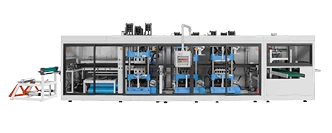


Plastic cups are widely used as single-use containers in modern life. Due to the impact of their production on the environment, more and more people pay attention to them. As the core equipment in the manufacturing process, Plastic Cup Manufacturing Machines has a significant impact on the sustainability of the entire supply chain through energy consumption, pollutant discharge, waste disposal, etc. This paper analyzes the environmental impact of these devices from five dimensions:energy consumption, air pollution pollution, water pollution pollution, solid waste management and noise pollution.
1.Energy consumption: the Dual challenges of high energy consumption and high carbon emissions
The core processes of plastic cup manufacturing, including sheet heating, mold forming and punch separation, require significant energy inputs. During thermal molding, for example, plastic sheets must be heated to 180–220°C to soften the molding, while mold cooling systems must operate continuously to maintain production efficiency. Medium plastic cup production equipment is typically rated at 50–100 kW., according to industry data. If operated for eight hours per day, the annual electricity consumption would be between 146,000 292,000 kWh, equivalent to 116.8–233.6 tons of CO2 emissions (based on a CO2 emission factor of 0.8 kg/kWh).
Optimization Strategies:
Equipment Upgrades: replace traditional asynchronous motors with servo motors, adopt frequency conversion speed regulation technology, make energy consumption and production speed match accurately, reduce energy consumption by 15–30%.
Waste Heat Recovery: Installation of Install heat exchangers in mold cooling systems to repurpose waste heat for raw material preheating or workshop heating. Practical applications have shown that this can reduce gas consumption by over 30%.
Clean energy integration: Combining solar photovoltaic (PV) systems with machine power supply in sunny areas further reduces carbon footprints.
2.Air pollution: Volatile Organic Compound control challenges
VOC emissions the production of plastic cups occur during injection molding, printing and thermal melting and mainly include styrene, esters, alcohols and non-methane hydrocarbons. If left untreated, these pollutants can exacerbate photochemical smog and haze formation while posing a threat to human neurohealth. For example, a manufacturer of plastic cups faced penalties for failing to install exhaust treatment systems, which resulted in non-methane hydrocarbon concentrations in the surrounding area exceeding the regulatory limit by 2.3 times.
Processing Technologies:
Zeolite Rotor Concentration + Catalytic Oxidation: adsorption of volatile organic compounds by hydrophobic zeolite molecular sieves, then desorption of volatile organic compounds by hot air, producing high concentrations of exhaust gas. Catalytic oxidation decomposes pollutants into CO2 and water. A car parts factory project to achieve a non-methane hydrocarbon removal rates more than 98%, emission concentration is controlled below 15 mg/m3.
Activated Carbon Adsorption + Regenerative Catalytic Oxidation (RCO): suitable for low concentration, high volume exhaust gases, this method concentrates pollutants through activated carbon before catalytic oxidation. A paint workshop project demonstrated a 90% cent heat recovery rate, saving approximately 30% per cent per year in natural gas.
Cryogenic Plasma + Photocatalysis: This technique generates plasma through high voltage discharge and combines with photocatalysts to break down volatile organic compounds, but requires periodic replacement of the catalyst to maintain efficiency.
3. Water Pollution: Differentiated Treatment of Production Wastewater and Cooling Water
Water pollution in the production of plastic cups comes from two main sources: printing and cleaning wastewater containing ink and solvents, and cooling water, which can lead to waste of resources if not recycled. For example, a company that uses alcohol-based cleaning and printing equipment does not produce production wastewater, but wasted 20 tons of water per day due to a 60 per cent recovery rate for cooling water.
Treatment Solutions:
Wastewater Segregation: Printed cleaning wastewater is collected separately from domestic wastewater. After ``gas flotation + biochemical treatment"to meet discharge standards, domestic sewage after septic tank pretreatment through municipal network discharge.
Closed-Loop Cooling Systems: The open-loop cooling tower is replaced by a closed-loop cooling system, with multiple levels of indirect water cooling to reduce evaporation losses. A food packaging enterprise has achieved 95% recycling of cooling water in this approach.
Reclaimed Water Reuse: purified treated wastewater used for floor cleaning or irrigation. A drinks packaging plant project is saving 12,000 tonnes of water a year through a recycled water system.
4. Solid waste: balancing marginal Material Recycling and Hazardous Waste Management
Production of plastic cups produces a lot of edge trim, defective products and packaging waste. Improper disposal can lead to waste of resources and secondary contamination. For example, a company that produces 300 tons of plastic cups produces 15 tons of edge trim each year. It takes 50 m2 of land to landfill and hundreds of years to degrade.
Management Pathways:
Edge trim recycling: Shred waste into small balls, mix with the original material and resurface. One practical example showed that raw material costs have been reduced by 12-15 per cent through this method.
Hazardous Waste Compliance: Storage of used activated carbon and ink containers in designated hazardous waste areas and commissioning of safe disposal by licensed agencies to prevent soil and groundwater contamination.
Packaging lightweight: Replace traditional plastic bags with biodegradable alternatives or optimize design to reduce material use. One business uses the measures to reduce plastic consumption by 8 tonnes a year.
5. Noise Pollution: Synergistic Optimization of Equipment Noise Reduction and Workshop Layout
Noise of plastic cup machines opening,closing and punching can endanger worker health and disturb residents. For example, a factory without noise control measures registered 95 dB levels, exceeding the 85 decibels limit set by industrial noise standards.
Control measures:
Choice of low noise equipment: preferred machine with eccentric gear linkage system for mold operation, noise reduction 5 – 8 dB.
Acoustic Design: Install sound-absorbing panels on workshop walls and double-glazed windows. One project uses these modifications to reduce indoor noise to below 75 dB.
Layout Optimization: centralize high-noise equipment away from factory and residential areas and use green belts to further block noise propagation.
6. Future Trends: Green Manufacturing and Smart Transformation
Plastic cup making machines are moving towards greener, smarter machines as carbon neutrality goals drive innovation One company, for example, developed a biodegradable plastic cup machine to process paper materials by optimizing mold curvature and heat seal parameters, with a 99.2% product qualification rate. Equipped with IoT module, real-time monitoring of production data, automatic adjustment of parameters, annual energy consumption reduced by over 10%.
Conclusion:
The environmental impacts of plastic cup making machinery relate to energy use, air/water pollution, waste management and noise. Enterprises can equipment upgrades, process optimization, terminal management, intelligent transformation, etc., while maintaining production efficiency, and greatly reduce the impact on the environment. With the development of green manufacturing technology, the plastic cup industry is expected to realize the synergy of economic and environmental benefits.


