




Product Overview
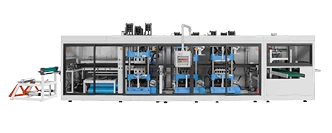
TJP-900E is a single-layer PET/PLA sheet extrusion machine that is our middle capacity sheet extrusion machine. The machine combines heating device, die head device, Three roller device, tracking and cooling stand shaft, and finished sheet roll into process.
PET/ PLA single-layer sheet machine is mainly used to process PET (polyethylene terephthalate) and PLA (Polylactic acid) single-layer sheets. Its application areas cover multiple industries, such as:
1. Packaging industry:
Suitable for the production of food packaging, disposable lunch boxes, trays and other products.
2. Electronic toy outer packaging:
Used for insulation protection of electronic equipment (such as electrical back panels) and toy plastic protective cover packaging.
3. Medical industry:
After thermoforming processing, medical equipment trays can be made.
4. Agricultural products:
Such as seedling trays, disposable plastic flower pots, etc.,

PLA Sheet Roll

PET Sheet Roll

PET Plastic Sheet Roll

PET Thin Sheet

Highly automated production
1
Intelligent circulation temperature control system
2
High-efficiency and energy-saving design
3
Modular structure design
4
Accurate raw material processing
5
Waste edge recycling function
6
Maximum capacity: When the sheet thickness is in the range of 0.7mm to 0.8mm and the sheet width is in the range of 850mm to 900mm, the extruder can reach at its biggest capacity of 400kg/hour.

If samples size 314*156mm, then one mould 6 pieces, mould layout is 2*3.
Design Schematics


MAIN TECHNICAL PARAMETER
|
Model |
TJP-900E |
|
Suitable Material |
PET/PLA |
|
Max. Width of Product |
900mm |
|
Thickness of Product |
0.2-1.5mm |
|
Screw Rod Dia |
75mm |
|
Screw L/D ratio |
40:1 |
|
Max. Output |
400kg/hour |
|
Main Motor Power |
132kw |
|
Rated Power |
360kw |
|
Power Supply |
AC 380V,50Hz, Three-phase, Four-wire |
|
Dimension |
L22000*W4500*H4400mm |
|
Weight |
About 15T |

Layout Drawing
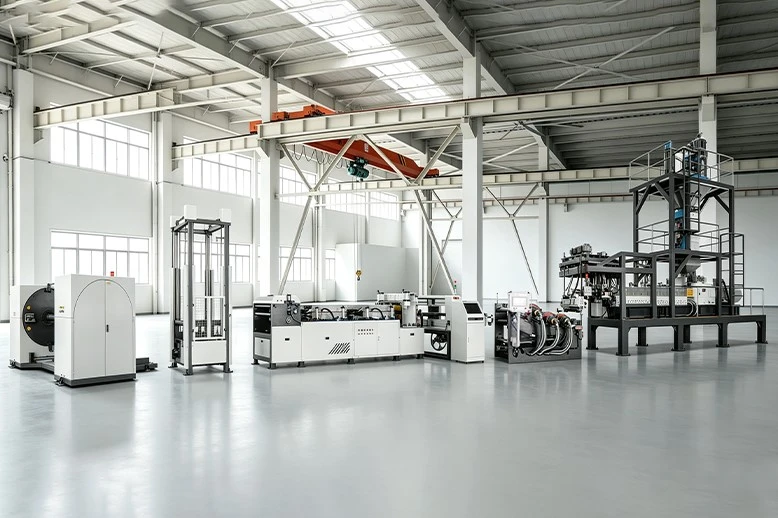
Note: The above image is a layout diagram of the standard equipment set for customer reference. You may use this layout as a guide when arranging your mechanical equipment.
Structure & Design
- Material Feeding Part
- Twin Screw Part
- Net Changer And Gear Pump Part
- Three Rollers Polishing Part
- Silicone Coating System
- Die Head
- Thickness Gauge

Material Feeding Part
One hopper for new material and the other for used material, the ratio can be adjusted by feeding speed. Or use a mixer to mix the new and used materials evenly, then transfer the materials by automatic feeding machine into two hoppers respectively.

Twin Screw Part
This machine adopts double screw. The screw heating is automatically controlled by an independent water cooling system.

Net Changer And Gear Pump Part
The net changer is changed by hydraulic system. Material extruding controlled by gear pump, more precisely.

Three Rollers Polishing Part
The temperature of three rollers is controlled by an external thermostatic system, which needs preheating for about 1 hour to stabilize the setting temperature. Three rollers are controlled separated by servo Motor.

Silicone Coating System
Silicone oil will drop in the middle of roller, and spread on the whole surface through the extrusion of the following roller. Then the silicone oil dried by two ovens to ensure the drying degree of the sheet.

Die Head
● Uniform material distribution: Hanger die head flow channel design makes the molten material flow out of each point of the die lip at basically the same time, theoretically avoiding the problem of material stagnation and ensuring the uniformity of the sheet thickness.
● Lightweight structure: Compared with the traditional die head, the hanger-type structure is lighter and suitable for high-speed production;
● Precise thickness adjustment: The dual throttling design and independent temperature control system can accurately adjust the thickness of the sheet, and the temperature difference control is accurate to ±1℃ to ensure flatness.
● Easy maintenance: The die lip can be designed with a continuous unobstructed flow surface, combined with high-strength bolts and zoned heating system to simplify the cleaning and maintenance process.

Thickness Gauge
● High-precision thickness measurement
This is the most basic and most critical function. The single-point thickness of the sheet is directly measured through contact (such as mechanical probe) or non-contact (such as laser, infrared) sensors.
Contact type: suitable for materials with flat surface and moderate hardness (such as plastic sheets, paper). The probe contacts the surface of the material with slight pressure to avoid errors caused by excessive extrusion;
Non-contact type: suitable for materials that are easy to deform and sensitive to the surface (such as film, metal foil). The thickness is calculated by light or sound wave reflection to avoid damage to the material.
● Multi-point/continuous scanning measurement Supports multi-point measurement of different positions of the sheet (such as edge, center, random point), or continuous scanning through automatic conveying device (such as online detection on coil production line) to obtain the thickness distribution data of the sheet (such as maximum thickness, minimum thickness, average thickness).
● Data recording and analysis
Built-in data storage function can record the value, time, number and other information of each measurement; some high-end models are equipped with software that can automatically generate thickness distribution curves and statistical reports (such as standard deviation, range), which intuitively reflect the uniformity of material thickness.
● Tolerance determination and alarm
The thickness acceptance range (tolerance) can be preset. If the value exceeds the range during measurement, the instrument will use sound and light alarm prompts to quickly identify unqualified products and prevent defective products from flowing into the next process.
● Adaptable to a variety of materials and thickness ranges
Different models of thickness gauges can cover different thickness ranges (such as 0.001mm~10mm, or even thicker), and can adjust measurement parameters (such as probe pressure, scanning speed) according to material properties (hardness, flexibility, transparency, etc.) to meet diverse testing needs.
MAIN ELECTRICAL COMPONENTS


| PARTS | BRAND |
|---|---|
|
PLC |
Siemens (Germany) |
|
Main Motor |
Dedong (China) |
|
Servo Motor |
Huichuan(China) |
|
Solid State Relay |
Yangming (Taiwan) |
|
Intermediate Relay |
IDEC (Japan) |
|
Intermediate Relay Seat |
OMRON(Japan) |
|
Touch Screen |
Delta (Taiwan) |
|
Circuit Breaker |
Schneider (France) |
|
Thermal Relay |
|
|
AC Contactor |
|
|
Switch |
|
|
Frequency Converter |
Huichuan(China) |
|
Power switch |
Mingwei (China) |
|
Ammeter |
Aoyi (China) |
|
Temperature controller |
Yatai(China) |
|
Gearbox |
Zhitian(China)/GNORD(America) |
|
Die head |
Jingcheng(China) |
Supply Terms
| Machine | Model | Qty (SET) | Remark |
|---|---|---|---|
| PET/PLA Single-Layer Sheet Extrusion Line | TJP-900E | 1 | Machine |
| Cruher | TP-800 | 1 | Auxiliary equipment |
| Chiller | 60F | 1 | Auxiliary equipment |
| Thickness Gauge | 1 | Optional equiment |
1. Terms of shipment: FOB NINGBO, CHINA
2. Package: wooden case package (If fumigation is required, charge should be paid by customer).
3. Terms of payment: 30% advance before produce as deposit and the rest 70% should be paid upon finish and inspection before shipment.
4. Power supply: 380V/50HZ, 3 phases, 4wires. There is an extra charge for different voltages.
5. Delivery time: 2-3 months.
6. Validity of quotation: 60 days.
7. After-sale service: Within 13 months from the date of sailing, spare parts are repaired for free (except for human factors). If the guarantee period is expired, the cost and freight should be paid by buyer.
Case Showcase
Fruit pack company/ TTF-820AF+TJP-900E
Customer has high demands for the thickness of their products, so we make the plan of TTF-820AF+TJP-900E and also the thickness gauge to make sure all the sheets produced by TJP-900E are accord with the demand. Also according to the sheet comsumption we calculated in TTF-820AF, TJP-900E can produce 400kg sheet per hour to make sure the output of the sheet is larger than the consumption.
FAQ
Q: The core strengths of the machine?
Q: What is the output?
Q: Machine adjustment and installation?
Q: Guarantee time and after-sale?


