


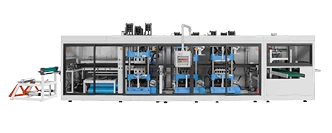


As the core equipment of modern packaging industry, the steady operation of plastic cup making machine directly affects production efficiency and product quality. Systematic maintenance management can significantly extend equipment lifespan, reduce failure rate and improve energy utilization efficiency. According to industry practice and equipment maintenance theories, this paper describes the key maintenance strategies from four aspects: mechanical structure, hydraulic system, electrical control and process parameters, in order to prolong the service life of equipment.
I. Refined Maintenance maintenance of Mechanical Structures
1.Lubrication Management for Key Moving Components
The clamping unit, ejection system and guide rod assembly of plastic cup manufacturing machine are high-load moving components which require graded lubrication systems. In the case of the clamping unit, the four tie bars required daily cleaning of surface oil contamination, weekly replenishment of 00# molybdenum disulfide lithium grease, and monthly parallelism deviation detection using laser alignment (tolerance ≤0.05mm). Practice has proved that strict implementation of this code can reduce plate wear by 60% and prolong mold service life by 2-3 times.
Maintenance of Ejection system maintenance must give priority to the straightness of ejector rod. dial indicators used for deflection measurements on a monthly basis. When bending more than 0.1mm, it shall be replaced. The delay in replacing the bent ejector rod caused the die core pin to break, causing direct economic losses of more than $15,000, according to the case study.
2.Preventive Replacement of Transmission Systems
Belt drive systems require quarterly tension measurements using a belt tensionometer to maintain values within manufacturer's specifications. Statistical analysis shows that 80% of the belt premature failure is due to slippage wear caused by insufficient tension. For synchronous belt drives, it is necessary to check tooth profile once a month and to replace the tooth when the high wear is more than 15%.
The maintenance of the gearbox requires monitoring of oil conditions and sampling for ferrous particle analysis within 500 hours. When the particle particle counts ISO ISO 4406 18/16 standards gear oil replacement must be immediately replaced and wear and tear investigated. Through this programme, food packaging enterprises have extended gearbox overhaul intervals from 18 months to 36 months.
ii. Hydraulic Systems deep maintenance
1.Dynamic Oil Quality Management
Hydraulic oil cleanliness directly affects system reliability and requires three levels of filtration: a 10μm filters filter for tank return lines, a 5-micron high-pressure filter for pumps and a 3μm precision filters for servo valves. Business practice has confirmed that the life of the system's hydraulic components is three times that of the original.
Optimal oil temperature must be between 40-50°C. When temperatures exceed 60 degrees Celsius, check the cooling system immediately. In one repair case, the cooling coils became scaly, causing constant heat that caused the hydraulic pump to completely seal and fail within three months. Chemical scale pressure tests are recommended every two years to verify the drainage area.
2. Periodic Seal Replacement
Hydraulic cylinder seals requires to be replacement scheduling according to operating pressure and temperature. U-cups in high-pressure systems (>21MPa) need to be replaced every 2,000 hours, while medium-lowpressure systems can extend the interval to 4,000 hours. The agreement reduced internal leakage rates of a enterprise from 15% to less than 3 per cent.
O-ring at the connection of the pipe must be replaced after each removal, and hydraulic oil lubrication should be applied before installation. Reuse can increase the probability of leakage by 8 times compared to new components. Fluororubber seals recommended as they offer a superior temperature resistance of 40% compared to standard nitrile rubber.
III. Intelligent maintenance of electrical systems
1. Life Cycle Management of Core Components
Contactors/relays require contact wear monitoring and monthly infrared temperature measurements. When temperatures rise above 25°C, they must be replaced immediately. Business statistics show that timely replacement can prevent 80% of motor burnout.
Servo drive maintenance must prioritise cooling fans, with bearings replaced every 5,000 hours and units replaced every 20,000 hours. In one case study, delays in replacing fan bearing caused IGBT module to overheat and damage, with repairs costing up to 30% of the value of the equipment.
2. Regular Grounding System Inspection
When measuring grounding resistance using ground resistance tester quarterly, ensure value < 4 omega. Enterprise practice demonstrates that proper grounding can reduce electrical failure rate by 50% and minimize electromagnetic interference to control system. The corrosion resistance of copper grounding bars is better than that steel alternatives rod.
IV. INTRODUCTION Optimized Process Parameter Management
1. Precision temperature control
Heating zones requires a segmented control strategy to set gradient temperature according to barrel sections. One enterprise reduced temperature temperature fluctuations from + -10°C to ±3°C through infrared temperature monitoring, increasing melt uniformity by 40%. Semiannual thermocouple calibration is recommended every six months and should be replaced immediately if the deviation exceeds + -2°C.
2. Dynamic Pressure System Adjustment
Clamping force must be calculated dynamically according to the size of the die, as too much force causes the plate to deform. A case study revealed that prolonged overuse of excessive clamping force can lead to permanent plate bending, with repairs costing more than $30,000. Pressure sensor monitoring is recommended to maintain clamping force within 110% of theoretical value.
servo valve control control, Injection pressure establishment should follow the principle of ``slow-fast-slow"in order to achieve accurate pressure profiling. One enterprise has reduced flash rate from 8 per cent to 1.5 per cent and energy consumption by optimizing the pressure curve optimization.
Innovative maintenance system practices.
1.Construction of Digital Maintenance Platform;
Implement Equipment Health Management Systems which combines vibration analysis, oil monitoring and temperature surveillance data. One business achieved 85% accuracy in fault prediction and 60% unplanned downtime through the system. It is recommended to use mobile maintenance terminals for real-time scheduling and closed-loop management of orders.
2.Upgrading the skills of Maintenance Personnel
To establish a three-level training system combining theory, practice and certification to train electromechanical andhydraulic integrated maintenance capabilities. Enterprise statistics show that systemically trained technicians can reduce troubleshooting time by 40% and improve the accuracy of spare parts replacement by 35%. Cross-departmental maintenance drills are recommended on a quarterly basis to improve emergency response capabilities.
Conclusion:
Extending the service life of plastic cup manufacturing machinery constitutes a systematic engineering, which requires collaboration in the design of equipment, maintenance protocols, personnel capabilities and so on. The maintenance strategy detailed in this article allows an enterprise to extend average service life of its equipment from 8 to 12 years, while reducing maintenance costs per unit of product by 35%. In the context of Industry 4.0, the combination of IoT technology and predictive maintenance will become a new frontier in equipment management, providing a solid foundation for the sustainability of the plastic packaging industry.


