




Introduction
With the increasing demands for high efficiency, hygiene, and food-grade safety in the food packaging industry, traditional single-station thermoforming equipment, due to its limited capacity and insufficient stability, can no longer meet the needs of large-scale food container production. To shorten production cycles, maintain product consistency, and enhance overall competitiveness, more and more food container factories are upgrading from single-station equipment to more advanced multi-station automated thermoforming technology. This article will focus on multi-station thermoforming equipment and analyze why food container factories are increasingly choosing multi-station thermoforming machines.

What Is a Multi-Station Thermoforming Machine?
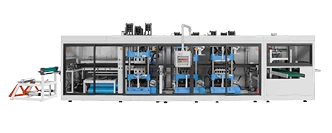
A multi-station thermoforming machine is an automated equipment that integrates heating, forming, cutting, and stacking functions across multiple workstations and operates continuously. This automatic thermoforming equipment feeds the sheet material sequentially into different workstations, with each workstation performing an independent function, thereby achieving high-speed and high-stability production.
Why Food Container Factories Are Switching to Multi-Station Thermoforming Machines
Higher Production Efficiency
With the continuous growth in demand for takeout food containers, ready-to-eat meals, and fresh food packaging, food container factories are facing pressure for higher production volumes and shorter delivery times. Improving efficiency has become the primary driving force for equipment upgrades.

Multi-Station Parallel Production
Multi-station thermoforming machines can perform heating, forming, and cutting processes simultaneously, significantly optimizing cycle time.
Faster Order Fulfillment
During peak seasons for food packaging, multi-station equipment can significantly reduce order backlogs and improve delivery speed.
High-Speed, High-Volume Packaging Production
Its high-speed and short-cycle characteristics make it particularly suitable for large-scale food packaging production, such as takeout boxes and disposable food containers, enabling high-volume packaging production to meet modern large-scale food packaging demands.
Improved Product Consistency & Quality
To enhance aesthetics and win consumer favor, food companies are increasingly demanding higher standards for the stability, appearance consistency, and hygiene safety of food-grade packaging. This is driving them to switch to higher-quality, more stable thermoforming equipment to improve product quality.

Uniform Heating Control
The independent zone heating system ensures that the sheet material reaches a uniform temperature before forming, resulting in consistent thickness across all areas and improving product consistency.
Reduced Common Process Defects
Stable forming pressure and optimized stretching control reduce defects such as warping, black spots, bubbles, and uneven stretching, improving the stability of food-grade packaging.
Independent Station Stability
Each station operates and is controlled independently. Even if a fluctuation occurs in one process, it will not affect the overall operation, thus reducing the scrap rate and maintaining overall quality stability.
Lower Operational Costs
Despite the slightly higher initial cost, multi-station thermoforming machines can help factories better control unit production costs in the long run, especially amid rising labor costs, energy fluctuations, and higher raw material prices.

Automated Workflow
Automatic feeding, cutting, and stacking reduce manual intervention, allowing a single production line to operate continuously and stably with minimal operators. Automated multi-station thermoforming machines significantly reduce labor costs.
Energy-Saving
The precisely controlled heating modules and energy-saving servo system only output energy in necessary areas, reducing unnecessary heat loss and energy waste. This leads to lower electricity costs over the long term.
Reduced Downtime
The mature station allocation method and robust mechanical structure reduce equipment failure rates, minimizing production losses and maintenance costs caused by downtime.
Higher Material Utilization
High-quality multi-station thermoforming machines offer high molding precision and compact layout, resulting in less waste and scrap material, thus increasing the actual utilization rate of each roll of material and reducing raw material waste.
Greater Production Flexibility
With increasing market demands for diverse food packaging designs and environmentally friendly materials, food factories need equipment that can quickly adapt to new products and various materials. Taking LITAI's thermoforming machines as an example:

Wide Material Compatibility
LITAI's multi-station thermoforming machines are compatible with a variety of food-grade materials such as PP, PET, and PLA, meeting the full range of needs from ordinary food containers to high-transparency containers.
Flexible Thickness Range
It can stably process materials ranging from thin, lightweight, and environmentally friendly 0.2mm containers to 1.6mm food trays, allowing factories to cover a wider range of food packaging applications.
Wide Packaging Applications
Whether it's clamshell containers, salad boxes, fruit trays, or multi-compartment food containers, the multi-station equipment can quickly adapt through mold changes, reducing changeover time and expanding product lines.
Comparison: Single-Station vs. Multi-Station Thermoforming Machines
The table below provides a comprehensive comparison of single-station and multi-station thermoforming machines across key dimensions such as production output, cost, and material compatibility. It shows that, to meet the demands of large-scale, high-volume, and diversified food packaging, food container manufacturers have had to switch to multi-station thermoforming machines.
|
Category |
Single-Station Thermoforming Machine |
Multi-Station Thermoforming Machine |
|
Production Efficiency |
Lower output |
High-speed production with significantly higher output |
|
Cycle Time |
Longer cycle time |
Parallel multi-station operation greatly reduces cycle time |
|
Product Consistency |
Heating and thickness vary more frequently |
Uniform heating and stable thickness ensure higher food-grade consistency |
|
Labor Cost |
Requires multiple operators |
High automation significantly reduces labor needs |
|
Material Compatibility |
Limited to basic materials |
Compatible with PP, PS, PET, PLA, and other food-grade plastics |
|
Application Scenarios |
Small orders, sample production, small-scale manufacturing |
Mass production, primary production lines, large food packaging factories |
|
Equipment Cost |
Lower initial investment |
Higher upfront cost but lower long-term operating cost |
|
Maintenance Difficulty |
Simple structure, easy to maintain |
Modular design enables more efficient maintenance |
How to Choose the Right Multi-Station Machine
Production Capacity Requirements
Food container factories must select the appropriate number of stations and production speed based on current production volume and future expansion plans. More stations mean larger-scale food packaging production.
01
Material Compatibility
Food packaging materials are diverse, and the equipment must be able to stably process the target materials. Heating and forming parameters vary greatly for different materials; incompatibility can lead to uneven thickness and insufficient molding. For example, when making takeout containers and meal boxes, good compatibility with PP material is essential.
02
Machine Size & Footprint
Thermoforming machines are usually large, and an unreasonable layout will affect the flow of materials in the loading, stacking, and packaging areas. Therefore, the equipment size should be chosen to match the space available in the production factory.
03
Automation Features
Automation features affect production efficiency, labor costs, and product consistency. Consider manpower, budget, and product type limitations when choosing the appropriate automated thermoforming equipment.
04
Supplier Reliability & After-Sales Service
Thermoforming machines are a long-term investment. Downtime can directly lead to order delays and customer losses. A reliable supplier can ensure the long-term stable operation of the equipment and provide timely support when problems arise.
05
LITAI: A Reliable Supplier of Multi-Station Thermoforming Machines
As a thermoforming machine supplier with 24 years of industry experience, you don't have to worry about the quality of our three-station and four-station thermoforming machines. In addition to providing high-quality multi-station thermoforming equipment, we also offer the following comprehensive service support:
• Solution Consulting Support: If you are still struggling to decide which thermoforming machine configuration is right for you, our engineers can provide one-on-one professional consulting guidance.
• Logistics and Transportation Support: Secure export packaging, complete customs documentation, and flexible transportation terms ensure your equipment is delivered on time and in perfect condition.
• Global On-Site Installation and Commissioning Support: We provide on-site factory support to help you quickly set up your thermoforming production line.
• Training and Educational Materials Support: We provide comprehensive training materials to help your team quickly master operation and maintenance.
• After-Sales Support: Your equipment will receive timely after-sales service and professional technical support to ensure reliable performance throughout its entire lifecycle.
Conclusion
Multi-station thermoforming machines are gradually becoming the mainstream equipment in food container factories. They not only provide higher production output per unit of time but also reduce labor and energy costs while ensuring product consistency. As the food packaging market moves towards mass production, standardization, and automation, multi-station thermoforming equipment can help food container factories remain competitive under tighter delivery schedules and stricter quality requirements. Contact us to upgrade to multi-station thermoforming equipment and achieve large-scale food packaging production.


