




Introduction
In today's highly competitive food packaging market, manufacturers face pressure to provide high-quality, cost-effective, and high-volume packaging products. Traditional molding methods struggle to meet modern production demands, especially the customer's requirements for shorter lead times and greater customization. To maintain a competitive edge, more and more factories are choosing thermoforming machines to retain their advantage in the food packaging market. This article will analyze in detail how thermoforming equipment can enhance the production capacity and market competitiveness of food packaging companies.

What Is a Thermoforming Machine

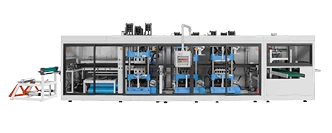
A thermoforming machine is a device that heats plastic sheets to a softened state, then uses vacuum or pressure to mold them into shape. The process then involves cooling, cutting, and stacking, ultimately enabling the mass production of food packaging containers. Unlike traditional injection molding, thermoforming is suitable for thin-walled food packaging requiring high-speed production, high consistency, and low cost.
Basic Process Flow
• Sheet Heating: The plastic sheet enters the heating zone, where upper and lower heaters uniformly heat it to the precise forming temperature.
• Forming: Depending on the thermoforming process (usually vacuum forming or pressure forming), the heated plastic sheet is molded onto the mold.
• Cooling and Shaping: After forming, the plastic is rapidly cooled by a cooling system to set the product's shape.
• Trimming and Stacking: Excess material is removed from the edges of the molded parts to obtain the final product, which is then neatly stacked using an automatic stacking device for packaging or counting.
5 Core Advantages of Thermoforming Machines for Enhancing Food Packaging Manufacturers' Competitiveness
Cost Optimization
High-efficiency thermoforming machines significantly reduce operating costs by lowering labor costs, raw material costs, and energy costs.
Lower Labor Costs
Traditional equipment requires multiple workers for feeding, collecting, and trimming processes, resulting in high labor costs. Thermoforming machines are highly automated, allowing one operator to supervise the entire production line, significantly reducing labor costs.
Higher Material Utilization
Materials account for 60-70% of food packaging costs. Precise heating and forming significantly reduce scrap and waste, leading to significantly lower production costs.
Low Energy Consumption
With rising energy costs, energy expenses represent a significant expenditure for large factories. LITAI's thermoforming equipment utilizes an energy-saving heating system, resulting in lower energy consumption.

Efficiency Improvement
One of the core competitive advantages in the food packaging industry is production capacity. Thermoforming machines for food packaging can significantly improve overall efficiency and enable larger-scale production.
Fast Forming Speed
Thermoforming machines are highly integrated, with short forming cycles, meeting the demands of large-scale orders.
Quick Mold Changeover
Significantly reduces downtime, allowing factories to quickly switch between different product orders.
Full Automation Integration
Thermoforming machines for food packaging integrate functions such as stacking, counting, and punching, improving the efficiency of the entire production chain.

Higher Product Quality
High-performance thermoforming machines ensure the consistency and dimensional accuracy of food packaging, improving product quality, which is a core competitive advantage.
High Dimensional Accuracy
Precise heating control ensures accurate dimensions of cup rims and tray edges, resulting in more reliable sealing and reduced leakage.
High Consistency
Fully automated production processes reduce quality fluctuations caused by human intervention. Preset forming parameters ensure high product consistency between batches.
Low Defect Rate
Precise heating and pressure vacuum forming technology significantly reduce the defect rate, guaranteeing the appearance quality of food packaging and strengthening customer trust.

Product Differentiation
As consumers demand more from food packaging in terms of appearance, functionality, and convenience, the food packaging market is becoming increasingly competitive. Companies need more distinctive products. Thermoforming machines support high levels of customization, helping manufacturers enhance their market recognition.
Custom Shapes & Branding
Thermoforming machines can support complex designs, logos, and textures, allowing food packaging to move beyond traditional square or round molds, creating a distinct visual identity on store shelves.
Multi-functional Packaging
Modern food packaging is no longer limited to simply "containing food," but needs to meet the storage, transportation, and usage needs of different food categories. Features include snap-on lids to prevent spills during delivery, ventilation holes to ensure the freshness of fruits and vegetables, and multiple compartments to prevent cross-contamination in bento boxes.
Adjustable Thickness
Thermoforming machines can produce lightweight trays through controlled sheet heating and adjustable air pressure/vacuum forming ratios, as well as high-load-bearing trays for meat products, covering a wide range of product series.

Sustainability & Green Packaging
With the growing environmental awareness of consumers, the global food packaging industry is transitioning to sustainable packaging solutions. The material compatibility and waste recycling mechanisms of thermoforming machines help food packaging factories achieve green upgrades.
Recyclable Scrap Recovery
Thermoforming machines can crush and recycle scrap materials, creating new materials and products, reducing waste.
Support for Eco-friendly Materials
Compatible with various environmentally friendly materials such as PLA, PET, and rPET, aligning with environmental trends.
Aligned with Green Packaging Regulations
More environmentally friendly, lightweight, and easily recyclable food packaging is the future trend. Thermoforming machines are compatible with environmentally friendly materials and offer lightweight packaging forming capabilities, helping food packaging companies adapt to global green packaging trends.

Typical Applications of Thermoforming Machines in Food Packaging
Fresh Fruits and Vegetables
Thermoforming machines are widely used to produce fruit and vegetable trays, providing clear display and transport protection for fruits and vegetables. Fruits and vegetables require good ventilation and protection against crushing. Thermoforming technology, through the design of breathable structures, reduces moisture accumulation, thus extending the freshness of fruits and vegetables.

Poultry and Egg Trays
For fragile products like eggs, food packaging thermoforming machines can produce shock-resistant, shatterproof, and individually protected packaging, reducing breakage rates during transportation and display.

Ready-to-Eat and Prepared Meal Containers
Thermoforming machines can produce microwaveable PP meal containers, especially suitable for prepared meals and multi-compartment bento boxes. Heat resistance, compartmentalized design, and good sealing make food easy to store, heat, and carry.

Baked Goods and Desserts
Packaging for baked goods and desserts emphasizes visual presentation and lightweight protection, such as cake boxes, dessert cups, jelly cups, and muffin trays. Thermoforming machines can manufacture highly transparent, well-sealed PET/PS cups, making products more attractive on the shelves; they can also incorporate designs such as logo embossing and patterns to achieve branded packaging.

Beverages and Cold Drinks
Beverage cups, such as milk tea cups and juice cups, require precise cup mouth dimensions to ensure a tight fit between the lid and the blister pack, preventing leakage and loose lids. Thermoforming machines can produce highly transparent PET/PS beverage cups with a firm and rigid cup mouth that is not easily deformed during sealing or lid application.

Conclusion
Thermoforming machines offer food packaging manufacturers significant advantages in increasing production capacity, reducing costs, improving quality, and enhancing differentiation. For factories planning to upgrade their equipment, choosing a stable, reliable thermoforming machine will be a crucial step in maintaining market competitiveness.
As a leading global provider of thermoforming solutions, LITAI's high-quality thermoforming machines will not disappoint you. Contact us today to get a high-performance thermoforming machine that will help you stand out in the food packaging market.


