




Introduction


Thermoforming Machine Models and Prices in 2025
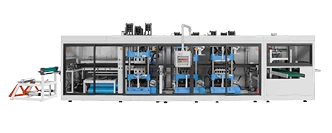
4-Station Thermoforming Machine
|
Parameter |
TTF-520AF |
TTF-820AF |
|
Forming Area |
520mm x 400 mm |
820mm x 650 mm |
|
Forming Depth (Max.) |
110mm |
140mm |
|
Sheet Thickness |
0.2-1.6mm |
0.2-1.6mm |
|
Forming Speed (Max.) |
30 times/min |
30 times/min |
|
Sheet Width (Max.) |
550mm |
850mm |
|
Suitable Material |
PP, PS, HIPS, PET, PVC, PLA |
PP, PS, HIPS, PET, PVC, PLA |
|
Heating Power |
75Kw |
171Kw |
|
Procedure |
Forming-punching-cutting-stacking |
Forming-punching-cutting-stacking |
• Price Range (2025)
The price range for four-station thermoforming equipment is $80,000-$300,000.
• Value Interpretation
TTF-520AF is suitable for regular food boxes and small containers, offering high cost-effectiveness.
TTF-820AF Four-Station Thermoforming Machine has the largest surface area, with significantly higher capacity and product size limits, making it suitable for large-scale factories.
3-Station Thermoforming Machine
|
Parameter |
TTF-520A |
TTF-820A |
|
Forming Area |
520mm x 400 mm |
820mm x 650 mm |
|
Forming Depth (Max.) |
110mm |
140mm |
|
Sheet Thickness |
0.2-2.0mm |
0.2-1.6mm |
|
Forming Speed (Max.) |
30 times/min |
30 times/min |
|
Sheet Width (Max.) |
550mm |
850mm |
|
Suitable Material |
PP, PS, HIPS, PET, PVC, PLA etc. |
PP, PS, HIPS, PET, PVC, PLA etc. |
|
Heating Power |
75Kw |
140Kw |
|
Procedure |
Forming-cutting-stacking |
Forming-cutting-stacking |
• Value Interpretation
The TTF-520A is suitable for medium-sized products, with low energy consumption and a more cost-effective investment.
The TTF-820A 3-Station Thermoforming Machine has a significantly larger molding area, enabling the production of large-size, multi-cavity products and offering higher production capacity potential.
Plastic Cup Thermoforming Machine
|
Parameter |
TQC-650B |
TQC-750 |
TQC-750S |
TFC-730 |
|
Forming Area |
650mm x 300mm |
750mm x 480mm |
750mm x 480mm |
730mm×320 mm |
|
Forming Depth (Max.) |
125-180mm |
125-180mm |
180mm |
180mm |
|
Sheet Thickness |
0.3-1.8mm |
0.3-1.8mm |
0.3-1.8mm |
0.3-2.0mm |
|
Forming Speed (Max.) |
30 times/min |
30 times/min |
30 times/min |
16-42 times/min |
|
Sheet Width (Max.) |
660mm |
760mm |
760mm |
510-760 mm |
|
Suitable Material |
PP, PS, HIPS, PET, PVC, PLA |
PP, PS, HIPS, PET, PVC, PLA |
PP, PS, HIPS, PET, PVC, PLA |
PP,PVC,PET,PS,PLA,etc. |
|
Heating Power |
78Kw |
146Kw |
146Kw |
151.75 Kw |
• Value Interpretation
TQC-650B: Entry-level model, suitable for small to medium production volumes.
TQC-750: Multi-cavity, high-output workhorse model.
TQC-750S: Enhanced version of the TQC-750, designed for deep-cavity or large-capacity cups.
TFC-730 High-Speed Plastic Cup Machine: Widest speed range and most versatile applicability – the top choice for multi-spec OEM manufacturers.
Factors Affecting Thermoforming Machine Costs
Machine Type
The type of thermoforming machine dictates the equipment's complexity and functional versatility.
• Multi station thermoforming machine: A 4-station automatic thermoforming machine can do forming, cutting, punching and stacking all at once. A 3-station automatic one only handles three steps: forming, cutting and stacking. A 4-station machine can make all the products a 3-station one can, plus perforated items like seedling trays, seedling pots and flower planters. Due to its more intricate structure and higher number of components, a 4-station machine incurs a higher cost than a 3-station model.
• Plastic Cup Thermoforming Machine: These automatic plastic cup thermoforming machines have a simpler production process than multi-station models. But if a business chooses different stacking systems(Belt Type Cup Stacker or Robotic Pick-and-Place System) to save on labor, the costs will still differ.


Production Capacity
Higher production capacity in thermoforming equipment indicates the need for a more powerful heating system, stronger mechanical transmission, and a more precise control system, all of which contribute to increased costs.
For example, LITAI's TTF-520AF four-station thermoforming machine can make 400×400 mm PET seedling trays at 30 cycles per minute with a multi-cavity mold. This means it can produce 1,800 pieces per hour.
The TTF-520A three-station plastic thermoforming machine, using a four-cavity mold, can produce 222×165×47 mm PP food containers at about 4,800 pieces per hour.
The TQC-650B automatic plastic cup thermoforming machine runs at 15–25 cycles per minute. With an 18-cavity mold (3×6 layout), it can produce 70 mm × 90 mm plastic cups at 270–450 cups per minute.


Manufacturing Quality
The parts used by a thermoforming machine manufacturer also affect the cost. To reduce equipment failures and lower maintenance costs for customers, some manufacturers-such as LITAI-use reliable servo motor brands like Yaskawa, Delta, B&R, and Inovance. They also perform raw material testing, process testing, and product inspection.
Although the initial investment is higher for buyers, high-quality machines last longer and improve production efficiency. In the long run, this becomes a positive and cost-effective investment for the factory.


Brand & Warranty
Some German brands, such as ILLIG Maschinenbau, Kiefel GmbH, and MULTIVAC, offer reliable products and excellent after-sales service; however, their thermoforming equipment is often more expensive due to brand premium.
In contrast, China, as a major manufacturing hub, possesses highly mature thermoforming machine production technology. Chinese suppliers also offer reliable after-sales service, equipment quality comparable to internationally renowned brands, and are more competitively priced.


Additional Features
If a factory chooses to customize thermoforming molds-such as cup molds, punching dies, cutting dies, or stacking molds-and adds features like quick mold-change systems, precise vacuum/pressure control, or energy-saving designs, these upgrades can significantly improve production efficiency. However, they will also noticeably increase the overall equipment cost.
How to Choose the Right Thermoforming Machine
- Determine Your Production Capacity
- Identify the Material You Will Use
- Consider Flexibility and Product Range
- Assess Energy Efficiency and Operating Cost
-
 Determine Your Production Capacity
Choose the thermoforming equipment that suits your factory based on the size of your orders. Manufacturers usually offer different models of thermoforming equipment, which vary in mold size and production speed. You can choose according to your daily order volume requirements.
-
 Identify the Material You Will Use
You need to decide which material you want to process. Some manufacturers, like LITAI, make 3-station and 4-station thermoforming machines, and plastic cup machines, that can handle PP, PS, HIPS, PET, PVC, and PLA. These cover most factories' material needs. You should also check if the machine can handle the sheet thickness and width you require.
-
 Consider Flexibility and Product Range
When selecting equipment, check if the model supports multiple mold changes for different products. Some machines can produce items for various industries-including egg trays, injection trays, plastic packaging boxes, and seedling trays. LITAI's machines feature mold-change systems that take less than 20 minutes, minimizing any impact on overall production efficiency.
-
 Assess Energy Efficiency and Operating Cost
When selecting equipment, the power of different models also needs to be considered. The higher the power, the more electricity it consumes, which will increase long-term costs. In addition, the utilization rate of materials should also be considered. Some manufacturers will install waste recycling devices to recycle and reuse leftover materials.
FAQ
Q: What is the difference between 3‑station and 4‑station thermoforming machines?
A: 4‑station machines include a punching station, allowing production of perforated or special‑shape items.
Q: What is the delivery time for a thermoforming machine?
A: It is usually 45 days.
Q: How long does it take to deliver a custom thermoforming solution?
A: A complete custom project typically takes 3 months to deliver.
Q: What is the difference between thermoforming and injection molding?
A: Thermoforming involves heating a sheet of plastic and shaping it in a mold. It is ideal for lightweight, high-volume packaging, such as trays or cups, as it has lower mold costs and shorter production cycles. Injection molding, on the other hand, involves injecting molten plastic into a mold, making it more suitable for producing complex, high-precision parts.
Q: How do I choose the right thermoforming machine for my business?
A: The best machine selection depends on your product shape, production volume, sheet material, and automation needs.
Conclusion
Thermoforming machine prices vary widely based on type, capacity, brand, and configuration. Whether you need a 3‑station, 4‑station, or plastic cup thermoforming machine, understanding your production volume, material type, and flexibility requirements will help you choose the right equipment.
To get an accurate quote tailored to your production needs or to download the full product catalog, contact our technical team today.


