




Introduction
Both thermoforming and injection molding can be used to produce plastic packaging, but they differ significantly in cost, molding capacity, design complexity, material utilization, and applicable scenarios. Companies often choose between thermoforming and injection molding, as different processes affect product quality, cost, production cycle, and material utilization. Therefore, this article will provide an in-depth comparison of these two processes from technical, cost, and application perspectives to help manufacturing companies find the most suitable production method for their packaging projects.

What Is Thermoforming?
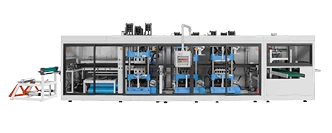
Thermoforming is a process that involves heating a plastic sheet to a pliable state, then using a mold to hold or press it into a specific shape. After molding, further processing such as drilling and cutting is performed.
• The Basic Thermoforming Process: sheet heating, molding (vacuum forming/pressure forming), cooling, cutting, and stacking.
• Common used Materials: PET, PP, PS, PVC, PLA, and other plastic sheets.
• Typical Packaging Products: food trays, medical device trays, seedling trays, electronic product inserts.
What Is Injection Molding?
Injection molding is a precision molding process in which plastic granules are heated and melted, then injected into a closed mold cavity under high pressure. After cooling and solidification, the final product is obtained.
• Injection Molding Process Flow: Plastic melting, injection into the mold cavity, cooling and solidification, product demolding
• Common Materials: Plastic granules such as PP, ABS, HDPE, and PS
• Typical Packaging Products: Disposable cups, bowls, thick-walled containers, cosmetic casings, bottle caps, and other threaded or snap-fit structural parts.
Thermoforming vs. Injection Molding: Key Differences Comparison
To help manufacturers understand the core differences between the two processes more intuitively, the following is a detailed comparison of thermoforming and injection molding from three dimensions: technology, cost, and application.
Technical Dimensions: Core Differences in Molding Methods and Performance
Molding Principle
Thermoforming typically relies on the stretching and deformation of sheet material, using vacuum or air pressure to force the material into a mold cavity. The material primarily elongates, resulting in products that are usually thin-walled, shallow-cavity, and cover a large area. Injection molding, on the other hand, involves injecting molten plastic into a mold cavity under high pressure, precisely replicating every detail of the mold cavity. It is suitable for high-precision, complex structures, and functional packaging components.
01
Precision and Structural Complexity
Injection molding can easily create intricate structures such as latches, threads, hinges, and slots, producing high-precision products with complex structures. In contrast, thermoforming is more suitable for simpler packaging components such as cups and trays.
02
Wall Thickness Consistency and Performance
Injection-molded products have uniform wall thickness, high strength, and good sealing performance. Thermoformed products, especially in deep cavities or areas with sharp turns, are prone to thinning due to overstretching, affecting structural strength. However, this can be improved through sheet quality, zoned heating, and pre-stretching techniques.
03
Production Flexibility
Thermoforming equipment offers faster molding and easier setup, making it suitable for packaging production with multiple specifications, small batches, or frequent style changes, thus providing greater flexibility. Injection molds, on the other hand, have complex structures, longer mold change times, and involve multiple parameters during the debugging process, making them more suitable for stable, long-term mass production.
04
Cost Dimensions: Molds, Materials, and Production Capacity
Mold Costs
Thermoforming molds are typically made of aluminum foil, resulting in low costs, usually 1/5 to 1/10 of injection molds. Injection molds, on the other hand, are steel molds, requiring complex cooling circuits, ejection structures, high manufacturing precision, and long processing cycles, thus increasing costs.
Material Utilization
Injection-molded products are essentially formed in one step, with almost no scrap material, resulting in minimal material waste. Thermoforming equipment still requires trimming at the end, resulting in more scrap material. However, LITAI's thermoforming machines also have waste recycling systems, allowing materials to be reused and reducing waste.
Unit Product Cost
Due to lower raw material consumption, lower mold investment, and lower molding energy consumption, the unit cost of thermoforming is often lower than that of injection molding, which requires more raw materials, more expensive molds, and higher energy consumption.
Production Capacity Efficiency
Thermoforming packaging production can produce thousands to tens of thousands of thin-walled packages per hour. Injection molding, however, is affected by cooling time, resulting in a slower production cycle and significantly lower production capacity per unit time.
Application Dimensions: Typical Use Cases in the Packaging Industry
Food Packaging Industry
In the food packaging sector, thermoforming is widely used for disposable products such as meat trays, fruit box lids, etc., due to its advantages of lightweight, transparency, and low cost. These packages typically require high-throughput production, good display effects, and rapid sealing, making thermoforming packaging machines the mainstream equipment.
Injection molding is more often used for reusable food storage containers, condiment jars, thick-walled lunch boxes, and other structural packaging. These products require higher impact resistance, sealing, and complex locking structures, and injection molding better meets the durability and precision requirements.
Medical and Pharmaceutical Packaging Industry
The medical industry has extremely high requirements for the cleanliness, dimensional stability, and material safety of packaging.
Common blister packaging and medical trays mostly use thermoforming because this process can quickly form thin-walled structures and seal them with aluminum foil for aseptic packaging.
However, bottle caps, medicine storage boxes, syringe components, etc., have high requirements for structural precision, sealing performance, and material strength, requiring injection molding to ensure strict dimensional tolerances and long-term stability.
Cosmetics & Personal Care Packaging
Thermoformed products offer high transparency and lightweight properties, making them ideal for display trays of perfumes and lipsticks, enhancing product presentation.
Meanwhile, cosmetic cases, bottles, caps, and nozzle assemblies require refined appearance, precise fit, and high surface quality-typical applications of injection molding.
Electronic Products & Industrial Components Packaging
Electronic component trays and transport positioning trays require lightweight, low-cost, highly stackable characteristics and the ability to precisely position parts; thermoforming is well-suited for manufacturing these products.
Injection molding is essential for plastic housings of electronic devices, connector housings, and functional structural components to achieve high strength, dimensional stability, and complex interlocking structures.
How to Choose: Thermoforming Equipment vs. Injection Molding Equipment?
Thermoforming and injection molding equipment each have their advantages in packaging production. The key factor is product characteristics, budget planning, and long-term production strategy.
Product Characteristics
If the packaging product is lightweight, primarily for display, and has a relatively simple shape, then thermoforming equipment will meet your needs. Injection molding equipment is more suitable for manufacturing complex, high-precision packaging products that are used repeatedly. Of course, due to the continuous development of thermoforming equipment, machines like LITAI's often come equipped with PLCs, enabling precise control of key parameters and the manufacture of high-precision packaging products.
Cost Budget
If a company has limited initial funds or frequent product iterations, the lower mold costs and equipment investment of thermoforming equipment can significantly reduce trial-and-error costs.
Production Scale
For small-batch production, thermoforming equipment is more advantageous. Lower mold costs reduce initial investment risk, and the shorter equipment setup cycle is suitable for rapid order response. For medium to large-batch production, both types of equipment can be chosen, but the choice should be based on the complexity of the product.
Conclusion
Thermoforming and injection molding each have their advantages for different types of packaging needs. Thermoforming boasts core advantages such as high efficiency, low cost, and lightweight design, making it particularly suitable for high-volume production of thin-walled packaging and the preferred process for food trays, blister packs, and disposable containers. Injection molding, on the other hand, is known for its high structural strength, ability to handle complex designs, and long-term durability, making it particularly suitable for food storage containers, functional lid components, and reusable packaging. When selecting packaging manufacturing equipment, companies should consider the specific characteristics of the products to be packaged, their cost budget, and production scale. In most cases, thermoforming equipment is the best choice.
If you are looking for high-performance thermoforming machines, LITAI is your best partner. As a thermoforming machine manufacturer with 24 years of experience, we can provide you with high-performance products such as four-station and three-station thermoforming machines. Contact us for more professional advice and solutions on thermoforming equipment selection.


