




Introduction
With the rapid development of the food industry, the demand for packaging is also continuously increasing. Traditional packaging methods suffer from low production efficiency, significant material waste, and heavy environmental pressures, which not only increase enterprise costs but also limit the green development of packaging. To address these challenges, thermoforming packaging machines, as a high-efficiency food packaging thermoforming solution, can effectively improve production efficiency, reduce material waste, and promote the development of sustainable packaging, becoming an important choice for modern food packaging plants and brand manufacturers. This article will analyze how thermoforming machines for food packaging improve efficiency and reduce waste to achieve large-scale and sustainable development, starting from their two core advantages.

Two Major Advantages of Thermoforming Machines for Food Packaging
Thermoforming machines for food packaging offer significant advantages in modern food packaging production. As highly efficient and flexible forming systems, plastic thermoforming machines meet diverse packaging requirements while helping manufacturers reduce costs and improve productivity. Their advantages can be summarized into two major aspects:
• Improving production efficiency
• Reducing waste to achieve environmental sustainability.
Therefore, automatic thermoforming machines have become essential equipment for modern food packaging plants and brand owners.

How Thermoforming Machines for Food Packaging Improve Efficiency
High Cycle Speed
A high-efficiency thermoforming machines utilize efficient heating systems and optimized mold design and material flowability, ensuring smooth and efficient cycles for heating, forming, and trimming. This allows for the rapid production of large quantities of pallets or packages, meeting the demands of high-volume orders.
01
Automated Operation
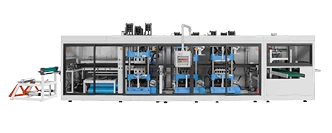
Modern thermoforming machines enable fully automated production processes, automating heating, forming, and trimming. This reduces manual intervention, lowers error rates, and improves production line stability. Fully Automatic Four-Station Plastic Thermoforming Machine integrates sheet loading, heating, forming, punching, cutting, and stacking, minimizing manual intervention and maximizing finished product output.
02
Flexible and Quick Mold Change
Thermoforming machines support quick mold-changing systems, allowing rapid switching between different product specifications to adapt to multi-SKU thermoforming production and multi-category production needs, minimizing downtime.
03
Real-Time Monitoring and Intelligent Control
Through an intelligent monitoring system, various parameters during production can be monitored in real time, automatically adjusting temperature, pressure, and forming speed to ensure consistent product quality across batches and improve production efficiency.
04
How Thermoforming Machines for Food Packaging Reduce Waste and Achieve Environmental Sustainability
High Material Utilization
Thermoforming machines utilize precision forming technology to maximize material utilization, reducing scrap and waste, thereby lowering raw material consumption and costs.
Thin-Wall and Lightweight Packaging Design
LITAI's thermoforming machines can manufacture thin-walled and lightweight food packaging, reducing material usage while maintaining packaging strength and protective performance.
Support for Environmentally Friendly Materials
Thermoforming machines support recyclable and biodegradable materials such as PP, PET, and PLA, meeting the requirements of modern food packaging for sustainable development and environmental regulations.
Reduced Transportation Losses
Food packaging manufactured by thermoforming machines is robust and reliable, reducing breakage during transportation, lowering food spoilage rates, and further reducing waste.
How to Select and Maintain Thermoforming Machines to Maximize Efficiency and Waste Reduction
In actual production, even with high-performance thermoforming machines, improper selection or inadequate maintenance will hinder their ability to reach their full potential for efficiency and waste reduction. Therefore, proper selection and scientific maintenance are crucial for achieving high-yield, high-efficiency, and environmentally friendly packaging.
Selecting Based on Needs
Select Models by Output Scale, SKU Volume, and Product Type
• Small, medium, or large fully automatic thermoforming machines should be selected based on the company's daily production volume and order requirements.
• For multi-SKU or multi-category production, consider flexible mold-changing and rapid adjustment functions to reduce downtime.
Consider Flexibility, Automation, and Smart Control
• Flexible mold-changing designs allow for rapid switching between different product specifications, shortening downtime cycles and improving production line utilization.
• Higher automation levels reduce manual intervention, leading to stable production and reduced human error.
• Equipping machines with intelligent control systems (such as PLC control) allows for real-time monitoring of key parameters such as temperature, pressure, and cycle speed, optimizing production efficiency and finished product quality.
In addition, you can refer to the articles "How to Choose the Right Thermoforming Machine for Food Packaging" and "How to Choose the Best Thermoforming Machine for Your Food Tray Production" for more detailed information to help you choose a thermoforming machine for food packaging.
Routine Maintenance
Regular Cleaning and Upkeep
Focus on maintaining modular components, sealing systems, and mechanical transmission parts to ensure equipment flexibility and sealing. Clean heating zones and molds to prevent residual material from affecting molding quality.
Parameter Optimization and Updates
Adjust molding temperature, pressure, time, and other parameters promptly according to different product characteristics. Regularly update equipment software to ensure the intelligent control system is fully functional and production efficiency and material utilization are optimized.
Personnel Training
Provide systematic training to operators to improve their proficiency in automation functions, troubleshooting, and safe operation. Skilled operation reduces human error, lowers defect rates and material waste, and ensures stable and efficient production line operation.
Conclusion
Thermoforming machines for food packaging, through high cycle speeds, automated operation, flexible mold switching, and real-time monitoring and control, significantly improve production efficiency. At the same time, they reduce material waste through high material utilization, lightweight packaging, compatibility with recyclable materials, and strong forming quality-supporting sustainable thermoforming packaging for modern food manufacturers. With proper selection and maintenance strategies, companies can save costs, improve production efficiency, and meet food safety and green packaging requirements. In the future, thermoforming packaging machines will play an increasingly important role in the food packaging industry, helping companies achieve efficient, green, and sustainable packaging production.
LITAI, as your trusted thermoforming machine supplier, offers a range of high-performance plastic thermoforming equipment, trusted by customers in nearly 100 countries and regions. Contact us to obtain the thermoforming machines needed for your food packaging production.


