




Introduction
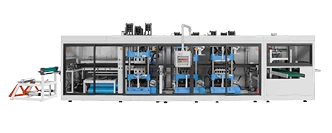
The food industry is rapidly evolving, especially with the booming development of the food delivery sector, making disposable food packaging a necessity. From coffee cup lids and takeout trays to fruit boxes, the catering, food delivery platforms, and pre-packaged food industries have a continuous demand for hygienic, lightweight, and cost-effective packaging. As product types become increasingly diversified, manufacturers need to be flexible in responding to new demands and finding reliable and efficient production methods. Thermoforming equipment is widely used due to its efficient production of food packaging and its design flexibility. This article will focus on how thermoforming machines support the production of disposable food packaging, explaining the important role of thermoforming in the food packaging industry from its technical principles and application scenarios to equipment selection.

Why Thermoforming Machines Are the Preferred Choice for Disposable Food Packaging

Why does thermoforming dominate the disposable packaging industry? To understand its superiority over other forming methods, we need to start with its working principles and technological advantages.
Thermoforming Technology Principles
Thermoforming is a processing method that uses heat and mechanical force to transform flat plastic sheets into three-dimensional products. When the sheet is heated to a certain plasticizing temperature, it softens and becomes deformable. At this point, the softened material is stretched into a mold cavity through vacuum, pressure, or mechanical molds to form structures such as cup lids and food trays. The plastic retains its new shape and dimensional accuracy after cooling. Based on this principle, thermoforming can produce thin-walled, lightweight, and lower-cost disposable food packaging at high speeds.
How Thermoforming Shapes Disposable Packaging
Thermoforming machines mainly process plastic sheets into various disposable food packaging through the following four steps:
• Heating: The sheet is uniformly heated to the forming temperature, softening it and making it stretchable.
• Molding: Using vacuum suction, compressed air, or upper and lower molds, softened material is stretched into the mold cavity to form the desired product shape.
• Cooling: The molded product is cooled and set, ensuring structural stability, uniform thickness, and dimensional accuracy.
• Trimming: A cutter removes waste material from the edges, yielding the final product, such as cup lids and trays, ready for stacking and packaging.
Why Thermoforming Stands Out in Disposable Food Packaging
Thermoforming stands out for several reasons:
• High Production Speed: Short cycle time allows for rapid, high-volume production of food packaging. Our TTF-820 series thermoforming machines can produce 230×180mm PET flip boxes at a rate of up to 13,500 pieces per hour.
• Strong Material Compatibility: Thermoforming can process various food-grade sheets. Our equipment can stably process PP, PET, PLA, and other materials with thicknesses ranging from 0.2mm to 1.6mm, providing customers with more flexible material choices and broader market adaptability.
• Stable Quality: Thermoforming ensures uniform wall thickness and dimensional stability. LITAI's thermoforming machines employ a closed-loop PID system and PLC control with high-sensitivity sensors to ensure precise temperature and pressure control.
• High Material Utilization: Thermoforming significantly reduces plastic usage by stretching sheet material, resulting in material consumption significantly lower than injection molding. LITAI's thermoforming machines further amplify this advantage, achieving a scrap rate as low as ≤2%, effectively reducing raw material waste and lowering costs.
• Flexible Design: Thermoforming easily achieves varying depths, complex structures, and multi-cavity layouts. Convenient mold-changing operations allow for the production of diverse products such as cup lids and trays.
• Versatile Applications: From beverage cup lids to food trays, thermoforming is suitable for a wide range of disposable food packaging. Our Plastic Cup Thermoforming Machine can also produce high-transparency PET plastic cups.
Applications: Lids, Trays & More Disposable Food Packaging
Thermoforming machines can produce a variety of disposable food packaging, each with different requirements in terms of structural strength, transparency, heat resistance, and sealing. With precise temperature control systems and flexible forming capabilities, thermoforming technology can reliably meet these diverse packaging standards. Below are some common types of thermoformed food packaging.

Cup Lids
Cup lids require extremely high dimensional accuracy to ensure a tight seal between the lid and the cup rim, preventing leaks. Thermoforming achieves stable wall thickness, smooth and safe edges, and high forming speeds through uniform sheet heating and forming control, and is compatible with food-grade materials such as PP and PET.

Food Trays
Thermoformed trays are widely used for loading prepared meals, fresh meats, fruits, baked goods, and frozen foods. They can be made into shallow trays, deep trays, or multi-compartment structures. Through precise molding pressure and cooling control, thermoforming achieves both high transparency for PET trays and microwave heating requirements for PP trays. Combined with multi-cavity molds, it increases unit production capacity while ensuring good stacking strength for easy storage and transportation.

Clamshell Containers
Clamshell containers have higher requirements for opening and closing performance, transparency, and impact resistance to ensure the safe display and protection of fruits, baked goods, or snacks. Thermoforming creates uniform fold lines for a smooth opening and closing experience, while providing a highly transparent PET surface and lightweight structure, making it a common choice for packaging such as fruit boxes, baking boxes, and salad boxes.
How to Choose the Right Thermoforming Machine for Disposable Food Packaging
When selecting thermoforming equipment for disposable food packaging, the first step is to clearly define the market demand for the packaging product itself. Based on application standards, a comprehensive evaluation should be conducted, considering factors such as machine type selection, material compatibility, molding capacity, and automation configuration.
Choose the Right Machine Type
For the production of high-volume disposable packaging such as cup lids and trays, multi-station thermoforming machines can provide continuous and stable high-speed production capacity. If order specifications change frequently or batches are small, single-station equipment, with its flexible structure and rapid mold changeover, can maintain production efficiency without excessive capacity investment.
Material Compatibility
Disposable packaging has different material performance requirements: PET emphasizes high transparency, PP emphasizes heat resistance, PS emphasizes rigidity, and PLA emphasizes biodegradability. Therefore, the equipment must be compatible with materials such as PET, PP, PS, and PLA, and have corresponding heating zone designs and precise temperature control systems to ensure stable material performance during the molding process.
Mold Design, Forming Depth & Speed
Cup lids require extremely high mold precision and dimensional stability, while deep trays or multi-compartment pallets demand stronger forming force and rapid cooling capabilities. When purchasing, focus should be placed on the equipment's supported forming depth and cycle time, and assessing its compatibility with multi-cavity molds to match actual production pace and output targets.
Automation Configuration
Modern food packaging factories increasingly prioritize product consistency and labor cost control. Thermoforming equipment can be expanded with automated modules such as automatic trimming, automatic stacking, and edge recycling, improving production line efficiency and maintaining consistent quality output in high-volume production.
Compliance Requirements
Since this involves producing products that come into contact with food, it's crucial to ensure the equipment uses food-grade contact parts, has a closed forming area design, and provides a low-dust, easy-to-clean production environment to avoid compromising food safety.
After-Sales Support
Choosing a reliable supplier is paramount, as they not only provide high-quality thermoforming machines but also comprehensive after-sales service to ensure the equipment's long-term operational reliability.
Conclusion
Thermoforming machines offer the high speed, flexibility, and cost-effectiveness required by the modern single-use food packaging industry, continuously driving its development. By choosing safe, reliable, compliant thermoforming equipment with comprehensive after-sales support, manufacturers can consistently produce high-quality cup lids, trays, and shell boxes to meet diverse market demands.
LITAI is a leading thermoforming manufacturer, providing comprehensive solutions to its clients through advanced technology, precise temperature control systems, and high-efficiency production performance. Contact us today for professional consultation and high-quality equipment to achieve high-volume, low-waste, and consistently high-quality single-use food packaging production.


