




Introduction
Thermoforming equipment is widely used in industries such as packaging, automotive, medical, and home appliances for the efficient and stable molding of various plastic products. Among the many thermoforming processes, vacuum thermoforming and pressure thermoforming are the two most common methods in industrial production. So what are the differences between them? Although both processes rely on heating plastic sheets and forming them using molds, there are significant differences in their molding principles, detailed performance, and applicable products. Understanding these differences will help manufacturers make more informed decisions when selecting equipment. This article will systematically introduce the core differences between vacuum thermoforming machines and pressure thermoforming machines.

What Is a Vacuum Thermoforming Machine?

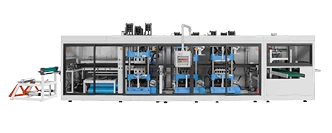
A vacuum thermoforming machine is a type of thermoforming equipment that shapes heated plastic sheets by using a vacuum. Its main components include: a heating system, a forming station, a vacuum system, a mold, and a cooling unit.
How a Vacuum Thermoforming Machine Works
In the vacuum thermoforming process, the plastic sheet is first heated to a softened state. Once the sheet reaches the appropriate forming temperature, it is placed above the mold. The vacuum system is then activated to remove the air between the plastic sheet and the mold. As the air is removed, atmospheric pressure presses the softened sheet against the mold surface, precisely forming the desired product shape. After the product cools and solidifies, it can be trimmed or further processed.
Key Features of Vacuum Thermoforming
• Relatively simple equipment structure
• easy operation and maintenance
• Limited forming force
• Suitable for products with simple shapes and shallow forming depths
Typical Applications Vacuum Thermoforming
• Food packaging
• Daily necessities packaging
• Toy manufacturing
What Is a Pressure Thermoforming Machine?

A pressure thermoforming machine is a thermoforming device that further introduces compressed air pressure on the basis of vacuum thermoforming. In addition to the conventional thermoforming system, it is equipped with a pressure chamber and a compressed air system, thereby achieving higher forming force and finer product details.
How the Pressure Thermoforming Machine Works
In the pressure thermoforming process, standard vacuum forming is performed first to make the heated plastic sheet conform to the mold. Once the plastic sheet is held in place by vacuum suction, compressed air is applied above the plastic sheet. The combined action of vacuum and air pressure allows the plastic to conform more precisely to the mold details, resulting in clearer textures, sharper edges, and higher surface quality. After cooling and setting, the molded part can be trimmed or further processed.
Key Features of Pressure Thermoforming
• Higher forming pressure
• Clearer detail representation and better texture reproduction
• Higher surface quality and dimensional accuracy
Typical Applications of Pressure Thermoforming
• Automotive manufacturing
• Medical equipment
• Home appliance casings and products requiring high aesthetic standards
Vacuum vs. Pressure Thermoforming Machines: Key Differences
Although both vacuum and pressure thermoforming machines are based on heating plastic sheets and forming them against a mold, there are significant differences in the following key aspects:
Forming Pressure
Vacuum thermoforming machines rely solely on atmospheric pressure created by vacuum to draw the sheet onto the mold, resulting in lower forming force. Pressure thermoforming applies compressed air above the sheet in addition to vacuum, creating higher pressure and allowing the plastic to conform precisely to complex mold details.
Detail and Surface Quality
Due to the limited pressure in vacuum forming, it is more suitable for shallow or simple shapes and struggles to reproduce fine textures. Pressure thermoforming, through the synergistic effect of vacuum and air pressure, achieves sharper details, smoother surfaces, and more accurate mold texture replication.
Applicable Plastic Sheets
Both machines are compatible with common thermoplastics such as ABS, PET, PS, and PP. Vacuum thermoforming machines are more suitable for thin sheets, while pressure thermoforming machines are more effective for thicker sheets or materials requiring high-precision detail reproduction.
Cost
Vacuum thermoforming machines, due to their simple structure and low-pressure requirements, use relatively simple molds, resulting in lower mold costs. Furthermore, the equipment itself has fewer components, thus reducing overall investment costs. In contrast, pressure thermoforming machines require higher forming pressure, so the molds must be more robust and durable, naturally leading to higher costs. In addition, to ensure forming accuracy and stability, the equipment structure includes pneumatic systems and reinforced frames, making the overall investment cost significantly higher than that of vacuum thermoforming machines.
Forming Cycle and Speed
For simple products, vacuum thermoforming machines are generally faster due to lower forming pressure and simpler mold operation. Pressure forming may have a slightly longer cycle due to the additional air pressure step, but it achieves higher forming quality.
Production Volume Requirements
Both types of equipment can meet medium-volume production needs, but for high-end products and applications requiring high quality and surface detail, pressure thermoforming machines are more suitable. Vacuum thermoforming machines, on the other hand, are suitable for large-scale production of simple, thin-walled products.
Which Thermoforming Machine Should You Choose?
• Products have simple shapes and limited detail requirements.
• Projects are budget-sensitive
• Production focuses on packaging or disposable products.
• High aesthetic or surface quality is required.
• Parts involve complex geometries or fine textures.
• Applications include the automotive and medical industries.
Conclusion
Vacuum thermoforming machines and pressure thermoforming machines each have their own advantages. Vacuum thermoforming is suitable for products with simple structures and those that are cost-sensitive, while pressure thermoforming performs better in applications requiring high precision and superior aesthetics. The final equipment selection should be based on a comprehensive assessment of product complexity, quality requirements, production volume needs, and budget constraints.
If you are having difficulty making a choice, LITAI, as a professional thermoforming machinery manufacturer with 24 years of experience, possesses unparalleled expertise in the field of thermoforming equipment. Whether you need to buy thermoforming equipment or have any related questions, please contact us.


