




Introduction
In recent years, thermoforming has continued to develop in industries such as packaging, medical devices, becoming a widely used and mature molding process in plastic product manufacturing. Entering 2025, thermoforming equipment is accelerating its upgrade towards automation, energy efficiency, and customization. This article will systematically analyze plastic thermoforming machines, covering working principles, equipment types, application scenarios, key parameters, and selection and maintenance considerations, to help procurement and engineering personnel make more rational and practical equipment choices.

What Is a Plastic Thermoforming Machine?
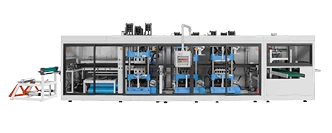
A plastic thermoforming machine is an industrial device that forms plastic sheets by heating them to a softened state and then shaping them using a mold. It utilizes the plasticity of thermoplastic materials to achieve high-efficiency, low-cost molding.
The core systems include:
• Heating System: Heats the plastic sheet evenly to a set temperature, providing the necessary flexibility for forming.
• Forming Station: The core area for mold installation and forming action, determining the product's size and structural accuracy.
• Vacuum/Pressure System: Uses vacuum suction or pressurized air to ensure the sheet conforms tightly to the mold surface.
• Cooling and Trimming System: After cooling and shaping, excess material is trimmed to form the final product.
What Are the Different Types of Plastic Thermoforming Machines?
There are many types of thermoforming machines on the global market. Based on the forming method, degree of automation, and workstation configuration, thermoforming machines can be classified as follows.
|
Classification Dimension |
Type |
Key Characteristics |
Typical Applications |
|
By Forming Method |
Vacuum Thermoforming |
Simple machine structure, lower tooling and equipment cost, fast forming speed |
Packaging trays, blister packaging, basic enclosures |
|
Pressure Thermoforming |
Higher forming accuracy, superior surface details, appearance close to injection molding |
Medical trays, consumer product housings, premium packaging |
|
|
By Automation Level |
Manual |
Flexible operation, low initial investment, suitable for R&D and prototyping |
Product sampling, small-batch production |
|
Semi-automatic |
Balanced productivity and cost, adaptable to various products |
Medium-volume, multi-product manufacturing |
|
|
Fully Automatic |
Continuous operation, low labor dependency, high production stability |
Large-scale, long-term production lines |
|
|
By Station Configuration |
Single-station Thermoforming Machine |
Heating and forming in one station, compact design, small footprint |
R&D applications, small batches, limited factory space |
|
Multi-station Thermoforming Machine |
Separate heating, forming, and cooling stations, parallel processing |
Medium to high-volume production, continuous industrial lines |
Vacuum Thermoforming vs. Pressure Thermoforming
In the selection of plastic thermoforming equipment, the forming method is the most critical step. Vacuum thermoforming and pressure thermoforming directly determine the forming principle, precision, mold complexity, and manufacturing cost of the product, and have the greatest impact on the final quality. The table below provides a direct comparison of the differences between the two methods from key dimensions, facilitating quick identification of the most suitable forming method.
|
Comparison Dimension |
Vacuum Thermoforming |
Pressure Thermoforming |
|
Working Principle |
Formed by negative vacuum pressure |
Vacuum + high-pressure air |
|
Forming Accuracy |
Medium |
High |
|
Cost |
Lower |
Higher |
|
Production Speed |
Fast |
Medium |
|
Surface Detail |
Standard |
Fine |
|
Typical Applications |
Food packaging |
Medical, automotive products |
Main Application Industries of Plastic Thermoforming Machines
Different industries have varying requirements for product performance, appearance, and production efficiency. Therefore, when choosing a plastic thermoforming machine, it is necessary to consider the specific characteristics of the industry. Below are the applications of thermoforming in four typical industries: packaging, medical, electronics, and agriculture.

Packaging Industry

Medical Industry

Automotive Industry

Consumer Goods Industry
How to Choose the Right Plastic Thermoforming Machine
Choosing the right thermoforming machine is crucial for ensuring production efficiency, product quality, and cost control. Different companies and products have varying needs, so the selection process should consider production requirements, equipment performance, cost factors, and manufacturer service capabilities.
Define Production Needs
This is the first step in your thermoforming manufacturing journey; clearly define your objectives.
• Product Type: Determine the type of product you will be producing. Food packaging, for example, prioritizes fast, large-scale production, while automotive parts require high structural strength, necessitating different thermoforming equipment.
• Product Size and Sheet Thickness: Product size determines the size of the machine's worktable, and sheet thickness determines the heating system and forming pressure requirements.
• Material Type: Confirm the type of plastic sheet material (e.g., PS, PET, PP, PLA, etc.). Some materials have specific requirements for heating methods and temperature control accuracy.
Evaluate Machine Characteristics
Understand the performance of each plastic thermoforming machine to ensure it meets both your current application needs and future development requirements.
• Heating Uniformity: Equipment with high temperature control accuracy ensures consistent product molding, reducing warping or uneven thickness.
• Forming Stability: Pay attention to pressure control accuracy, frame rigidity, and mold clamping method to ensure dimensional stability during long-term production.
• Cutting Method: Choose manual trimming, automatic trimming, or laser cutting systems based on product requirements to balance efficiency and precision.
• Automation and Control System: PLC control, human-machine interface (HMI), intelligent zone temperature control, and vision inspection features can improve production efficiency and adapt to industrial development needs.
Comprehensive Cost Considerations
We all want a top-of-the-line thermoforming machine, but this often comes at a high cost. It's essential to consider your budget.
• Equipment Price: Consider not only the initial purchase cost but also the cost-effectiveness based on service life and production capacity.
• Mold Costs: Mold material, complexity, and quantity directly affect the investment budget; pressure forming molds are usually more expensive than vacuum forming molds.
• Energy Consumption: Energy-efficient equipment using servo motor drives or high-efficiency heating systems can reduce long-term electricity costs.
• Labor and Maintenance Costs: Highly automated equipment reduces labor requirements; consider maintenance cycles, spare parts costs, and ease of maintenance.
Manufacturer Reputation and After-Sales Service
A reputable manufacturer can save you a lot of trouble, providing reliable support for installation, operation, and troubleshooting.
• Engineering Support Capabilities: Does the manufacturer provide selection guidance, process optimization, and on-site commissioning services?
• Spare Parts Supply: Ensuring uninterrupted long-term production and timely availability of wear parts.
• Training and Technical Support: Operator training and troubleshooting support can reduce production risks and improve equipment utilization.
Key Innovation Trends in Plastic Thermoforming Machines in 2025
Intelligent Upgrades
The development of artificial intelligence and machine learning technologies is enabling further automation and intelligence upgrades in thermoforming machines, effectively improving productivity and maintaining a leading position in the increasingly competitive market.
Sustainable Manufacturing
With increasingly stringent environmental regulations and a growing emphasis on green, energy-efficient, and sustainable development, plastic thermoforming machines are achieving sustainability through improved heating systems, servo motor drives, recycling of excess plastic, and compatibility with various environmentally friendly materials.
LITAI's thermoforming machines achieve energy-saving and circular practices through the adoption of intelligent energy-saving systems, the development of specialized molding processes for PLA biodegradable materials, and automated waste recycling systems, promoting sustainable production.
Multi-Material Forming
From packaging to protective trays, the demand for multi-layer and mixed materials is rising, and thermoforming equipment can support multiple production lines, providing manufacturers with greater flexibility.
Rapid Custom OEM Solutions
The changing consumer demand for personalized products requires thermoforming machines to quickly produce a variety of products. Thermoforming machines utilize quickly interchangeable modular tools, enabling rapid switching between multiple product categories.
Conclusion
In 2025, plastic thermoforming machines will continue to be a highly cost-effective and flexible solution for plastic thermoforming. By understanding the differences in forming methods, evaluating equipment performance, and selecting equipment based on production needs, companies can achieve efficient production, stable quality, and optimized long-term operating costs. Entering 2025, innovative technologies such as intelligent control, energy-efficient heating, multi-material forming, and rapid customized OEM solutions will provide companies with greater production flexibility and sustainable development capabilities, enabling them to quickly respond to market changes and green manufacturing trends.
LITAI is one of the leading Chinese manufacturers of plastic thermoforming machines. We are constantly upgrading our thermoforming equipment, and our tenth-generation thermoforming machine already incorporates three core technologies: full servo drive, composite material forming, and intelligent IoT. We continuously adapt to market and global trends. Contact us to obtain high-quality, high-performance plastic thermoforming machines and gain a competitive edge in the market.


