


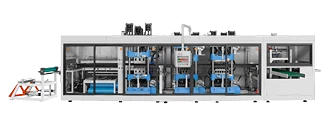


Plastic Egg Tray Machine are trays made of PP, PET or PVC. Heat the paper until tender. It is then pushed into a water-cooled mould using vacuum and compressed air. The machine cuts the plates and stacks them in the same cycle. It does not use pulp, water or drying tunnel. Each tray is made in seconds.
The main difference between machines is not the clamping force. How well it controls the die's pocket spacing and tray height. These must be consistent in size so that an automatic egg grader can handle 30 plates per minute without clogging up. Pockets must also support the shell of the egg on firm points to reduce the risk of breakage.
Two different machines answer to the same name
When looking for a Plastic Egg Tray Machine, many of the offers were for pulp molding lines. The two products look similar on a tray, but they are made in different ways.
The pulp molding line mixes recycled fibers with water. It forms wetness on the wire mold. Water is then drained in drying tunnel made of gas, diesel or wood. The process can take four to eight hours. The line requires a slurry tank, a water treatment system, a tall building and a mold that is difficult to change.
A thermoforming machine use plastic sheet rolls, a chiller, compressed air and horizontal floors.
These differences affect the way factories operate and the quality of their products. pulp line are usually set up for a product. In order to make different trays, the factory must replace the mold and adjust the dryer. A thermoforming line can produce different products by changing molds. The same machine makes a 30-egg flat in the morning and a six-egg carton after lunch.
pulp molding is a good option if your order is primarily a standard flat plate sold by weight. If you need a hinge carton, a clear tray to display eggs, a printed lid, pockets shaped like specific eggs, or quick changes between shift products, thermal molding is a better option.

Impact of a cycle on the worksheet
There are several steps to this process, and each one influences the next. The plastic sheet is opened, preheated to remove the curls, moved step by step into the oven and clamped. Heaters above and below bring the plate to the right forming temperature. Polypropylene is about 150-165 °C, HIPS is about 120-140 °C and amorphous PET is about 110-140 ° C. When the die is closed, vacuum pulls the plate from below and air from 3–5 bar pushes the plate from above. The paper was in the shape of a mold. A trench cooling plate is then added to the aluminum mold. The punch cuts the outer edge so that the ventilation holes remains in place while the part remains. The finished tray then descends to a stacker.
When making egg trays, two details are particularly important.
First, the sheet sag. The egg tray is wide and thin. The hot plate sags before it reaches the mold. Deflection decreases with the fourth order of the span and with the square of the thickness. If the thickness of the sheet is halved, the droop can increase fourfold. If span doubles, sagging can increase 16-fold. This is why the 0.5mm sheet on a 750mm wide machine is close to the actual limit. That's why the heater zones is controlled separately, with the bottom heater usually running a little slower than the top, and the chain or roller supporting the plate to move. Tensile tests based on ISO 527-3 help operators understand how much the material can stretch before the tip of the pocket tears. Sag control helps ensure that the plate reaches the right height for the die.
The second detail is pruning during molding trips. This is more important for egg trays than cups, as the trays have many pockets in a fixed grid. If a bag is misplaced, the tray will not stack up well. Cutting the tray with the same tool helps keep the pocket spacing accurate. It also eliminates the need for a second fixture and fixture and avoids changes caused by cooling between two separate steps. LITAI Machinery says its frame can maintain ±0.2 mm accuracy. This depends not only on the operator, but also on the design and build quality of the tool.
How big is the stack
The strength of many Plastic Egg Tray Machine specifications was miscalculated. Suppose there are 12 trays, each containing 30 eggs. If each egg weighs 60g, 30 eggs weigh 1.8kg. Add about 45g to the tray. The chassis supports the 11 trays above and weighs about 20kg, or 200N.
The goods is scattered on poles between the two bags. If there are about 20 posts, each with about 10 N. posts, the walls are 12 millimeters high, 0.7 millimeters thick and have a cross section of about 17 millimeters. Stress is about 0.6 MPa. Polypropylene yields around 25–30 MPa, so the tray operates at about 1 / 50 of that strength.
This helps explain why trays rarely fail under compression. A cheap tray can support both trays and expensive trays. So strength alone is not a good way to compare machine offers.
It's about getting through customs. Each support column must stand taller than the top of the egg. This way, the plates on top can be placed on poles without touching the eggs below. If suppliers reduce tray height by 3mm to save plastic, the gap can become too small. The tray may still be well stacked, but the eggs will crack under the weight. Buyers then report a high rate of egg breakage, rather than a tray failure.
Strength is more important in transport than in warehouses. Static stacking is usually not an issue at 0.6 MPa. The greater risk comes from sudden shocks. Trays may be too heavy, trucks may hit speed bump bumps, or a forklift tine may puncture stretch wrap.
These events can damage eggs. ASTM D642 includes compression testing and ASTM D4169 includes distribution testing. The buyer should require the supplier to provide test results in accordance with these criteria and not judge the quality of the tray solely on the basis of wall thickness.
Pocket Geometry Is Where Eggs Break
The eggshell is about 0.3 mm thick and is made of calcium carbonate. Its strength varies depending on the shell. When the egg is compressed from one end to the other along the long axis, it can usually withstand pressure of 25 – 45 N before cracking. Through the short shaft, it can withstand about athird of the force. The end curved like a dome, while the middle is more cylindrical. The middle is the weakest part.
This difference guides the design of tray pockets. The eggshell lies on its side, supported at both ends, and the curved shell is stronger. There is a gap between the eggs and a rib underneath, so it is best not to touch the plate directly. If the pocket supports only one side of the egg and not both ends, the shell will be loaded where it is weakest. Thickening the tray won't solve the problem. This will only add to the weight of the tray, not reduce egg breakage.
Pitch is the second key determinant. It affects both tray design and production costs. The amount of plastic used per egg depends on the square of asphalt, the thickness of the sheet and the density of the material.
For example, 50 mm pitch, 0.7 mm polypropylene sheet, density 0.91 g/cm3 (ISO 1183-1), approximately 1.59 g of plastic per egg. Each egg covers an area of 2,500 mm2 and has a material capacity of 1,750 mm3. So, after trimming the outer edges, the flat weight of 30 eggs is about 45g.
Reducing the pitch from 50mm to 45mm saves about 19% per cent on plastic per egg. However, without squeezing, smaller pockets may not hold eggs weighing more than 63g. Egg graders already sort eggs by size, so it's better to have one size plate than one that doesn't fit several sizes.
The gap around the widest part of the egg should be 1–2 mm. If the gap is too small, the pocket grabs the casing rather than supporting it. If the gap is too large, the egg will move during transport and hit the edge of the support rib.
Air, water and 7.2 °C Floor
Eggs are about 75% water. egg tray must be able to hold eggs and allow air to flow around them. This creates different design needs under European Union and United States rules.
In the European Union, European Commission Regulation (EC) No. 589/2008, based on Regulation (EU) No. 1308/2013, sets standards for the marketing of eggs. Grade A eggs must not be washed or washed. The natural protective layer on the shell, called the cuticle, must remain in place. Plates must help keep eggs dry. Remnants of water on the shell may cause problems and should therefore be designed to reduce condensation.
In the United States, eggshells are cleaned and disinfected before packaging. Under 21 CFR 118.4(e), they must remain at or below 7.2 °C (45 °F). Dishes must be drained because washed eggs can still be wet when refrigerated.
The storage limit of 7.2 °C poses design problems for importers. The dew point is about 17 degrees Celsius when the cold egg tray enters the packing hall at 25 degrees Celsius and 60% relative humidity. The temperature of the eggs is 10 degrees Celsius below dew point, so water can form in minutes.
If there are no drain holes in the pockets, water collects around the eggs. If the tray is placed on a printed cardboard box, water can spread to the paper, damaging the ink and labels. Trays used in a 7 °C cold chain need to be holed in place to prevent water collection. Without them, trays may be blamed for mold problems caused by dew.
Holes are part of the design, not just the visual details. These holes should be in the valley under the eggs, not under the support points. Holes in the support area weaken the structure, leaving sharp edges that can damage the shell.
A total open area of 6–10% is a useful starting range. It allows air to flow and water to escape without making the strut too weak. The hole shall be at least 3 mm from the trimmed edge. If they get too close, the punch can tear at the edges, leaving a sharp corner where people handle trays.
Resin Choice depends on hinge
Plastic Egg Tray Machine need to choose the right plastic material before molding. The main factor is whether tray has hinges. Hinged cartons usually use polypropylene (PP). The die has a hinge sheet of 0.25–0.4 mm. Polypropylene can handle repeated folding because its polymer chains line this thin section. Polystyrene (PS) and PET don't do that very well. They break at the first fold and may break after two or three folds. That's why most hinged egg cartons use PP.
For open, flat egg trays, there are more ingredients to choose from. PET provides clear vision, good stiffness and better recycling option. But the sheet must dry to 50–200 ppm residual moisture before heating. PVC is clear, low-cost and rigid. It has been widely used in flattened egg trays in parts of Asia over the years. However, PVC is heavier with a density of 1.38 g/cm3 and polypropylene 0.91 g/cm3. For the same pocket volume of 1,750 mm3, PVC uses about 2.4g of material and polypropylene uses about 1.59g. PVC also requires more attention to food exposure rules and handling. PS is stiff and fragile. It's suitable for flat plates that don't require bending, but not for hinged cartons. PLA is formed at 90-120 °C. Based on ISO 306's softening properties, it works with frozen displays but may soften in hot delivery vans.
| Resin | Hinges | Food exposure pathways | Failures |
|---|---|---|---|
| PP | Yes, living hinges | 21 CFR 177.1520; (EU) 10/2011 | Creep hot warehouses |
| PET | No need | 21 CFR 177.1630; (EU) 10/2011 | Damp, if sheets aren't dry |
| PVC | No need | Home and EU separation routes | Density and end-of-life debate |
| PS | No need | 21 CFR 177.1640; (EU) 10/2011 | Crazy with any wrinkle |
| PLA | No need | (EU) 10/2011, plus compostability claim | Heat, roughly 55 °C + |
Food contact rules depend on the plastic material, not the shape of the tray. In Europe, regulation 1935 / 2004 (EC) and Commission regulation 10 / 2011 (EU) set out rules for plastic food handling materials. In the US, common materials such as PP and PET are covered in different parts of the food exposure regulations. Approved polypropylene pallets do not automatically comply with regulations if the material changes.
LITAI Machinery has designed production lines for PP, PS, HIPS, PET, PVC and cornstarch-blended materials. heating system, cooling systems and discharge system must work together, so they are designated as a complete pipeline.
Number of purchases
Forming area is the first number that is almost always misread. It's not the platen size that matters, it's how much space your plate takes up, because the paper you pay for is the paper you provide, not the paper you use.
| Format | Pocket layout | Cavity on 750 × 480 knife | Area of use | Resin per egg |
|---|---|---|---|---|
| 30 eggs flat | Cal. 50 mm 6 x 5 | 2 | 42% | 1.6g |
| 20 eggs flat | Cal. 50 mm 5 × 4 | 6 | 83% | 1.6g |
| 12-egg carton | 2 × 6, with lid | 4 | 67% | 3.2 grams |
| 6-egg carton | 2 × 3, with lid | 9 | 75% | 3.2 grams |
| 30-quail tray | Cal. 30 mm 6 × 5 | 12 | 90% | 0.6 grams |
Mould style is important. A saucepan with 30 eggs does not fit on a a platen in this shape. It measures 300 × 250 mm, so it only uses part of a 750 mm bed. Most of the sheets had to go back to the grinder. A saucepan with 20 eggs can hold three eggs, or six fifths of the bed. The hinged carton also uses more plastic per egg as the lid adds area but does not hold an egg. Each egg requires twice as much resin as a pan with the same pocket spacing.
The width of the board is also important, but buyers tend to forget that. LITAI Machinery makes molds ranging from 650 × 300 mm to 750 × 480 mm frames. The lines are 510-770 mm in width. This allows the buyer to run a very narrow mold on a thin sheet without paying for a full-width roller that the mold doesnot work.
The rest of the machine specifications were simple. Egg trays are usually made 0.5 – 0.9 mm thick plates. The rack can handle plates up to 1.8mm thick. Below 0.5mm, the top of the pocket may become too thin to pass the damage test. A typical pocket is 40–50 mm deep. LITAI Machinery's frames has a depth of 125–180 mm, leaving room for future depth products.
It's also important that the transfer time is no more than 20 minutes. Demand for egg trays varies with the season, and buyers may need different tray sizes. Heating demand are more useful in calculating energy consumption than the installed heater rating. 750 x 480 mm sheet, 0.7 mm thick, weighs about 230 grams, heats from 25 °C to 155 °C, has a specific heat capacity about 1.9 kJ/kg · K and requires about 57 kJ. At 18 laps per minute, the machine needs a net heat of nearly 17 kW to account for the loss of the heater.
Two things had to be examined at the scene. First, stack 20 trays and measure the total height at three points. Height should be limited to a few millimeters. If the stack gets taller as you add the tray, lugs don't keep the tray apart.
Next, pull a tray from the middle of a full magazine and count how many trays have come out. Test trays made from materials stored under controlled conditions. ISO 291 covers standard conditions for plastic conditioning and testing. A tray tested in a cold, dry room may behave differently from one prepared for transport.
It needs to be checked again before acceptance. Check that the machine complies with ISO 12100 standards. In a risk assessment, check that oven and punch interlocks comply with safety requirements. The machine's electrical design shall also comply with IEC and the applicable provisions of Regulation (EU) 2023/1230.
FAQ
Can a machine make both flat shoes and hinged cartons?
Chassis can make both. But each type needs its own mold. Hinged cartons require blades and polypropylene sheets in the mold. It also requires a stacker to count sealed cardboard boxes rather than pans. Plan to use two molds on one machine.
How thick should the egg tray be?
The sheets must be thick enough for pocket tips to survive pruning. It should also be thin enough to avoid wasting plastic. Start with 0.7mm plate. Cut open the pocket and measure where it is thinnest. The thickness of the tray can be reduced only after the tray has passed the breaking test.
How many eggs can this machine produce per hour?
Production was calculated using the number of cavities, the number of eggs per cavity and actual production cycles, rather than the rated circulation rate. Based on 18 active cycles and 60 egg cycles per minute, the yield is about 1,080 eggs per minute, or 64,800 eggs per hour. A 750 × 480 mm frame can only achieve this output if the mold uses all available area.
And most importantly
Plastic Egg Tray Machine use heaters, molds, a chiller and presses. But die design has the biggest impact on production. pocket spacing, cradle shape, support height and hole shape must be determined before ordering a machine.
Choose a tray that is easy to separate and stack. Then choose a rack that fits the plate. LITAI Machinery provides mold layouts, molding depth and plate thickness options for cup, tray and carton production. It can process PP, PS, PET, PVC and PLA. Find more details at litaimachinery.com.
Source of information
- ISO 527-3 - tensile properties of thin films and plates
- ISO 306 -Vicat softening temperature for thermoplastics
- ISO 1183-1 - density of non-honeycomb plastics, immersion method
- ISO 291 -Standard Atmosphere for Conditioning plastics specimens
- ISO 12100 --Mechanical risk assessment and risk reduction
- IEC 60204-1 --Electrical equipment for industrial machinery
- Regulation (EU) No. 2023/1230 --machinery safety
- Regulation (EC) No. 1935/2004 --food contact materials and Articles
- European Commission Regulation (EC) No. 10/2011 -Plastic food contact materials
- 21 CFR 177.1520, 177.1630, 177.1640 -Food-contact polymers olefin, PET and styrene
- European Commission Regulation (EC) No. 589/2008 --Egg Marketing Standards
- 21 CFR 118 --eggshell production, storage and transport
- ASTM D642 --compressive strength of shipping containers
- ASTM D4169 --shipping containers and system performance test


