


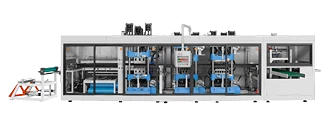


The polyester cup maker heats amorphous PET to a narrow temperature range above its glass transition point. A thin sheet is then formed on a temperature-controlled mould and the cup is cut in the same cycle. That's how most thermoforming lines work. The main difference between PET and PP and PS is that PET must be heated at the right time. If you heat it too long, it starts crystallizing. Once the plate crystallizes too much, it is difficult or impossible to form properly. The machine must control heating time and temperature, use cold mould cleaning cups or hot mould crystallized cups, and handle completely dry plates.
Changes when resin is PET
Each resin type has different restrictions on a thermoforming machine. Polypropylene (PP) and polystyrene (PS) soften and form when heated. If the machine heats slowly or quickly, or stays heated while operators clear blockages, they can usually be maintained during molding without major problems. Amorphous PET is different. It leaves the extrusion line in a cool glassy state with a density about 1.335 g/cm3. The situation is unstable in the long run. According to ISO 1183-1, total crystalline PET has a high density of about 1.455 g/cm3. Because crystallized PET is harder to form, the machine must be formed before crystallizing too much.
LITAI Machinery uses the same basic tilt molds, servos and hydraulic racks as other plastics. The main difference is the process setup. The PET cup maker needs to control temperature control and dry the board properly. Its performance depends not only on the size of the molding, but also on how the machine controls heat and keeps the PET sheet moist.
Heating: Deadline windows
The difference between a transparent PET cup and a white PET cup comes down to a very narrow temperature range.
Amorphous PET softens at 75 – 80 °C and melts at 250-260 °C. At about 140 degrees Celsius, it can start crystallizing without molds, as polymer chains can move and form orderly structures. This behavior can be measured by differential scanning calorimetry under ISO 11357-3 and ASTM D3418. Plates must be carefully heated to a surface temperature of about 110-140 degrees Celsius. Polypropylene cups are usually formed at higher plate temperatures of around 150-165 degrees Celsius.
This changes the way heaters work. heating zones require lower settings, and top and bottom heaters require more precise control. The distance between the last heater and the molding station must also be short. Once PET reaches the right temperature, the time before crystallization begins is limited. PP overheating can cause drooping and can be resolved by adjusting the process. Overheating PET can lead to crystallization, which cannot be reversed during normal forming.
Two Paths: transparent cup and Crystallized Cups
The transparent PET process uses amorphous sheets and cooling molds, usually at 15 -25 ℃. The cup cools quickly, maintaining its transparent glassy structure. The result is a transparent cup, similar to the polystyrene cups it replaces. However, its heat resistance is limited by the glass transition temperature, so it's suitable for cold and room-temperature drinks rather than hot refills.
The crystallized PET process are made using hot molds, usually at temperatures of 140 -170 ℃. The cup stays in the mold long enough for the material to crystallize. This makes the glass opaque and white, making it more heat resistance. ISO 306 measures softening behavior to help assess PET performance under heat; appearance alone doesnot show heat resistance.
When ordering a PET Cup Making Machine for transparent cups, the system requires a mold cooler and a cycle in seconds. For crystal cups, the machine requires a hot oil mold to heat and a longer cycle, usually measured in a few dozen seconds. The transition from one process to another requires changes in heating system, mold design and cup delivery systems. LITAI Machinery offers two configurations on the same basic forming frame.
| Clear, amorphous | Crystallization | |
|---|---|---|
| Mold temperature | 15–25 °C, refrigerated | 140–170 °C, heated |
| Appearing | Glass transparent | opaque white |
| Working temperature | Cold and ambient fillers | Heating fillers |
| Cycle time | Seconds | Scores of seconds |
Drying and chain length: what boards bring
Water can break down PET at very high melting temperatures. This is why PET resin dries for 4-6 hours at 160–170 °C before squeezing. The dryer should keep dew point near -40 °C and reduce moisture content to about 0.005–0.02% or 50–200 ppm. Humidity must be measured, not touched.
Even small amounts of water can damage polymer chains. At 100 ppm moisture, a kilogram of PET contains about 5.6 mmol of water. If each water molecule breaks one ester bond, a single melt can reduce the number of polymer chains by about atenth for a sheet resin with an an intrinsic viscosity of 0.80 dL/g and an average molecular weight of 20,000 g/mol. The intrinsic viscosity may decrease by about 0.05 dL/g. This can make the cup brittle and cause the rim to crack.
Silver streaks and small bubbles on the walls of cups are common signs of moisture damage. Buyers usually notice the signs first because they are easy to see and photograph. LITAI Machinery considers resin drying and plate treatment to be part of molding line specification. If exposed between the dryer and the molding oven, the PET absorbs moisture again. If the quality of the incoming paper is uncertain, check its intrinsic viscosity using a capillary viscometry under ISO 1628-5 or ASTM D4603.
Making and fixing a That Cracks cup
PET plates must be heated above their glass transition temperature before stretching. If the temperature is too low, the material may yield rather than stretch evenly, and the stretch area will turn white. This defect is called stress whitening. Plates should also not be too hot because PET hardens when stretched. This strain hardening helps form deep cups without tearing the bottom. This also means the material hardens quickly during molding. As the sheet softens, the plug should move quickly at the beginning and slow down towards the end. Vacuum alone is often not enough for a tapered drinking cup, so plug-ins of 4–8 bar are often used to help shape the air.
Trim can also affect the quality of the cup. The rims are cut into forming tools, which help keep their dimensions in + -0.2 mm of well-tuned machinery. The rim is also a common fault point because it is thin, highly oriented and easier to crystallize against a warm tool. There was a faint streak at the rim to indicate partial crystallization. The area feels harder, probably cracking earlier than the transparent wall next to it.
Cutting the rims inside the molds also improves safety and keeps hands away from exposed blades. Mechanical design shall conform to relevant safety standards, including ISO 12100 and ISO 13849-1. Electrical systems shall comply with IEC 60204-1 and applicable machinery regulations, including Regulation (EU) No. 2023/1230.
| What you see | What it points to |
|---|---|
| milky white walls or edges | Below the Transition in Pictures |
| Silver stripes, delicate foam | The plate is damp, not defective. |
| Hazy band, then the edges split | Crystallization of fringes |
| Full sidewall, paper-thin base | Too few plug assist |
throughput: same tools, different numbers
Even if PET Cup Making Machine and polypropylene production lines run at similar speeds, their output figures are different. The difference is the need for heating and the conditions for molding.
Take 0.5 mm PET tablets with a density of 1.335 g/cm3. The 730 × 320mm sheet weighs about 156 grams and is het from 25 °C to 130 °C, requiring roughly 28 kJ at a specific heat capacity of 1.7 kJ/kg·K. At 15 laps per minute, the molding heat demand is about 7kW.
For polypropylene, 140g sheets are heated from 25ºC to 155ºC with a specific heat capacity of 1.9 kJ/kg · K and require about 35 kJ per cycle. Running at 20 laps per minute, the demand for heat is nearly 11 kW. This means PET ovens need less heat to form.
The main difference is production. a 36-cavity mold can produce 540 cups per minute, or about 32,400 cups per hour. With 20 cycles per minute, the same mold can produce 720 cups per minute, or about 43,200 cups per hour.
Dry systems also use energy. At 160-170 ° C, drying about 140 kg of PET plate per hour increases heat demand by roughly 10 kW before including energy for desiccant regeneration. Therefore, LITAI Machinery bases its practical requirements for PET production lines on dryers and molding machines.
What can pets not do?
PET has the advantage of being widely collected and recycled. PET cups can also meet design recycling standards. However, amorphous PET cups start to soften at about 70–80 °C, making them unsuitable for hot filling, retort processing or commercial dishwashing. PET is also sensitive to indentations and can be damaged by strong alkaline substances, making it unsuitable for some areas with higher pH levels.
PET is unstable and does not meet the stabilization requirements of EN 13432 or ASTMD6400. From September 2026, Directive 2024/825 treats unproven environmental claims as unfair business practice.
Food contact rules also apply to PET cups. In the United States, 21 CFR 177.1630 covers polyethylene terephthalate. In Europe, requirements for food exposure materials are set out in Regulation (EC) No. 1935/2004 and Commission Regulation (EU) No. 10/2011. Recycled PET must come from a recycling process authorized by Regulation (EU) 2022/1616. The regulation authorizes the use of recycling processes rather than the usual recycled materials. Currently, the recyclingcontent requirements set out in Directive (EU) 2019/904 apply to beverage bottles, not cups.
Frequently Asked Questions
Can PET and polypropylene run on a single line?
The molding frame works because LITAI Machinery builds machines for different plastics. But tools and heating system must be adapted to different materials. PET requires more control, usually lower tool temperatures. Due to the narrow molding range, a gentler molding process is also needed. The plates must dry before entering the oven.
Why do PET mugs sometimes look murky?
A milky white area is stretched, meaning it forms below the glass transition temperature. A haze over the entire part, including the unformed flange, may mean the sheet starts crystallizing in the oven. Small bubbles or silver streaks usually indicate moisture in the plate. Each problem requires a different solution.
What are the most common specification error?
Choose the cup according to its appearance, not the temperature it has to deal with. A clear amorphous PET cup and an opaque crystal PET cup can be made on the same PET Cup Making Machine and look just as perfect. But their heat resistance can vary by more than 100 degrees. If you order PET cup that doesn't specify whether it holds cold or hot contents, you may get the wrong heating and molding system.
The basic steps of a PET cup maker are the same as other thermoforming lines: unwind, heat, shape, cool, trim and stack. The main differences are the narrow molding temperature range, the need to dry the plate to very low humidity, and the selection of hot and chilled molds for cleaning cups and hot molds for heat-resistant cups. Drawings, molding depth and mold options for cups, pallets and containers made from polypropylene, PS, PET and PLA are available at litaimachinery.com.
Source of information
- ISO 11357-3, ASTM D3418 and ISO 306 -Melting, crystallization and Vicat softening temperature of thermoplastics
- ISO 1183-1 and ISO 1628-5 with ASTM D4603 -Density of non-honeycomb plastics and intrinsic viscosity of thermoplastic polyester
- ISO 12100, ISO 13849-1, IEC 60204-1 and Regulation (EU) 2023/1230 - machinery risk assessment, control system safety, electrical equipment and EU machinery framework
- Regulation (EC) 1935/2004, Commission Regulation (EU) 10/2011 and 21 CFR 177.1630 --food contact materials and polymers
- Regulation (EU) No. 2022/1616 -Recycling of plastic food contact materials and approved recycling processes
- Directive (EU) 2019/904 and Directive (EU) 2024 / 825 -single-use plastics targets and substantiation of environmental claims
- EN 13432 and ASTM D6400 -Stability of packagings


