


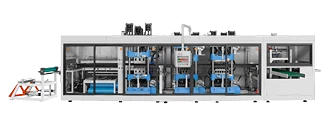


A PET Thermoforming Machine do not choose sheet thickness. It uses the thickness of your choice. You should choose plate thickness based on the minimum wall thickness of the finished part, the area stretch ratio of the mold and the acceptable thickness loss. The 90mm cup model is on an 80mm court and has an area stretching ratio of about 3.3. This means a 0.6mm slab can form a wall 0.18mm thick. Much of the debate about sheet thickness is really about stretch ratio, mold shape, tensile depth and plug design, not just resin properties.
The Gauge you Buy is not the wall of your ship
A PET Thermoforming Machine process sheet metal into parts, walls and finishes. The density of the material remains the same and no material is added. The thickness of the wall is determined by the shape of the parts before heating starts. area stretch ratio ratio refers to the surface area of the finished product divided by the plate area of the finished product.
Take a glass of water, 78 mm at the mouth, 55 mm at the bottom and 90 mm at the bottom. It's molded on an 80mm pitch. The lateral slope is 90.7 mm. The wall area is 18,955 mm2 and the base area is 2,376 mm2. The total floor area is 21,331 mm2 and the plate area is 6,400 mm2. The area stretch ratio is 3.3. As a result, the average wall thickness of a 0.6mm plate about 0.18 mm. If you take into account the thin panels used between the cavities, the surface of the wall may be closer to 0.16mm. Density only matters if you need to calculate weight rather than thickness. ISO 1183-1 is used to measure density. That's why the panels are bought by weight and specified by thickness.
LITAI Machinery makes thermoforming machines with thickness ranging from 0.2 mm to 2.0 mm. It has a range of 650 × 300 mm hydraulic presses and 750 × 480 mm servo machines. This machine can control rim dimensions to ± 0.2 mm. This tolerance depends on the mold, not the plate.
Back away from the Weakest Wall
The cup is not rejected because its average wall is thin. It is rejected because it was a little thinner than the rest. This is easy to predict. In a deep cup, it's usually the bottom, where the sheet stays in contact with the plug the longest and stretches the longest. In a shallow cup, it may be on the rim, and its shape varies little, but there is less material to resist damage during retreat. In a rectangular tray, it is usually the radius of the corner.
The process is simple: identify faults, cut a formed sample, measure the wall surface, and then choose the thickness of the plate. Cutting is necessary. The fixture measures rims and rarely points to partial failure.
The thickness distribution of the wall depends on the tool. Vacuum forming without plug assist usually produces a bezel-base thickness ratio of about 3:1. Plug assist and pressure forming can reduce this ratio to less than 2:1. This may be more effective than adding 0.1mm to the plate as it transfers the material to where the stress is greatest, rather than thickening the entire section.
The width of the plate must also match the die. LITAI Machinery's TJP-900E uses a 900mm web and can process up to 400kg/h. Use a 750mm mould so each side has 75mm sides for recycling. The width of the web and the layout of the cavity should be planned together.

Failure patterns vary in scale
| Failure mode | Zoom by Scales | What else is moving | When meters are the wrong lever |
|---|---|---|---|
| Stacks sagging under pallet load | roughly t2 | taper, rib, rim flare | Nesting lugs fixed stack height |
| Sidewall panel stiffness | t3 | Mix | mold can'tcut any deeper |
| Rim cracking during ovulation | Nearlinear, then brittle | Rim radius, tool temperature | Edge crystallized |
| Falling and impact | t and IV add up | IV. base radius | Resin is wet |
| Basic thrust | Local thickness of poles | plug shape, base radius | Withdrawal rate above 1.5 |
These figures show why simply using thicker boards is not always the best option. The stiffness of the panel depends on the effect of thickness on the third power. Thickness decreased from 0.6 mm to 0.5 mm cuts and stiffness decreased by about 42%. From 0.6 mm to 0.7 mm, stiffness improved by about 59%. The stacking buckling strength depends more on thickness's effect on the second power, so the same reduction reduces it by about 31%. Rim cracking is closer to linear change, but failure can change that. Below a certain thickness, the rims can stop slowly tearing and start cracking on small surface defects.
The first question is not how thick the sheets should be, but what needs to be addressed. Stacks that bend on trays have stiffness problems, so changing the thickness of the sheet can help. Because resin can also affect results, cracked rims on fillers may react less to thicker flakes. Tensile data from ISO 527-3 can help guide the selection, but it doesn't give a complete answer. The test uses a flat sample that has not been the forming process.
The Oven is length, not setting
A PET Thermoforming Machine have a fixed heating time limit. Heating time is the length of the oven divided by the speed at which the paper travels. For a 2.4m oven with an index of 320mm per trip, the plate passes through 7.5 sections. At 20 beats per minute, it stays under the heater for 22 seconds. If the thickness of the sheet increases to 0.8 mm and the oven temperature stays the same, the core takes more than athird of time to heat up. Heating time in this range is almost the same as the thickness of the plate. Over 1.5mm, heat travels through the plate more slowly, so the heating time rises faster.
Raising the temperature won't solve the problem. The temperature range Amorphous PET is narrow, from soft enough to start crystallizing, around 30K. As the core catches up, there is little room for the surface to warm up. If the heater is set too high and the middle is not ready, the surface turns white.
Production figures show the cost. A 36-cavity mold runs at a rate of 20 beats per minute and is made of 43,200 cups of 0.6mm of sheet metal per hour. Using 0.8mm flakes, production drops to about 32,400 cups per hour. Use an extrathird of resin per cup and yields drop by 25%. Machines, molds and operators remain the same.
Thickness Cannot Fix Resin
Two common causes of component failure are wet plate and short polymer chains. Both may look like thickness problems, but neither is caused by sheet thickness.
The intrinsic viscosity of PET thermoforming sheet is generally 0.70-0.80 dL/g. It can be measured using the the viscosity number method in ISO 1628-5 or the intrinsic viscosity method in ASTM D4603. Each extrusion shortens the polymer chains. Adding 30% internal regrinding usually the blend's intrinsic viscosity by about 0.01–0.02 dL/g. This is usually acceptable. It is also possible to dry the resin to 50-200ppm of humidity. But 400ppm is too high. At melting temperatures, water breaks the ester bonds in PET. intrinsic viscosity decreased from 0.78 dL / g to 0.70 dL/g, which may be the difference between a cup that passes the drop test and one with a cracked rim during filling.
That is the problem. The converter uses damp resin and gets rim cracks. The converter adjusted the sheet thickness from 0.6 mm to 0.7 mm and the crack stop. The converter then assumes the sheet was too thin. Resin costs were up 17% and the dryer was still malfunctioning. A calorimetry test under ISO 11357-3 measures crystallinity, while ISO 306 measures softening behaviour. These tests help explain the behavior of the material, but only a viscosity test can show whether the polymer chains is shorter.
Food exposure compliance also depends on resin. The requirements relating to the elimination of POPs in Regulation (EC) 1935 / 2004, Commission Regulation (EU) 10 / 2011 and Regulation (21) CFR 177.1630 apply to the materials used. Increasing sheet thickness does not alter the resin's compliance status.
Reading the Certificate, Not the Nominal
No PET Thermoforming Machine to solve the material certificate problem, no one to check. Plates are sold with nominal thickness and tolerances, usually ±5%. The minimum thickness is the most important value for the parts. For example, a 0.6 mm plate with tolerances ± 0.03 mm can be thin to 0.57 mm. This thin area can appear in any cavity.
Thin and different flakes are also important. The central thickness of the 750mm web may be 2–4% thicker than the edge. In a 24-cavity mold, the cup that comes out of the center may weigh more than the cup that comes out of the rim. The packaging line may detect this before the quality control team. This is a problem with sheet molds, and replacing the molds does not solve the problem. LITAI Machinery uses a scanning bench to check the thickness of the incoming paper because one reading doesnot show the full thickness profile of the entire Web.
Ask how supplier thickness is measured, not just the value of the report. According to the mechanical scan carried out by ISO 4593, measurement points are set up on the width of the paper, providing a clear basis for comparison. ASTM D6988 includes thickness measurement practices and ISO 291 requirements for plastics testing. These methods help labs test the same piece of paper under consistent conditions. The material certificate shall also include the quantity of gel and intrinsic viscosity of each consignment.
When a Thicker Sheet make things worse
The use of thicker plates does not always make PET thermoforming parts safer. There are three main reasons.
Firstly, the temperature difference between the thicker plate surface and core is bigger under the same heating time. When the core is 20 – 25 K cooler, the core surface can reach molding temperature. The plate then behaves like the oven is too low. The rims have less detail, more stress stays in parts, and parts bounce back after more punch is released.
Secondly, a 0.6mm plate plug cannot extend to a 0.9mm plate. There is less material moving down the side wall and more coming out of the bottom. The finished part is heavier, but the base is thinner. This is the opposite of what was expected.
Third, the design of decorative mold must have a certain sheet thickness. The gap between the punch and die is set to match the plate. If a 0.9mm sheet passes through a mold designed for a 0.6mm sheet, the mold may tear the edges rather than cut clean. Tearing can start with the sealing edge cup.
LITAI Machinery designs decorative tools to match the thickness of the panels listed on the approved drawings. Machine protection at the same site is based on risk assessment, not just sheet thickness. Relevant standards include ISO 12100 and IEC 60204-1, as well as the applicable requirements of Regulation (EU) 2023/1230.
FAQ
What thickness do PET paper cups typically use?
Use 0.35-0.6mm flakes in a cold drink glass. Rigid and premium cups use 0.6–1.0 mm and heavy trays use 0.8–1.5 mm. LITAI Machinery makes thermoforming machines with thickness ranging from 0.2 mm to 2.0 mm. But mugs are more limited. About 0.35mm below, the rim may not be strong enough to withstand damage during removal of thenesting, depending on the design and molding ratio of the cup.
Can a machine operate within a wide thickness?
No. The rack can support the entire range, but oven lengths, plugs and trim molds must also match the plate. Production lines designed for 0.4mm cups require different heating setup and punch gaps than production lines designed for 1.2mm trays. Set sheet thickness in specification before ordering the tooling.
Can existing parts use sheet metal without changing the die?
This may be possible, but only if the thinnest walls become too weak. A 17% reduction in thickness reduces panel stiffness by about 42%. A once hard cup may bend under the tape of the tray. Measure the thickness of the wall before and after sample replacement and check the edges for signs of crystallization.
And most importantly
The thickness of the sheet depends on the required wall thickness, area stretch ratio and material loss within the allowable tolerance. Calculate these values first, then select the plank gauge. If the calculation is wrong, other machine settings donot fully resolve the problem. The rim dimensions of the polyester thermostat can be controlled at + -0.2 mm and heater temperatures can be controlled at ±1 °C, but it cannot add materials other than sheet metal. Drawings, thickness tables and tools for PET and RPET cups, trays and containers are available at litaimachinery.com.
Source of information
ISO 4593: 2019 -Mechanical scanning film thickness
ASTM D6988 -Plastic film test sample thickness
ISO 1183-1 - density of non-honeycomb plastics, immersion method
ISO 527-3 - tensile properties of films and sheets
ISO 11357-3 melting and crystallization temperature and enthalpy
Viscosity of PET in ISO 1628-5 diluent
ASTM D4603 -Determination of inherent viscosity of PET by glass capillary viscometer
ISO 306 -Vicat Softening Temperature
ISO 291 -Standard Atmosphere for Conditioning plastics specimens
ISO 12100 --Mechanical risk assessment and risk reduction
IEC 60204-1 --Electromechanical Equipment; Regulation (EU) No. 2023/1230
Regulation (EC) No. 1935/2004 and Commission Regulation (EU) No. 10/2011 --food contact materials
FDA · US FDA 21 CFR 177.1630 - PET polymers for Food Exposure


