




Introduction
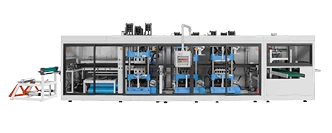
Thermoforming is a plastic processing technology that involves heating plastic sheets to a softened state, then shaping them using molds, vacuum, or pressure, and finally cooling them to obtain the desired product. Thermoforming equipment is manufactured based on this technology. Different thermoforming equipment can meet both small-batch customized production and large-scale mass production needs, and it also has a high utilization rate of plastic raw materials. This guide will systematically organize the core knowledge for beginners, covering thermoforming technology fundamentals, equipment classification, industrial applications, workflow, and selection points, helping them quickly grasp the key information about thermoforming equipment.

Technical Basis of Thermoforming Equipment
Core Principles
The essence of thermoforming is utilizing the thermoplasticity of thermoplastics. By heating the sheet material to a softened state above its glass transition temperature but below its melting point, external force (vacuum suction, pressure pushing) is used to conform the softened plastic to the mold contour. After cooling and solidification, a product conforming to the mold shape is obtained.
Common Materials
Thermoforming is primarily suitable for thermoplastic sheets. Common types include:
• PET: High transparency, good toughness, commonly used in food packaging and blister trays;
• PVC: Low cost, easy to mold, suitable for everyday product casings, medical packaging, and building materials;
• PP: Good temperature resistance and strong chemical stability, suitable for food containers and automotive interior parts;
• ABS: High-strength, impact-resistant, commonly used for appliance casings and industrial components.
Classification of Thermoforming Equipment

Classification by Number of Workstations
• Single-Station Thermoforming Equipment: Heating, forming, cooling, and part removal are completed in the same location. Simple structure, suitable for sample making and small-batch customization.
• Dual-Station Thermoforming Equipment: Heating and forming have independent workstations, with alternating operations on sheet metal. The forming cycle is shorter than that of single-station equipment, making it suitable for medium-batch production.
• Three-Station Thermoforming Equipment: Heating, forming, and trimming are performed continuously in three workstations. Suitable for large-batch production of standard parts such as food trays.
• Four-Station Thermoforming Equipment: Includes a punching workstation, allowing direct production of products with perforations (such as seedling boxes) without further processing.
Core Components
• Heating System: Includes heating furnace and heating tubes/infrared heaters, responsible for uniformly heating the plastic sheet and precisely controlling the temperature;
• Mold Station: A platform for installing molds, supporting quick mold changes. Some equipment is equipped with multi-station turntables to improve production efficiency.
• Vacuum/Pressure System: Core components such as vacuum pumps and air compressors, providing the negative and positive pressures required for molding;
• Cooling System: Cooling fans, cooling water pipes, etc., enabling rapid product shaping;
• Finishing Mechanism: Includes punch presses and cutting blades, used to remove excess scrap material from the product;
• Control System: Utilizes PLC or touchscreen control, allowing setting of parameters such as temperature, pressure, and molding time for automated operation.
Industrial Applications of Thermoforming Equipment

Packaging Industry
Thermoforming equipment enables the packaging industry to produce lightweight, impact-resistant, and highly customizable packaging products. These products not only protect goods during transportation and storage but also enhance shelf display and brand appeal. Their consistent molding quality is particularly suitable for the stringent requirements of high-volume food packaging lines and the pharmaceutical packaging industry.
01
Automotive Industry
In the automotive sector, thermoforming technology is suitable for manufacturing large, lightweight parts, such as door trim panels, dashboard housings, and bumper covers. These components have high requirements for strength, weather resistance, and aesthetic quality. Thermoformed materials balance strength and plasticity, enabling parts to meet the reliability requirements of long-term vehicle use while also achieving complex curved shapes, enhancing the overall design of interior and exterior trims.
02
Medical Industry
The medical industry uses thermoforming equipment to produce hygienic and structurally precise products. Sterile trays, instrument liners, and equipment housings rely on the molding stability and material selectivity of thermoforming to meet the stringent safety, sterilization resistance, and cleanliness requirements of hospital environments.
03
Other Industries
In the aerospace industry, thermoformed materials, due to their light weight and high strength, are often used to manufacture aircraft interior parts and equipment protective covers, helping to reduce overall aircraft weight and ensure safety. In agriculture, thermoformed products such as seedling trays, irrigation accessories, and greenhouse components maintain structural stability in outdoor environments due to their excellent weather resistance and lifespan. In the retail display sector, the high transparency and design flexibility of thermoforming are leveraged to create display boxes, shelves, and billboards, significantly enhancing the presentation of merchandise.
04
Thermoforming Equipment Workflow: Step-by-Step Analysis

Preparation Stage
• Material Selection: Select suitable plastic sheets according to product requirements, ensuring uniform thickness and no impurities.
• Mold Preparation: Install the corresponding mold, check the mold surface finish, and ensure the vents are clear; clean and lubricate if necessary.
• Equipment Debugging: Set parameters such as heating temperature, molding time, cooling time, pressure/vacuum, etc., and conduct trial runs.
Heating Stage
The plastic sheet is fed into the heating furnace and heated evenly using infrared heating or hot air heating. Different materials have different heating temperatures; for example, PVC's heating temperature is approximately 100-130℃, and PET's is approximately 120-150℃. During heating, localized overheating must be avoided; this can be achieved by adjusting the distribution of heating elements or the sheet's movement speed to ensure uniform heating.
Molding Stage
The softened, heated sheet is conveyed to the mold station. After the mold closes, the vacuum system is activated to remove air, or positive pressure is applied simultaneously to ensure the plastic sheet completely conforms to the inner wall of the mold, forming the desired shape. The molding time is adjusted according to the product complexity and thickness, typically ranging from a few seconds to tens of seconds.
Cooling Stage
The molded plastic product is rapidly cooled using an air-cooling device or internal cooling water pipes within the mold. Sufficient cooling time is required to ensure the product does not deform due to excessive temperature after setting.
Tying Stage
After cooling and setting, the mold is opened, the product is removed, and sent to the trimming station. Excess material at the edges is removed using mechanical cutting, punching, or laser cutting. For three- or four-station thermoforming equipment, the trimming process is usually integrated into the production line as an independent station. Products do not need to be removed from the mold and sent separately to external trimming equipment; instead, automatic continuous processing is achieved internally, significantly improving production efficiency.
Quality Inspection
The dimensional accuracy, surface finish, and wall thickness uniformity of the product are checked. Defects such as bubbles, cracks, and missing material are inspected. Qualified products are stored, while unqualified products are reworked or recycled.
Key Considerations for Selecting Thermoforming Equipment
Define Production Needs
• Production Scale: Small-batch production can utilize small semi-automatic equipment, while large-scale mass production requires industrial-grade fully automatic equipment.
• Product Specifications: Select the processing area, molding pressure, and mold compatibility of the equipment based on the product's size, thickness, and complexity.
• Production Speed: Clearly define the required output per unit time. Multi-station equipment enables continuous production and improves efficiency.
01
Material Compatibility
Confirm that the equipment is compatible with the target materials. Different materials have different heating temperatures and molding pressure requirements, and the equipment's heating and pressure systems must be matched accordingly. For example, processing PP requires equipment with a wider heating temperature range, while processing thick-walled ABS requires higher molding pressure.
02
Budget and Cost Control
• Initial Investment: Smaller equipment is typically much cheaper than industrial-grade equipment; the choice should be based on the budget and production needs.
• Operating Costs: Consider the equipment's energy consumption, consumable replacement costs, and maintenance expenses. Prioritize equipment with low energy consumption and ease of maintenance.
03
Automation Level
• Manual Equipment: Simple to operate and inexpensive, but with low production efficiency, suitable for R&D or very small batch production;
• Semi-automatic Equipment: Requires manual assistance for feeding and unloading, but automates the molding and cooling processes, balancing cost and efficiency;
• Fully Automatic Equipment: Integrates automatic feeding, molding, cooling, and finishing processes, requiring no manual intervention, resulting in high production efficiency, suitable for large-scale mass production.
04
After-Sales Service and Support
Choose a supplier with comprehensive after-sales service to ensure timely repair support in case of equipment failure. Also, pay attention to whether the supplier provides value-added services such as mold design, equipment debugging, and operator training. LITAI, a manufacturer with 24 years of experience, not only provides cutting-edge plastic thermoforming equipment but also offers comprehensive support, including solution consultation, logistics and transportation, on-site installation and commissioning support, training, timely after-sales service, and equipment upgrades and optimization.
05
Conclusion
Thermoforming equipment, with its flexible forming capabilities, economical production costs, and wide material adaptability, has become a core processing tool in many industrial sectors, including packaging, automotive, medical, and construction. Understanding the fundamentals of thermoforming technology, equipment classification, and workflow, and clearly defining your own production needs, is key to selecting the right equipment. Of course, maintaining communication with experienced thermoforming equipment suppliers can help resolve many questions and concerns.
Contact us now, LITAI will provide you with complete plastic thermoforming solutions.


