


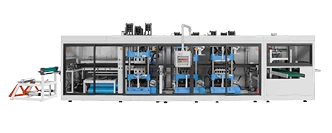


In modern industrial production, plastic cups are widely used in various fields, such as catering, food packaging and household life, because of their lightweight, durable and high value for money. As the core equipment of producing plastic cups, the performance and operation stability of Plastic Cup Making Machine directly determine the quality and consistency of the products. From the precise control of raw materials to the precise management of the production process to strict quality inspection, every link contains the secret of ensuring the quality of products.
Precise Control of raw materials
Material Selection and inspection of raw materials
Quality raw materials are the basis of producing quality plastic cups. Thermoplastic plastics such as polypropylene (PP) and polyethylene (PE) are commonly used in Plastic Cup Making Machine. In the procurement of raw materials, suppliers must be rigorously screened to ensure that the materials provided meet relevant quality standards. After entering the factory, the raw materials are thoroughly inspected, including for uniformity of appearance and impurities, physical properties such as melt velocity, tensile strength, impact strength, etc., and chemical properties such as resistance to chemical corrosion. Only raw materials that have passed all these tests can enter the production process and guarantee the quality of the product at the source.
Accurate Control of Raw Material Proportions
Different plastic cup products have different requirements for the properties of raw materials. For example, some countries require higher transparency, while others need better flexibility. In order to meet these diverse needs, it is often necessary to mix a variety of raw materials in a specific proportion. Plastic Cup Making Machine with an advanced advanced batching systems, which can precisely control the proportion of each ingredient added. By means high-precision measuring devices and automatic control system, we can ensure that each batch of raw materials meets the requirements of the prescribed formula and avoid the variation of product performance due to inaccurate proportion of raw materials, thus ensuring the stability of product quality.
Meticulous Management of production process
Optimization of Injection Molding Process
Injection molding is a key process in plastic cup manufacturing. In this process, the plastic material is heated and melted, then injected into a mold cavity under high pressure, where it cooled to form a plastic cup shape. Plastic cup machine can control injection temperature, pressure, speed and other parameters accurately to ensure that the injection molds are fully filled and evenly distributed. Too high injection temperature can cause plastic to break down, producing defects such as bubbles and discoloration. On the other hand, too low a temperature can also reduce the fluidity of plastic, leading to problems such as inadequate filling and rough surfaces. Unreasonable settings of injection pressure and speed will also affect the size accuracy and appearance quality of the product. Through continuous optimization of injection molding process parameters, using advanced sensors and control systems for real-time monitoring and adjustment, to ensure that each plastic cup is the same size, beautiful appearance.
Mold Design and Maintenance
Die is the key factor to determine the shape and size accuracy of plastic cups. High-quality molds should have precise cavity dimensions, good surface finish and reasonable runner design. In the mold design stage, the flow characteristics and shrinkage rate of plastic need to be taken fully into account. Computer aided design (CAD) and computer-aided engineering (CAE) technologies simulation analysis used to optimize the mold structure and ensure that the plastic cups produced meet the design requirements. At the same time, regular mold maintenance and upkeep is also essential. Mould is easy to wear and corrode during use. If not repaired and cleaned in a timely manner, product size deviation and surface defects may result. Through the establishment of a perfect mold maintenance system, regular inspection of mold wear, timely replacement of worn parts, cleaning mold rust, can prolong the mold service life and ensure the stability of product quality.
Control of the production environment
The production environment can also affect the quality of plastic cups. For example, changes in temperature and humidity can affect the properties and injection molding of plastic materials. Therefore, plastic cup manufacturing workshop needs to maintain constant temperature and humidity conditions. In general, workshop temperature should be between 20 and 25 degrees Celsius and humidity between between 40% -60%. Cleanliness in the workshop is also crucial. Dust and impurities can mix into plastic materials, causing surface defects. By installing air purification equipment and cleaning workshop regularly, dust and impurity pollution can be effectively reduced to ensure the cleanliness and quality of products.
Strict Quality Inspection
Application of Inspection Technology
In order to detect quality problems in the production process, Plastic Cup Making Machine are usually equipped with online inspection equipment. These devices can monitor all kinds of quality indicators such as size, weight and appearance in real time. For example, parameters such as the diameter and height of plastic cups can be accurately measured using laser measurement technology. Visual inspection systems can automatically identify and classify product surface defects such as scratches, bubbles and black spots. Once a nonconforming product is detected, the online inspection equipment immediately raises the alarm, automatically removing the nonconforming product from the production line and preventing it from entering the next process or market, thus ensuring the quality of the produced plastic cups.
Sampling and full inspection of manufactured goods
In addition to online testing, sample testing and comprehensive testing of finished products are required. Sampling inspection refers to the selection of a certain number of products from the production batch for comprehensive inspection according to a specific sampling plan to evaluate the quality of the whole batch. Comprehensive inspection refers to the inspection of each product and is suitable for products or key processes with extremely high quality requirements. In the course of the finished product inspection, in addition to the size and appearance of the product, the physical and chemical properties of the product need to be tested, such as sealing performance, heat resistance, cold resistance, hygiene indicators, etc. Only products that pass all the tests can be considered eligible for packaging and sale.
Staff Training and Management
Professional Skill Training for operators
The operation of plastic cup molding machine requires professional technical personnel. Operators must be familiar with the equipment's operating procedures, process parameter setting and adjustment methods, and troubleshooting methods. Through regular organization of training and skill assessments, improve the professional skill level of operators, ensure that operators can operate equipment correctly, deal with production problems in a timely manner, ensure smooth production and stable product quality.
Cultivation of Quality Awareness
In addition to professional skills training, there is also a need to cultivate quality awareness among operators. Let them be fully aware of the importance of product quality and that every action they take will affect the quality of the product. By carrying out quality education activities, establishing quality reward mechanisms, motivating the initiative and initiative of operators, making them voluntarily comply with quality management systems, actively participate in quality improvement activities and form a good atmosphere of all employees participating in quality management.
In a word, the Plastic Cup Making Machine can ensure the quality and consistency of the plastic cup produced by adopting a series of effective measures in the fields of raw material control, production process management, quality inspection and personnel training. With the continuous progress of technology and the intensification of market competition, plastic cup manufacturing enterprises need to introduce new technology, new equipment, optimize production process and management mode, and continuously improve product quality and competitiveness to meet the growing demand of consumers.


