




Introduction

Food packaging manufacturing requires production methods that can deliver consistent quality, efficient output, and flexible packaging designs to meet different product requirements. From food trays and containers to cups and other disposable packaging products, manufacturers rely on advanced processing technologies to transform raw materials into finished packaging solutions. Among these technologies, thermoforming production lines play an important role in modern packaging manufacturing. This article explores how a thermoforming production line works and how plastic sheets are converted into finished food packaging products through a series of automated processes.
Why Thermoforming Is Widely Used for Food Packaging Production
Thermoforming has become a popular choice for food packaging production because it offers a practical solution for manufacturers producing large volumes of lightweight, customized packaging. The process enables plastic sheets to be efficiently formed into various packaging structures while accommodating different product sizes, designs, and application requirements. With automated thermoforming production lines, manufacturers can achieve continuous production and maintain consistent results across large-scale packaging operations. To better understand the advantages of this manufacturing method, it is important to first look at how a thermoforming production line transforms plastic sheets into finished packaging.
How a Thermoforming Production Line Transforms Plastic Sheets into Food Packaging
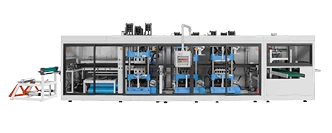
Taking LITAI thermoforming machines as an example, the production process includes multiple
automated steps that transform plastic sheets into finished food packaging products.

Step 1: Feeding
The thermoforming process begins with the feeding station, where plastic sheets are introduced into the machine and accurately transferred to the production line. Common materials used for food packaging, such as PP, PS, HIPS, PET, PVC, PLA, can be processed according to different product requirements. A stable feeding system ensures precise material positioning and smooth sheet movement, providing a reliable foundation for the following heating and forming processes.

Step 2: Heating
After feeding, the plastic sheet enters the heating station, where controlled temperatures soften the material and prepare it for forming. Uniform heating is essential because uneven temperature distribution may affect forming accuracy, product thickness, and overall appearance. An efficient heating system helps ensure the sheet reaches the proper condition for stable molding.

Step 3: Forming
The softened plastic sheet then moves to the forming station, where it is shaped into the required packaging structure through vacuum forming, air pressure, or other forming methods. This stage determines the final shape and dimensions of the packaging product, making forming accuracy important for achieving consistent quality and reliable performance.

Step 4: Punching and Cutting
After forming, the packaging products go through punching and cutting processes to complete separation and finishing. The cutting process removes individual products from the remaining sheet material and creates clean edges, while 4-station thermoforming machines can include an additional punching step for packaging designs requiring holes or specific structural features.

Step 5: Stacking
The final stage is stacking, where finished packaging products are automatically collected and arranged after cutting. An automated stacking system helps organize product output, reduce manual handling, and improve production efficiency, making the entire thermoforming process more suitable for continuous manufacturing.

Step 6: Waste Recycling
LITAI thermoforming machines are equipped with a dedicated waste recycling system to process leftover sheet materials generated during production. The waste sheets can be crushed and mixed with new raw materials for reuse, helping manufacturers reduce material waste and improve resource utilization. This recycling capability supports a more efficient and sustainable thermoforming production process while lowering overall material costs.
Key Factors That Affect Thermoformed Food Packaging Quality
The quality of thermoformed food packaging depends on multiple factors throughout the production
process, from material preparation to forming accuracy and process control.
Sheet Material Quality
The quality and characteristics of plastic sheets directly affect the final packaging performance. Factors such as material type, thickness consistency, and thermal properties influence forming stability, product strength, and appearance. Selecting suitable sheet materials helps ensure the packaging can meet different application requirements while maintaining reliable production results.
Heating Uniformity
Consistent heating is essential for achieving accurate forming results during thermoforming. Uneven temperature distribution may cause problems such as incomplete forming, inconsistent wall thickness, or surface defects. A reliable heating system helps ensure the plastic sheet reaches the proper forming condition, improving product consistency throughout continuous production.
Mold Design and Precision
The mold plays an important role in determining the shape, structure, and details of thermoformed packaging products. Precise mold design and stable forming performance help maintain consistent product dimensions and improve appearance quality, allowing manufacturers to produce packaging solutions that meet different design requirements.
Forming and Cutting Accuracy
Accurate forming and cutting processes directly influence the usability and quality of finished packaging products. Stable forming pressure ensures consistent shapes and structures, while precise cutting helps create clean edges and uniform dimensions. Together, these processes help improve overall product quality and production reliability.
Advantages of a Thermoforming Production Line
A suitable thermoforming production line helps manufacturers improve production efficiency, maintain stable quality, and optimize packaging operations.
- Improved Production Efficiency: Integrated processes such as feeding, heating, forming, punching, cutting, and stacking help manufacturers achieve continuous and efficient packaging production.
- Consistent Packaging Quality: Precise process control supports stable product dimensions, appearance, and performance throughout production.
- Better Material Utilization: LITAI thermoforming machines feature a waste recycling system that allows leftover sheet materials to be crushed and reused with new materials, reducing material waste.
- Flexible Packaging Applications: Different molds and production settings enable manufacturers to produce various food packaging products for different market needs.
- Reduced Labor Requirements: Automated operation reduces manual intervention and helps simplify daily production management.
Conclusion
A thermoforming production line plays an important role in modern food packaging manufacturing by transforming plastic sheets into reliable and customized packaging products through an efficient production process. From material feeding and heating to forming, punching, cutting, stacking, and waste recycling, each stage contributes to stable production performance and consistent packaging quality. Choosing the right thermoforming solution allows manufacturers to improve efficiency, optimize material utilization, and better adapt to changing packaging requirements. LITAI provides advanced thermoforming machines designed for different food packaging applications, helping businesses achieve efficient and reliable production. Contact us today to discuss your thermoforming needs and find the right packaging solution for your production line.


