




Introduction
Thermoforming machines are used to heat plastic sheets and shape them into products such as trays, containers, lids, and packaging components. However, thermoforming equipment is not configured the same way for every production application. Machine configuration can vary according to product dimensions, forming depth, material and sheet specifications, required production capacity, and the processing functions needed after forming. Choosing a suitable configuration helps manufacturers match the equipment to their products and production requirements while maintaining a practical and continuous manufacturing process.

What Are the Main Stations in a Thermoforming Machine?
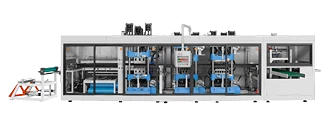
A thermoforming machine typically combines several processing stations to complete the production cycle, with each station performing a specific step from sheet heating to finished-product handling.

Heating Station

Forming Station

Cutting Station

Stacking Station
How Does Each Thermoforming Station Affect Production Performance?
The performance of each station influences a different part of the production process, while the overall result depends on how consistently the stations work together.
Stable Heating for Consistent Forming
Stable heating provides the forming station with a sheet that has more consistent thermal conditions. If different areas of the sheet reach significantly different temperatures, the material may stretch differently during forming, affecting wall distribution and product dimensions. A controlled multi-zone heating system allows processing conditions to be adjusted according to the material and sheet specifications, helping maintain more consistent forming results.
Accurate Forming for Product Shape and Dimensions
Forming accuracy determines how closely the finished product follows the mold design. The forming system needs to coordinate sheet positioning, mold movement, and forming pressure to produce the required shape and dimensions. For products such as trays, containers, boxes, and lids, the available forming area and forming depth should therefore match the product geometry and mold requirements.
Precise Cutting for Consistent Product Separation
Precise cutting ensures that formed products are separated from the sheet at the intended position. Consistent cutting helps maintain the dimensions and edge profile of individual products while reducing irregular separation between adjacent cavities. The cutting system should therefore be matched to the mold layout and the required production cycle.
Efficient Stacking for Continuous Handling
Efficient stacking keeps finished products organized as they leave the cutting station. Automatic stacking can reduce manual collection and arrange products into a consistent format for subsequent packaging, storage, or transport. The appropriate stacking configuration depends on the product dimensions, shape, stacking requirements, and downstream handling process.
What Should You Consider When Choosing a Thermoforming Machine Configuration?
The appropriate configuration should be determined by the products to be manufactured, the required output, the materials being processed, and the way finished products will be handled.
Product dimensions and geometry determine the required forming area, forming depth, mold structure, and processing sequence. For example, a larger tray or container may require a larger forming area, while a deeper product may require greater forming depth and additional forming assistance. The machine should therefore provide sufficient forming capacity for the intended product range rather than being selected only according to nominal machine size.
Production capacity should be evaluated according to the required output, forming cycle, mold cavity arrangement, and product size. A machine with a larger forming area can accommodate different mold layouts, while the actual number of products produced per cycle depends on the mold design. Selecting the configuration based on the required production volume helps avoid both insufficient capacity and unnecessary equipment investment.
请替换当前内容 Architectural design & planning cepteur sint occaecat cupidatat proident, taken possession of my entire soul, like these sweet mornings of spring which I enjoy with my whole...Architectural design & planning cepteur sint occaecat cupidatat proident, taken possession od my entire soul, like these sweet mornings of spring which I enjoy with my whole Lorem ipsum dolor sit ament, consectetur adipisicing elit,sed do eiusmod tempor incididunt labore et dolore magna aliqua. it enim ad minim veniam.
The required finishing process can determine whether a basic forming, cutting, and stacking configuration is sufficient or whether an additional punching station is needed. A three-station configuration can integrate forming, cutting, and stacking, while a four-station configuration can add punching between forming and cutting for products requiring holes or other punching operations. Stacking requirements should also be considered according to the finished product and downstream packaging process.
Machine dimensions, sheet feeding direction, operator access, mold-change space, and connections to other equipment should all be considered when planning the production line. A suitable configuration should provide enough space for operation and maintenance while maintaining a practical material flow from sheet loading through heating, forming, cutting, and stacking.
What Are the Benefits of a Well-Matched Thermoforming Machine Configuration?
Matching the machine configuration to the actual production requirements can improve process coordination and make the overall production system easier to operate.
• More Consistent Heating and Forming - A suitable heating and forming configuration helps maintain stable processing conditions for different materials and product designs.
• Better Production Flow - Integrated processing stations allow the sheet to move continuously through the main thermoforming stages without unnecessary manual transfers.
• Higher Production Efficiency - Automated forming, cutting, and stacking reduce repetitive manual handling and support continuous production.
• More Consistent Product Handling - Automatic stacking provides a more organized output format for subsequent packaging and handling operations.
• Easier Adaptation to Production Requirements - Different forming areas, station configurations, material ranges, and processing functions allow equipment to be selected according to specific product requirements.
Conclusion
A thermoforming machine should be configured according to the complete production process rather than a single machine specification. Heating, forming, cutting, and stacking each contribute to production performance, while the choice between three-station and four-station configurations depends on the required processing sequence and product design. Material compatibility, forming capacity, production output, cutting and stacking requirements, and factory layout should also be evaluated before purchasing equipment. LITAI provides 3-station and 4-station thermoforming machine solutions for different plastic packaging applications, with configurations covering different forming areas, materials, and production requirements. Contact us to discuss your thermoforming requirements and find a suitable machine configuration for your production line.


