




Introduction
Disposable food containers are widely used for takeaway meals, prepared foods, fresh produce, salads, and other food packaging applications. Their production requires thermoforming equipment that can heat plastic sheets and form them into specific container shapes before cutting and handling the finished products. For manufacturers evaluating a disposable food container thermoforming machine, understanding how the equipment works and which production requirements affect machine selection can help determine a suitable configuration.
What Is a Disposable Food Container Thermoforming Machine?
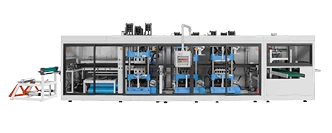
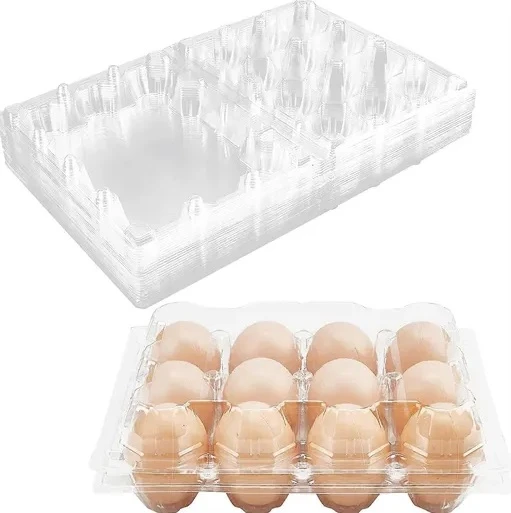
A disposable food container thermoforming machine is plastic forming equipment designed to convert thermoplastic sheets into finished food containers through controlled heating and forming. Depending on the machine configuration, the production cycle can include sheet feeding, heating, forming, cutting, and product stacking or collection. Different molds can be used to produce containers with varying shapes, dimensions, depths, and capacities, making the equipment suitable for products such as lunch boxes, takeaway containers, salad containers, and fruit boxes.
What Features Matter When Choosing a Thermoforming Machine for Food Containers?
The right machine configuration should correspond to the specific requirements of the food container being produced.
A multi-station thermoforming machine can combine several production stages within a continuous operating cycle. Depending on the configuration, heating, forming, cutting, and stacking can be arranged as separate but coordinated stations. This allows the equipment to handle multiple operations in sequence rather than relying on separate manual processes between each stage.
Disposable food containers can be produced from different thermoplastic materials depending on the required product properties and application. Common materials include PP, PS, HIPS, PET, PVC, and PLA. These materials do not have identical heating and forming characteristics, so buyers should confirm that the machine is suitable for the actual sheet material and thickness range used in production. PLA is commonly used for biodegradable or compostable-oriented packaging applications, while PP, PS, HIPS, PET, and PVC are conventional plastics with different processing characteristics.
Stable temperature control is important because the sheet needs to reach a suitable forming condition before it enters the mold. Variations in heating conditions can affect material distribution and forming consistency. Thermoforming machines may therefore use temperature control systems such as PID regulation to maintain more stable heating conditions, while servo-driven forming systems can provide controlled movement during the forming process.
After forming, individual containers need to be separated from the surrounding sheet material. Cutting accuracy can influence the finished product dimensions and edge quality. For automated production, a stacking station can then collect and arrange finished containers for easier handling and packaging. Integrating these processes into the machine can reduce the need for manual product collection between production stages.
Different food containers require different mold designs, making mold configuration an important consideration for manufacturers producing multiple container sizes or product types. Buyers should consider whether the equipment can accommodate the required mold dimensions and whether the mold change process is suitable for their production schedule. Custom mold development may also be required when standard container designs do not match the final product requirements.
What Are the Benefits of Using a Suitable Thermoforming Machine for Food Containers?
A suitable thermoforming machine can help manufacturers maintain a more stable and efficient production process for disposable food containers.
- More Consistent Container Dimensions - Stable heating and forming conditions can help maintain consistent container dimensions, shapes, and forming results across repeated production cycles.
- Improved Production Efficiency - Coordinating heating, forming, cutting, and product handling within the machine can reduce interruptions between individual production stages and support a more continuous workflow.
- Reduced Manual Handling - Automated cutting and stacking can reduce repetitive handling of finished containers, particularly in production environments with regular and higher-volume output requirements.
- Greater Product Flexibility - Different molds can allow the same equipment to produce food containers in different shapes, sizes, depths, and capacities, giving manufacturers more flexibility when product requirements change.
- Better Production Process Control - Controlled heating and forming parameters allow operators to manage key conditions more consistently, which can be important when processing different thermoplastic sheet materials.
What Should Buyers Consider Before Purchasing a Food Container Thermoforming Machine?
Before purchasing equipment, buyers should define their actual container production requirements and match them with the machine configuration.
- Container Design and Dimensions - Confirm the required container shape, length, width, depth, capacity, and other design specifications before determining the machine and mold configuration.
- Material and Sheet Specifications - Identify the plastic material and sheet thickness that will be used in production. PP, PS, HIPS, PET, PVC, and PLA can have different processing characteristics, so the equipment should be suitable for the intended material range.
- Production Capacity - Consider the required output, production schedule, mold layout, and operating hours rather than selecting equipment based only on its maximum rated speed.
- Mold Requirements - Evaluate the number and type of containers to be produced, required mold dimensions, product change frequency, and whether customized molds will be needed.
- Machine Configuration and Automation - Determine whether the production process requires integrated cutting, stacking, automatic product handling, or connections with other upstream and downstream equipment.
- Factory Space and Layout - Check the machine footprint, feeding direction, operating area, and maintenance space to ensure that the selected equipment can be properly installed and operated within the available facility.
- Technical Support and Customization - Buyers should confirm whether the manufacturer can provide machine configuration, mold development, installation, commissioning, operator training, and technical support according to the actual production requirements.
Conclusion
Choosing a thermoforming machine for disposable food container production requires consideration of the product design, sheet material, production volume, mold requirements, machine configuration, and automation needs. A suitable equipment configuration can help manufacturers achieve more consistent forming results while supporting efficient production and reducing unnecessary manual handling. LITAI provides 3-station and 4-station thermoforming machine solutions for disposable food container production, with configurations designed for different forming, cutting, and product-handling requirements. Contact us to discuss your food container production requirements and find a suitable thermoforming machine solution for your application.


