




Introduction
Food packaging manufacturers face increasing demands for higher production efficiency, consistent product quality, and greater packaging flexibility. Plastic tray thermoforming machines have become a widely used solution for producing trays and containers for fresh food, ready meals, bakery products, and takeaway packaging. However, selecting the right thermoforming machine configuration can significantly impact productivity, operating costs, and future business growth. This article explores the mainstream thermoforming machine configurations used for food packaging, compares their key differences, and provides practical selection tips to help manufacturers choose the most suitable solution.

What Are the Two Mainstream Plastic Tray Thermoforming Machine Configurations?
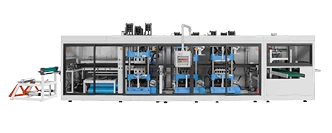
Food packaging manufacturers typically choose between 3-station and 4-station thermoforming machines based on their production requirements, packaging complexity, and growth plans.
3-Station Thermoforming Machines
A 3-station thermoforming machine integrates forming, cutting, and stacking into a streamlined production process. This configuration is commonly used for standard food trays and containers, offering a balance between production efficiency, machine investment, and operational simplicity. It is often selected by manufacturers seeking reliable output for conventional packaging applications.

4-Station Thermoforming Machines
A 4-station thermoforming machine adds an additional processing station, allowing more complex forming and punching operations. This design improves production flexibility and supports the manufacture of deeper, more detailed, or premium packaging products. It is frequently chosen for higher-capacity production environments and more demanding food packaging requirements.

Key Differences Between 3-Station and 4-Station Thermoforming Machines
Taking LITAI's 3-station and 4-station thermoforming machines as an example, the specific parameters and performance differences are shown in the table below:
|
Comparison Factor |
3-Station Thermoforming Machine |
4-Station Thermoforming Machine |
|
Process Integration |
Heating, forming, cutting, and automatic stacking in a compact production process |
Heating, forming, punching, cutting, and stacking are integrated into a multi-station automated process |
|
Independent Punching Station |
No independent punching station |
Dedicated punching station enables more complex product designs and precision trimming |
|
Forming Precision |
Meets conventional tray requirements |
High precision, especially suitable for products with holes, locking mechanisms, or complex structures |
|
Maximum Production Speed |
Medium-high speed |
High speed |
|
Mold Change Time |
Relatively fast |
Quick-change system; less than 20 minutes |
|
Forming Depth |
Up to 110-140mm (varies by model) |
Up to 90-140mm (varies by model) |
|
Investment Cost |
Lower; cost-effective |
Higher; but lower per-unit cost for high-volume production |
|
Suitable Production Scale |
Small-to-medium batch, multi-variety |
Large-scale, continuous production |
|
Typical Applications |
Salad containers, Bakery trays, Fruit trays, Standard compartment trays |
Ventilated fruit containers, Hinged packaging, Locking food containers, Medical and precision packaging trays |
Advantages of the Two Mainstream Plastic Tray Thermoforming Machine
Both 3-station and 4-station thermoforming machines offer distinct benefits depending on your production needs. Understanding their respective strengths will help you make the right choice.
Advantages of 3-Station Thermoforming Machines
The greatest advantages of 3-station machines are cost control and flexibility. For companies just entering the food packaging industry, or factories that handle many product types with small batch sizes, 3-station machines offer a lower-risk entry point. They are simpler to maintain and require less training for operators. If your products are relatively regular in shape without complex holes or non-standard punching, a 3-station machine can fully meet your needs while allowing for faster return on investment.
Advantages of 4-Station Thermoforming Machines
The greatest value of 4-station machines lies in their high precision and high level of automation. The independent punching station can perform precision hole punching, side openings, and complex locking mechanism forming, resulting in finished products with smooth edges and consistent dimensions. Automatic stacking significantly reduces manual labor, making these machines especially suitable for large factories operating continuous production. Although the initial investment is higher, high-speed operation and low scrap rates result in significantly lower per-unit costs for high-volume production.
How to Choose the Right Machine for Your Project
Selecting between a 3-station and a 4-station thermoforming machine depends on several key factors. Here is what you need to consider.
Production Capacity Requirements
Businesses should evaluate their expected output volumes, operating schedules, and future expansion plans. Selecting equipment that aligns with long-term production goals helps maximize investment value.
01
Packaging Product Design
Tray depth, shape complexity, compartment requirements, and dimensional accuracy all influence machine selection. More sophisticated packaging designs may require advanced machine configurations.
02
Material Compatibility
Manufacturers should ensure the machine can efficiently process the materials used in their production, including PP, PET, PS, PLA, and other commonly used food packaging materials.
03
Automation and Operational Efficiency
Modern thermoforming machines equipped with advanced control systems can improve production consistency, reduce labor requirements, and simplify machine operation and maintenance.
04
Why Choose LITAI as Your Plastic Tray Thermoforming Machine Supplier?
Choosing the right supplier is just as important as choosing the right machine. LITAI brings decades of experience and a commitment to quality that sets it apart.
- 24+ Years of Experience – Specializes in thermoforming equipment R&D and manufacturing, with over 60 engineers and $20M+ annual output value.
- Certified Quality – ISO9001 and CE certified, with products sold to over 100 countries worldwide.
- Complete Product Portfolio – Offers both 3-station and 4-station models, covering mold sizes up to 820*650mm and forming depths up to 140mm.
- Customization Capabilities – Supports mold development, core parameter adjustments, automation configuration, and OEM/ODM services.
- Fast Delivery & Support – Standard lead time 45 days, custom 60 days. Spare parts are shipped within 24 hours. Remote video diagnostics and on-site visits available.
Conclusion
Plastic tray thermoforming machines play a vital role in modern food packaging production, supporting efficient manufacturing of trays and containers for a wide range of food applications. Understanding the differences between the two mainstream plastic tray thermoforming machines, evaluating application requirements, and considering key selection factors can help manufacturers make informed investment decisions. Whether you are expanding production capacity or upgrading existing equipment, LITAI offers reliable thermoforming machine solutions designed to meet diverse food packaging needs. Contact us today to discuss your project and find the right thermoforming machine for your production goals.


