




Introduction
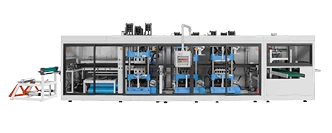
Thermoforming machines are widely used in food packaging, disposable containers, medical trays, appliance housings, and automotive interiors. Understanding how a thermoforming machine works may sound complex, but breaking it down into key components makes it much clearer, helping purchasing personnel assess equipment performance, improve production efficiency, and reduce downtime maintenance costs. This article will guide you through the main components of a thermoforming machine and explain how they interact in the thermoforming process to produce precise and high-quality products.

Why Understanding the Components of Thermoforming Machines Matters
A thermoforming machine is more than just a piece of equipment; it consists of multiple cooperating components, including a feeding system, heating system, vacuum system, cooling device, and trimming unit. Understanding these components helps companies make more informed decisions regarding selection, production, and quality control.
• Choosing the Most Suitable Thermoforming Machine: Understanding how each system affects product performance helps buyers select a machine truly suited to their material type, product thickness, and production volume requirements.
• Improving Production Stability: Process parameters can be set more precisely, reducing defects in thermoformed products.
• Reducing Downtime and Maintenance Costs: Understanding which components are prone to failure and their causes helps teams anticipate and prevent equipment downtime.
• Ensuring Product Consistency and High Quality: High-quality products rely on stable temperatures, appropriate forming pressures, and precise trimming calibration, all of which are closely related to the equipment components.
• Assessing Supplier Technical Strength and Equipment Quality: Suppliers using high-quality thermoforming components often represent a higher level of manufacturing expertise and can provide long-term, reliable equipment.
Key Components of a Thermoforming Machine
Here are the essential thermoforming components that affect the production of high-quality thermoformed products.
Sheet Feeding and Conveying System
The first step in a thermoforming machine is feeding the plastic sheet into the machine. A precise and reliable feeding system ensures that the sheet does not wrinkle or shift as it enters the heating zone, and is suitable for various thermoplastic materials such as polypropylene (PP), polyvinyl chloride (PVC), and polyethylene terephthalate (PET).

Heating System
The heating system uses quartz heaters, infrared heating elements, or ceramic heaters to uniformly heat the sheet, giving it good plasticity and laying the foundation for the molding process. High-end thermoforming machines utilize zoned control (PID) technology for precise temperature control.

Forming System
The softened sheet material enters the forming system. Through vacuum adsorption, pneumatic pushing, or a combination of power, the softened sheet material is completely molded to fit the inner wall of the mold. This precision directly determines the product's wall thickness, shape, and surface quality.

Cooling System
After forming, the cooling system rapidly solidifies the thermoformed product, stabilizing its dimensions and surface finish. Common methods include air cooling, water cooling, or a combination of cooling solutions. Rapid and uniform cooling shortens the production cycle and ensures consistent product quality.

Cutting and Trimming System
The cooled finished product needs to be trimmed to remove excess material, achieving precise edge shaping. Servo trimming systems enable high-speed, high-precision cutting and reduce material waste.

Stacking and Packaging System
Finished products can be stacked using an automated stacking system or a robotic arm. Automated stacking improves production efficiency, reduces labor costs, and prepares the product for packaging or transportation.

Control System
Modern thermoforming machines use PLCs and touchscreen HMIs to monitor and control key parameters such as temperature, speed, vacuum, and pressure in real time, coordinating the operation of various systems within the equipment. Operators can save different process parameters and achieve rapid switching.

Collaborative Working Process of Core Components
The thermoforming process relies on the precise coordination of all key thermoforming components. Below is a detailed explanation of how a thermoforming machine transforms a plastic sheet into a high-quality thermoformed product.
Preparation and Feeding Stage
The automatic unwinding device of the feeding system releases the plastic roll. A servo feed mechanism transports the sheet to the clamping frame at a preset speed. The clamping device precisely secures the sheet edges to prevent displacement or wrinkling during heating and forming.
Heating and Softening Stage
The control system activates the heating system, setting the target temperature and heating time according to the material type and thickness. Infrared or ceramic heaters radiate heat evenly, bringing the sheet to its optimal plasticity.
Forming Stage
The heated sheet is conveyed to the forming station. The mold closes under pneumatic drive, and the vacuum or pneumatic system activates, using suction or pushing force to ensure the sheet perfectly conforms to the mold contour. The clamping frame continuously secures the sheet edges to ensure forming accuracy.
Cooling and Solidification Stage
The cooling system activates simultaneously with forming, rapidly reducing the product temperature through cooling channels or spray. Once the product has solidified and set, the vacuum or pneumatic system depressurizes.
Trimming and Discharging Stage
The formed sheets (including finished products and scraps) are conveyed to the cutting station, where steel dies or laser cutting devices remove excess waste. Finished products are stacked, counted, and then conveyed to the next process. Waste can be collected and recycled by a pelletizer or shredder.
Cycle Control Stage
The control system collects data (temperature, pressure, speed) from each station in real time using sensors, dynamically adjusting operating parameters to ensure each system operates cyclically according to a preset program, achieving continuous batch production.
The Relationship Between Product Quality and Thermoforming Machine Components
In thermoforming production, product defects are often closely related to the performance and settings of key machine components. The table below summarizes common thermoforming problems and their potential causes to facilitate troubleshooting in thermoforming.
|
Common Issue |
Possible Component Cause |
|
Uneven thickness |
Heating system imbalance |
|
Poor definition |
Forming station vacuum pressure too low |
|
Warping |
Cooling insufficient |
|
Excess flash |
Trimming misalignment |
Conclusion
Understanding the key components and relationships between them of a thermoforming machine helps companies evaluate equipment performance and ensure stable product production. Special attention should be paid to critical components such as the forming system, heating system, cooling system, and trimming system during selection, as these key components affect the quality of the finished product.
LITAI: Providing High-Performance Thermoforming Machines
As an experienced manufacturer of thermoforming machines, LITAI uses high-quality components to create high-performance thermoforming machines for you. Contact us for advanced thermoforming solutions.


