


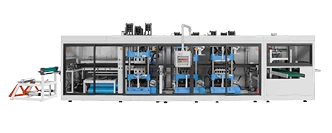


Introduction
Choosing the right plastic thermoforming machine is key for efficient production of food packaging, medical trays, electronics packaging, and agriculture products. LITAI offers both 3-station and 4-station thermoforming machines, each designed to meet specific production needs. This guide explains their differences, production capacity, and how to select the ideal machine for your business.

What is 3 Station Thermoforming Machine
A 3-station thermoforming machine is a fully automatic plastic molding machine suitable for materials like PP, PS, HIPS, PET, PVC, and PLA. It integrates sheet feeding, heating, forming, cutting, stacking, and rewinding, producing products efficiently and consistently.
Typical Applications of 3-Station Machines:
- Disposable egg trays
- Biodegradable plates
- Plastic food containers
- Hardware packaging trays
Compared to traditional vacuum forming machines (8–10 cycles/min), 3-station machines can reach up to 30 cycles per minute, making them ideal for small to medium batch production.
What is 4 Station Thermoforming Machine
A 4-station thermoforming machine adds a punching station to the standard forming, cutting, and stacking process. This makes it perfect for products that require holes, perforations, or complex shapes.
Applications of 4-Station Machines:
- Plastic fruit boxes and cup lids
- Seedling trays and flower pots
- Syringe trays and medical product packaging
- Electronics packaging
With speeds up to 30 cycles per minute, 4-station machines are suitable for high-volume, continuous production where efficiency and consistency are critical.
Key Differences Between 3-Station and 4-Station Plastic
Thermoforming Machines
|
Feature |
||
|
Stations |
Forming, Cutting, Stacking |
Forming, Punching, Cutting, Stacking |
|
Production Speed |
Up to 30 cycles/min |
Up to 30 cycles/min |
|
Typical Products |
Food containers, disposable plates, egg trays, hardware trays |
Fruit boxes, cup lids, seedling trays, syringe trays, electronic packaging |
|
Power Consumption |
199kW rated, 140kW heating |
246kW rated, 171kW heating |
|
Mold Sizes |
820x650mm |
820x650mm |
|
Best For |
Large-scale, continuous production with perforated products |
|
To help you better distinguish the differences between the two machines, we have provided a detailed introduction to each part.
01 Machine Structure
The main structural difference between 3-station and 4-station thermoforming machines lies in the processing steps:
• 3-Station Machine: Handles forming, cutting, stacking, and waste recycling.
• 4-Station Machine: Adds an extra punching station before cutting and stacking, making it ideal for products that require holes or perforations.
Both machines follow the same sheet feeding, transport, heating, and forming steps. The added punching station in the 4-station machine enables more complex product shapes without additional manual processes.

Structure of High Speed 3 Station
Thermoforming Machine

Structure of 4 Station Large Plastic
Thermoforming Machine
02 Product Application
4 Station Thermoforming Machine
Suitable for plastic products with holes.
Applications include:
- Food packaging: fruit boxes, egg trays, cup lids
- Agriculture: seedling trays, flower pots
- Electronics: protective packaging for components
- Medical: syringe trays and other perforated trays

Plastic Fruit Boxes

Plastic Lids

disposable Food Containers

Seedling Tray

Syringe Tray

Electronic Packaging

Disposable Plastic Bowl

Egg Tray

Disposable lunch Tray

Hardware Packaging Tray

Hardware Tray

Disposable Plastic Plate
3 Station Thermoforming Machine
The three-station plastic thermoforming machine performs forming, cutting, and stacking simultaneously. It is also widely used in the packaging of food, pharmaceutical, electronic, and consumer products. Examples include plastic food containers, biodegradable plates, egg trays, disposable lunch boxes, and hardware packaging trays.
03 Production capacity (output per unit time)
Production speed varies depending on the machine type and product size:
- 4-Station Machine: Up to 30 cycles per minute
Example: Producing 400×400mm PET seedling trays results in approximately 1,800 trays per hour. - 3-Station Machine: Up to 30 cycles per minute
Example: Producing 222×165×47mm PP plastic food containers with 4 cavities yields about 4,800 pieces per hour.
This shows that 3-station machines are more suitable for smaller products or higher-cavity molds, while 4-station machines excel in continuous high-volume production.

04 Mould Size

Of course, when choosing a suitable multi-station thermoforming machine, you also need to compare whether the mold dimensions of these two types of equipment match the dimensions of the products you want to produce.
For example, LITAI offers two mold sizes for both four-station and three-station machines: 820x650mm and 520x400mm, which can basically meet the production needs of most plastic products on the market. If your factory needs to produce plastic products of special sizes, you can also contact us to customize mold dimensions. We have a dedicated design team to provide mold design and development.
Real-World Examples and Applications in LITAI
Here are some real-world examples from our clients using LITAI 3-station and 4-station thermoforming machines. These cases demonstrate how our machines perform in actual production environments.


Why Choose LITAL As Your Plastic Thermoforming
Machine Manufacturer
Strong Manufacturing Capability
Beyond our team of 90+ experienced engineers, we operate 5gh-precision machining centers from Germany, delivering ±0.05 mm accuracy for consistently precise core components.
We use trusted servo motor brands - Yaskawa, Delta, Baijialai, and Innovance - to ensure stable, long-term performance.
Before shipment, every fully automatic thermoforming machine undergoes over 300 operational tests to guarantee smooth, safe, and reliable production-ready performance.

Comprehensive Customization Services
We do not rely on external suppliers; instead, we independently design and manufacture custom molds based on customer needs. Furthermore, we offer customization services for plastic products, including size, shape, material, depth, and logo. If your workshop space is limited, we can also customize equipment layouts.

Reliable Technical Support
Our engineering team has years of experience and is familiar with the diverse process requirements of food, agricultural, electronics, and medical packaging. We can anticipate potential molding challenges and provide corresponding solutions.
Whether you choose a three-station or four-station configuration, we can recommend the most suitable and stable setup based on your materials, product depth, and structural complexity.

Professional R&D Team
We have a team of 20 R&D engineers specializing in the development and innovation of thermoforming machines. Each year, we invest 8% of our revenue into R&D to continuously enhance our technology. Currently,
we hold over 100 patents and certifications, ensuring our products stay ahead in both innovation and quality. With a 98.6% yield rate and a fast mold locking system, mold changeover time is less than 20 minutes, and quick switching is possible between more than 300 plastic products, we can provide customers with reliable and efficient production solutions.

Conclusion
Above, we introduced the differences between three-station and four-station thermoforming machines. Hopefully, you now know which machine is more suitable for your production line. LITAI, as a professional plastic thermoforming machine manufacturer in China, offers both three-station and four-station machines to meet your production line needs. Contact LITAI today to discuss your production requirements, request a quote, or download our product brochure.


