


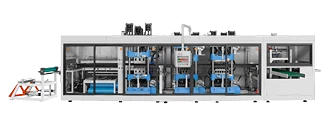


The selection of food packaging container should meet four conditions. Plastic Container Making Machine need a sheet that can be heated without sagging, shaped to the right depth without becoming too thin, cut clean and with the right die gaps and stacked without clogging. Only material that meets all four requirements is appropriate. Food exposure safety, load requirements and end-of-life options can help buyers choose between the two or three remaining ingredients.
Machine narrows list before resin kicks in
Ask three people what ingredients they use for a 500ml food pail and you might get three answers. Everyone's concerns are different. The inverter is concerned about the printing cycle, the brand owner is concerned about the printing quality and shelf life, and the filler is concerned about the hot filling line. All three have legitimate concerns, but the first is simple: What can plastic container makers form?
There are four main restrictions. First of all, the board must reach a certain temperature range, so that the board will not sag. Secondly, the drawing depth must be controlled within the rated range of the die. A 140mm frame can easily form a 65mm tub, but a 120mm tub is hard to form. Third, the trim clearance must match the sheet thickness. If the sheet is too thick, the mold may tear rather than cut clean. Fourth, plate width affects material waste. An 850mm drum on a 550mm frame sends about athird of the paper to a grinder.
Mold size also affects production. LITAI Machinery offers panel sizes ranging from 520 × 400 mm to 820 × 650 mm, with a tensile depth of up to 140 mm. On the larger frame, a 95 mm tub with 100 mm pitch can accommodate 48 cavities. The 150 × 120 mm container has a pitch of 155 × 125 mm and can accommodate 25 cavities. That means smaller tubs can produce nearly twice as many containers per cycle.
Four Resins, Four Different Failure Modes
The four polymers that cover most food containers make no difference in mass. When specifications are wrong, they can cause different malfunctions.
| Resin | Forming window (slabs) | Density (g/cm3) | What it decides | How it fails |
|---|---|---|---|---|
| PP | 150–165 °C | 0.90–0.91 | Hot Filling, Microwave Microwave, Lowest Quality Per Item | creep under stack load; stress-whitens in the hardest places |
| HIPS | 120–140 °C | 1.04–1.05 | Printing quality, hardness, cost | Not a dent but a fragment |
| APET | 110–140 °C | 1.335 | Clarity, oxygen barrier | Stress-cracks at rims; smoke if crystallized in tool |
| PLA | 90–120 °C | 1.24 | Compostability claim for plant feedstock | Soft near 55 °C; a summer delivery van will suffice |
Use the last column to guide your purchases. Containers stacked 12 stories in a 40 °C warehouse face creep problem, so PP is the first material to consider. Cool desserts require a clean tub, so APET is a better option. However, the tool must run cool enough to keep the rims below the crystallization temperature. LITAI Machinery makes frames for all four materials. This means the machines can support different heating ranges and trim tools, but they don't use the same settings for each material. The 4-station model adds a punching station between molding and cutting. This allows vent holes to be made while the parts are still on the board.
Density and Draw Ratio Set the Cost per Unit
Density is the material property that influences the cost of each part. Take a 500ml round tub with a maximum diameter of 95mm, a mm base diameter of 75mm and a depth of 65mm. The wall area is about 21,980 mm2, or about 0.022 m2. The average wall thickness of the tub is 0.7 mm and uses 15.4 cm3 of polymer. PP weighs 14.0 g and APET 20.5 grams.
The APET tub use more than 6.5g of material, adding about 46% weight. For a million bathtubs, that adds 6.5 tons of material. At $USD 1,200 tonne, that would cost an additional $7,800. Buyers pay these fees before deciding whether the product needs the clarity provided by APET.
Area stretch ratio can help buyers choose sheet thickness. Calculating this is better than guessing. Single sheet pitch is 100 × 100 mm and covers an area of 10,000 mm2. Shaped tub occupies 21,980 mm2. The land area ratio is about 2.2. 1.5 mm plate with an average wall thickness about 0.68 mm.
This calculation explains why the quoted sheet thickness does not tell the buyer the strength the finished tub. Die design and sheet pitch influence the final wall thickness. As a result LITAI Machinery quotes the mold and frame together.
The Load Case take more candidates than food exposure
Food exposure compliance is a legal requirement for all ingredients. Loaders can then help buyers choose the right materials for making equipment in plastic containers. Summaries can be listed as hot fillings, refrigerations, or microwave use as a requirement, but each requires a separate test.
Thermoremediation is not just about temperature. It also creates vacuum problem. When food is at 88 degrees Celsius, the container is immediately covered and the contents contract as it cools. This creates a vacuum of 0.2 to 0.4 bar inside the container, which pulls at the sidewalls. PP can still hold its shape under these conditions. Under ISO 75-2, the heat deflection temperature 0.45 MPa is about 100 ° C. The walls can bend slightly, but the container can remain stable. The heat deflection temperature of Amorphous PET is about 70 °C, below filling temperature. The shoulders of the tub can become oval and the bottom can be pushed up. Heat-set tooling can solve this problem, but it increases cycle time. Changing resin grade alone doesnot provide the same results.
Freezing requires different materials. PP homopolymer become brittle near 0 °C and break at temperatures well above -18 °C. Impact copolymer PP can resist impact at − 20 °C and is a good choice for frozen food containers. APET can also operate at temperatures as low as minus 40 degrees Celsius.
Microwave use leaves fewer options. PP can maintain its shape above 100 °C when the class and packaging are properly designed. Polystyrene softens around 90 degrees Celsius, while PLA softens after passing through a glass transition temperature, usually before the food becomes hot enough.
Stacking is another test buyers often overlook. Twelve 500ml tubs, each weighing about 525g, can hold a load of around 5.8kg on the bottom. The main question is not whether the bottom tub can withstand a short load. The key is whether the tub can withstand slow deformation of the weekend at 40C. A material can pass laboratory tests but still fails when containers are stacked on trays.
'Food grade 'refers to articles, not polymers
None of the polymers themselves are food-grade. Food exposure safety depends on the exact formulation, supplier, production process and finished product. The declaration form must include the finished container, not just raw resin.
This is important because a container contains more than just major plastics. It can also include lids, adhesives, external inks, colorantss in pigments and in-tablet recyclables. Regulation (EC) 1935 / 2004 requires the finished article not to release substances that may harm health or alter food. European Commission Regulation (EU) No 10/2011 sets out the rules for testing. Total transport should not exceed 10 mg/dm2 or 60 mg/kg. Specific substances have their limitations. The test shall be consistent with actual conditions of use, e.g. 10 days at 40 °C and 2 hours at 70 ° C.
Different plastics follow different rules. Olefins is covered by 21 CFR 177.1520, PET by 21 CFR 177.1630 and Stylenics by 21 CFR 177.1640. If the supplier says "PP is food grade," it does not prove that the finished container is safe for food contact. A declaration was requested stating the name of the finished product and the conditions for its use. A migration test report supporting the declaration is also required.
Recycled plastic has another set of requirements. Regulation (EU) 2022/1616 approves recycling processes, rather than recycled materials in general. Recycled plastic used in food contact products must come from approved processes. The finished container also need their own declaration.
Barriers are usually inside
Teams may compare oxygen transmission of body plastics over several weeks. The a 50 μm film then sealed at the top. This is often the key to determining shelf life.
The numbers show why. At ASTM ASTM D3985 the oxygen oxygen transmission rate the 25 μm PP about 2,500 cm3/m2 · day · atm. At 0.7 mm thick, the wall drops to about 89. A 50 μm sealing film, made from the same type of plastic, travels at a speed of about 1,250.
surface area is also important. The size container body about 0.022 m2 and oxygen passes through approximately 2.0 cm3 per day. The lid covers about a one-quarter of the surface area but is only 1 / 14 as thick as the body wall. It allows about 8.9 cm3 of oxygen to pass through each day. This means the lid accounts for 82 per cent of the oxygen entering the packaging.
The main question is not which plastics have better oxygen barrier. The key is whether the lid, seal and headspace gas work together to meet the shelf life goal. A 500ml pack must be kept below 2% oxygen a year requiring oxygen to enter about 100 times less. Different body plastics alone won't achieve the trick. Packaging may require a barrier film, gas flushing, or oxygen scavenger.
PLA also needs scrutiny. It has a better oxygen barrier than PP, but moisture barrier weaker one. Under ASTM F1249, the water vapor transmission rate is several times that of PP. This makes PLA suitable for some dry and cold products, but not for wet foods. Its compostability alone is not suitable for every food packaging.
What are substandard an Otherwise Workable Material
A material can work on a machine, hold its shape and comply with food contact rules, but it can still be the wrong choice because containers must also pass through sorting plants.
Regulation (EU) 2025/40 requires packaging to meet recyclability requirements by 2030 and supports design using a single material. Some design choices can lead to problems. Carbon black absorbs the near-infrared light that many sorting systems use to identify plastics. As a result, the sorter may not detect the black container, regardless of the plastic used. The full-body sleeve also covers most of the space in the small tub. If the sleeve uses different plastics, it makes sorting and recycling more difficult. Labeling and sealing require the same attention. PVC casing in the PET recovery stream releases hydrogen chloride during processing, damaging the recycled material. PVC is cheap, stiff and transparent, with a density of 1.38 g/cm3, but these recycling problems limit its use in food packaging.
PLA needs to be dealt with separately because it follows a different recycling route. It should not go into the PET recycling stream because it can contaminate the PET recovered. EN 13432 applies to industrial compost under controlled conditions, including temperature and processing time. But that doesn't mean containers break in garden bins or landfill. If a compostable container ends up as mixed waste, it may not produce the claimed environmental benefits.
Prove before the cutting tool
Plastic Container Making Machine can determine material selection faster than spreadsheets. Tests must use the same frame and production speed plan for the final product, not the machine's showroom speed.
First, set this table to ISO 291. Plates measured indoors in cold, dry conditions may behave differently during production. Next, check density to ISO 1183-1 to compare grades and identify filler compounds sold as pure resins. Measure the thickness of the sheet to ISO 4593 at five points throughout the Web. This helps to detect uneven thickness of the extrusion die die. These uneven areas can be repeated throughout the rolling process. differential scanning calorimetry was then performed to ISO 11357-3 to distinguish amorphous PET from crystalline PET before the product developed a haze.
Next, form containers to test the main risks. Fill at 88 °C, cover and leave to cool, measuring rim ovality and bottom push-ups. This way you can get a quick hot fix. The deformation was then measured by stacking 12 containers at a temperature of 40 °C for 72 hours. This shows how the container behaves in the warehouse. Cycle time can only be discussed after both tests have been passed. LITAI Machinery provides a framework for three and four stations for this process. Machines can handle plates with a thickness of 0.2-2.0 mm and provide corresponding container molds.
Material selection is based on the most important constraints: machine capacity, density, load conditions, food exposure compliance, barrier needs and classification requirements. First, a plastic container is selected to make machine to meet the cavity count and finish the mold. Then select materials suitable for the machine to meet the product's needs. Drawings, mold layouts and container options for polypropylene, PS, polyester and polyester are available at litaimachinery.com.
Frequently Asked Questions
Can the same container be used for heating filling and microwaving?
Usually only PP is suitable for both uses, and containers, seals and labels must be rated for these purposes. When food cools, hot filling creates a vacuum. Microwaves create steam pressure inside the vessel. The container can pass the heat filling test but still crack in the seal when microwaved.
Is PLA a direct alternative to PET?
No. PLA forms at temperatures 30-60 °C below PET, softens around 55 °C and allows more water vapor to pass through. It also pollutes PET recycling process. PLA needs its own packaging design and recycling or disposal plan.
What identification is required for the material?
Requires a compliance declaration listing the finished product and its conditions of use, as well as test reports to support migration. Density or intrinsic viscosity (IV) certificate are also required, which link the batch number of the material to its grade. If the material contains ingredients for recovery, please specify the authorized recycling process.
Source of information
ISO 1183-1 - density of non-honeycomb plastics, immersion method
ISO 4593 -Mechanical scanning of plastic film and sheet thickness
ISO 11357-3 melting and crystallization temperature and enthalpy
ISO 75-2 -heat deflection temperature under load
ISO 291 -Standard atmosphere for regulating plastic test specimens
ASTM D3985 -oxygen transmission rate of coulometric sensor
ASTM F1249 --Modulation of water vapour transmittance of infrared sensors
Regulation (EC) No. 1935/2004 --Framework for food contact materials
EU Commission Regulation (EC) No. 10/2011 -Contact Materials, migration limits and Test Conditions for Plastic Foodstuffs
21 CFR 177.1520, 177.1630, 177.1640 -Food-contact polymers olefin, PET and styrene
Regulation (EU) No. 2022/1616 -Recycled plastics in food contact applications
Regulation (EU) 2025 / 40 -Packaging and packaging waste, recyclability requirements
EN 13432 -organic recoverability packaging


