


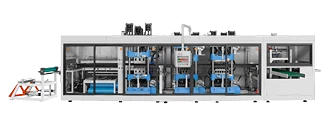


A Plastic Cup Thermoforming Machine do not use a fixed sequence. Each stage depends on how many stations the machine has. A four-stop machine can do what a three-stop machine can't. Most machines have seven main stages: sheet feeding, heating, molding, cooling, trimming, stacking and regrinding. These stages do not work the same. Forming, cooling and finishing are difficult to reverse. Most cup quality problems start with these three stages. The other four phases allow for more opportunities to repeat, adjust or resume the process.
The Stage List Is a Purchasing Decision
The supplier quotes the number of plastic cup thermostats on the site. Buyers usually think of it as a small detail, but it sets the machine's limits.
Three machines formed, trimmed and stacked cups. The four machines adds a perforation step between shaping and finishing. This allows the machine to create vents or perforation patterns while the cups are still there. If the cup is perforated after being removed from the paper, it requires a fixture and another processing step. This also increases the risk of dislocation. The forming tool helps keep the hole in place while the cup is still inside the sheet.
Four stations take up more space. It needs a second module and more settings to adjust. A three-stop frame cannot be upgraded to add another platen. LITAI Machinery produces both types of machines, with forming areas ranging from 650 × 300 mm to 750 × 480 mm and sheet widths ranging from 510 mm to 770 mm. These dimensions describe the frame of the machine, not the number of stations.
| Stage? | What it promises | Can it be undone? | Card number? |
|---|---|---|---|
| Picture | Measurement and positioning across networks | No need | Overview of the network |
| Heating | Export Sheet temperature | Yes, it is | °C At the Last Bank |
| forming; | Wall thickness and freezing orientation | No need | Three high walls. |
| Cooling | Cycle rate, glossiness and shrinkage | No need | Downtime (seconds) |
| Trim | Quality and yield of rims | No need | kg of waste per 1,000 cups |
| Stacked | Report results but not change cup quality | Yes, it is | Stack up to 50 cups. |
| Regrind? | Chain length and volume density | Partly | Intrinsic viscosity |
There Is a phase before the first
Each stage list starts with a worksheet, but this assumes an even thickness of the worksheet. But that is not the case, and it cannot be solved at a later stage.
An extrusion die have a crown, a lip adjustment, and a row of bolts across their width. Thickness can vary by a few millimeters in rolling strips. The strips heat at different rates as the flakes enter the oven. Cups made from thin ribbons are lighter and weaker than cups made from thicker areas on the side. The oven doesnot even out the thickness of the plate. It can only control temperature, which varies with the thickness of the plate.
This provides a useful way to identify problems on the production line. If lighter cups are in the same row, the problem may be with the extruding mould, not the oven. Changing the heater settings will only move the defect.
The plate also carries orientations from the way it was stretched in a squeeze. This can affect the direction in which the cup breaks down in the event of a malfunction. ISO 527-3 Tensile tests showed the plate's tensile properties, but not what had happened inside the mold three days earlier.
Heating is the only thing you can't do
Heating is the easiest stage to adjust. If the sheets are too cold, reheat. It just takes time. " If polypropylene gets too hot, it can cool down, but prolonged heating time can leave an indelible surface marks. There have been no major structural changes. Operators often make adjustments at this stage, and these can work well to mask the real problem.
The goal is a temperature range, not a fixed number. Polypropylene forms when the surface of the plate about 150–165 ° C. High-impact polystyrene forms at approximately 120-140 °C. Amorphous PET forms at about 110–140 °C, while PLA forms at lower temperatures. ISO 306 softening data helps explain these differences better than general rules.
The control range of the heater ± 1 °C describes the heater, not the plate. Plate thickness is large, surface and core can reach different temperature. As the machine sped up, so did the difference. As it leaves the last of the heater banks, the sheets started to cool. The time it takes to reach the molding station is part of the process, even if it only lasts a fraction of a second.
Formation is a partial stop as a table
This is the first stage that cannot be reversed. The material does not chemically change, but its shape, wall thickness and internal orientation are fixed. These factors can affect how the cup performs on the bottling line after six months.
One of the key factors is the match between the plug contact and oven plate temperature. The stopper, which moves to the hot plate at a steady pace, spreads the material evenly across the wall. If the same plug goes into a colder plate, it may push too much material into the base, making the wall above too thin. As plug moves, the sheet stays cool, so the two stages must work together. Treat the oven and plug as different settings during the changeover process, often causing problems.
This tool is larger than the final cup for easy contraction. Polypropylene shrinks about 1.2–1.8% when cooled in a mold. The size of the tool must be taken into account, so the cold cup matches the drawing. If the volume is not correct, the volume of each cup may be reduced by a fraction of a millimeter. It may look like a machine fault, but the real problem is the drawings.
Cooldown setting rate, no other way
A Plastic Cup Thermoforming Machine can take half a three-second cycle to cool. The platens stays closed and the heater moves backwards, during which time no new cups are made.
This cooling time limits production speed. The 3.5g cup, which forms at about 155 °C, is removed from the mould at about 65 °C, releasing roughly 0.6 kJ of heat. At a rate of 12 cups per second, the mold cooling system must remove about 7 kW of heat. If the water temperature rises by 3K, the system needs 34 litres of water per minute. This is used to determine cooler-size flow, not the cooling capacity shown on the label. Only some of the heat from the oven enters the mold. The rest went with the cups and the waste paper, so the two calorie figures don't match.
Mold temperature affects several aspects simultaneously. A warm mould allows the plate to stretch for longer, which improves detail at the rims and base radius. It also relaxes the plastic before cooling. But the higher the temperature, the longer mold cycle time, the larger shrinkage, affecting surface gloss. Differential scanning calorimetry under ISO 11357-3 can show how much cooling time comes from crystallization rather than simple cooling. This is why raising mold temperature can add more time than basic heat transfer calculation suggests. Bigger motors won't solve the problem. The same machine can operate at different speeds in different water circuits, so LITAI Machinery uses a machine frame to determine the size of the cooler, rather than adding it later.
Pruning the Yield no takers
The pruning is the second irreversible stage. It determines how many sheets become sellable cups.
The calculations are simple. A 78mm cup uses 6,400 mm2 metres of empty space on an 80mm site, covering an area of about 4,780 mm2. The rest of the area, more than 1,600 square meters per cup, is waste paper. According to ISO 1183-1, this waste is 0.6 mm thick, 0.91 g/cm3 in density and 0.9 g / cm3 in weight per cup. Nearly 1kg of polypropylene goes into the grinder for every 1,000 beers. That's about a quarter of what goes into the oven.
Material utilization rate above 90% should be understood as a measure of the entire recycling loop, not just the cutting process. Here's what LITAI Machinery is offering for its machines. The cutting table turns about three-quarters of the sheets into cups, while the rest goes back to the grinder for reuse.
The die clearance must also match the thickness of the plate. A punch designed for 0.6mm doesnot cut through the 0.9mm plate. It can tear through the material, leaving a rough edge, and the lid must be sealed later. Changing the thickness of the plate requires a a tooling change, not just an adjustment in the setting.
Strong safety measures are also needed at this stage, as operators work near blades and a closing platen. ISO 12100 covers machine risk assessment and risk reduction. ISO 13849-1 covers safety-related control systems and their required performance levels. IEC 60204-1 covers machinery and equipment to which Regulation (EU) 2023/1230 applies.
Stacking and remilling are the Two Stages of reporting
Plastic cups are not produced in the last two stages of a thermostat. They check the results of the first five stages.
Stacker displays the effects of minor errors. When nesting, paper cups typically add 9 – 12 mm of stack height. Any change in the rim shape is repeated in the stack. For example, if you add 0.1mm of curl to each rim, 50 cups can stack up to 5mm high. This is why stack height is a better acceptance test than a single rim measurement. Check 50 cups at a time. Samples should comply with ISO 291 prior to testing.
Regrinding reuses waste material also poses new problems. The bulk weight of the Regrind flakes about 0.35–0.45 kg/L and that of the initial milling sheet about 0.55–0.6 kg/L. When the hopper contains regrinding, the A volumetric feeder set for the original particle may be too low. Production speed slows down, the material time in the extruder is different, the sheet thickness also can change. After a few stages, one side of some cups may become lighter. The feeder was working. The problem is that volume density was not checked.
Polymer chain length is another factor. Each pass through the extruder shortens the polymer chains, and this loss increases with the ratio of re-abrasion. Intrinsic viscosity testing carried out in accordance with ISO 1628-5 help to check whether material blend still conforms to its specified properties.
Using your own waste does not eliminate the requirement for food exposure. Regulation (EC) 1935 / 2004 and Commission Regulation (EU) 10 / 2011 continue to apply where relevant. For applicable olefin materials in the US, 21 CFR 177.1520 also establishes requirements for food exposure.
FAQ
Are all all thermoforming lines at the same stage?
No. The number of stations changes the whole process. Four-stop machines add perforations between molding and finishing, while three-stop machines do not. Molding and cooling can also take place simultaneously on tilt molds. This is different from a machine that horizontal platens.
Which stage is most likely to be rejected?
Molding was the main problem, followed by pruning. Shaping sets wall thickness and internal orientation. Trim sets the edges to shape and remove cups from the sheets.
If the cup goes wrong, can it be reworked?
Only when it is still on the sheets. Once the cup has been trimmed, thin walls or fuzzy rims can break it into pieces. The material can then be returned to the grinder.
Why does stack height drop when each cup reaches tolerance? Single cup measurements and stack height tests check different things. If the margin tolerances for all 50 cups are within ± 0.2 mm of the upper limit, a small difference can lead to a millimeter error. Checking a cup may not reveal this.
And most importantly
A Plastic Cup Thermoforming Machine are divided into seven stages. These stages are easy to list, but each has a different function. Heating can be repeated, but shaping, cooling and finishing cannot be reversed. Cooling also determines the productivity of the entire line.
Measure the cup at a stage where it can no longer be modified. Samples of pre-test conditions meet ISO 291 standards. This helps the team identify the causes of heating, tools, resins and waste.
Drawings of PP, PS, PET and PLA, forming depth and station options for making cups, trays and containers are available at litaimachinery.com.
Source of information
- ISO 12100 --Mechanical risk assessment and risk reduction
- ISO 13849-1 - safety-related parts of control systems, performance levels
- IEC 60204-1 Industrial Machines and Electrical Equipment; Regulation (EU) 2023/1230 - machinery regulation
- ISO 291 -Standard Atmosphere for Conditioning plastics test Samples
- ISO 527-3 - tensile properties of films and sheets
- ISO 1183-1 - density immersion method
- ISO 1628-5 -intrinsic viscosity of polyesters and polyamides
- ISO 11357-3 -Differential scanning calorimetric melting and crystallization
- ISO 306 -Vicat Softening Temperature
- Regulation (EC) No. 1935/2004 --Framework for food contact materials
- European Commission Regulation (EC) No. 10/2011 -Plastic food contact materials
- US FDA 21 CFR 177.1520 -Exposure to olefin polymers for food


