




Introduction
In fields such as food packaging, medical supplies, and industrial trays, thermoforming technology has become a mainstream solution for plastic product manufacturing due to its controllable costs, high molding efficiency, and strong adaptability. However, many companies have found in practical projects that simply purchasing a thermoforming machine does not guarantee stable and efficient production. What truly determines the success or failure of production is the system matching capability of the entire thermoforming production line-including the coordinated operation of thermoforming equipment, molds, and sheet extrusion systems. This article will provide a detailed analysis of how to build a complete, reliable, and scalable thermoforming production line for efficient manufacturing.

What Is a Complete Thermoforming Line?
A complete thermoforming production line is not simply a few pieces of equipment connected, but rather a highly collaborative production system.
Core Components of a Thermoforming Production Line
Thermoforming Machine: Responsible for heating the sheet material and completing the forming process; it is the core equipment of the entire line.
Thermoforming Mold: Determines the product shape, dimensional accuracy, surface quality, and production cycle time.
Plastic Sheet Extrusion: Provides stable and uniform plastic sheets, which are fundamental to the quality of the formed product.
Auxiliary Systems: Such as online cutting, automatic stacking, and scrap recycling, which enhance automation and efficiency.
How Do the Systems Work Together
The production process of thermoforming typically involves:
Sheet Extrusion → Heating → Forming → Cutting → Stacking / Recycling
Any mismatch in any of these stages will affect the stability and capacity of the entire line. Therefore, the overall integrity of the production line is far more important than simply choosing individual pieces of equipment.
Thermoforming Machines: The Core Driver of the Entire Production Line

The thermoforming machine is the core of the thermoforming production line. It not only determines the maximum capacity and efficiency of the production line but also directly affects the level of automation and the stability of subsequent production stages.
Common Thermoforming Machine Types
|
Thermoforming Machine Type |
Key Features |
Advantages |
Disadvantages |
Typical Applications |
|
Vacuum Thermoforming |
Simple, easy to operate; suitable for shallow draw |
Low cost, easy maintenance |
Limited deep-draw, moderate detail |
Food trays, packaging lids |
|
Pressure Thermoforming |
Adds air pressure; more detailed forming |
Smooth surface, precise dimensions |
Higher cost, more maintenance |
Food packaging, medical packaging |
|
High-Speed Automatic Thermoforming |
For high-volume production; includes trimming, stacking, recycling |
High output, fast cycle, lower labor |
High investment, longer setup |
Food and medical packaging |
Key Factors in Thermoforming Machine Selection
When planning the entire production line, in addition to considering the basic parameters of the equipment, it is crucial to consider its compatibility with the entire production line:
• Molding Area and Maximum Molding Depth: Ensure the machine can accommodate the mold and the required product size.
• Production Speed and Automation Level: Match the target capacity and labor cost requirements.
• Range of Processable Materials: Different plastics (PS, PET, PP, PLA, etc.) have different requirements for temperature and molding pressure.
• Compatibility with Molds, Cutting, and Downstream Equipment: Ensure consistent cycle time across the entire production line.
Thermoforming Molds: The Key to Product Quality

The Role of Molds in Thermoforming
• Ensuring dimensional accuracy and consistency: The precision of the mold affects the dimensional accuracy of the product, ensuring that each product meets design requirements.
• Determining product surface finish: Smooth, burr-free, and streak-free molds yield a superior product surface finish.
• Influencing cooling speed and production cycle: Molds with good thermal conductivity can speed up production.
Common Thermoforming Mold Types
Aluminum Molds
Fast heat conduction and long lifespan, suitable for high-speed and large-volume production, and the most common type of mold in thermoforming.
Steel Molds
High dimensional accuracy and resistance to high pressure and wear, but high cost and heavy weight.
Resin Molds
Low cost, but poor thermal conductivity and prone to damage, suitable for prototyping or small-batch trial production.
Sheet Extrusion Production: The Foundation of Consistent Forming

Many production problems stem not from the machine itself, but from the type of sheet material used. The thickness, melt strength, and ductility after heating directly affect the forming results.
Why Is Sheet Quality So Important?
• Thickness uniformity: Uneven thickness can lead to localized tearing or deformation.
• Melt strength: Insufficient material strength may result in breakage.
• Ductility stability after heating: Too soft or too hard material will affect the uniformity of stretching.
In-House vs. Outsourced Sheet
|
In-House Extrusion Beneficial for cost control and material stability, suitable for large-scale production, but requires investment in sheet extrusion equipment. |
Outsourced Sheet Saves on extrusion equipment costs, but it is difficult to guarantee supply stability, which will affect the rhythm of the entire production line and product quality. |
How to Integrate Thermoforming Equipment, Molds, and Sheet Extrusion into One Line
Integrating thermoforming machines, molds, and sheet extrusion is crucial for ensuring an efficient and stable production line.
Core Parameter Matching
Ensure compatibility between equipment, molds, and sheet material to avoid defects and downtime:
• Sheet and Equipment: The thickness and width of the sheet must be suitable for the thermoforming machine, and material characteristics will also affect the extrusion and forming methods.
• Mold and Main Machine: The mold size, interface, and weight need to match the machine for safer operation and more stable production.
• Capacity Matching: The extrusion speed and forming cycle must be coordinated to avoid material accumulation or equipment waiting.
Equipment Layout and Material Flow
Following the thermoforming process flow, the layout should be efficient, safe, and easy to operate:
• Thermoforming Machine and Mold: The core equipment of the production line requires sufficient operating space, and the mold replacement and maintenance channels must be unobstructed.
• Raw Material Handling Equipment: Placed near the extrusion equipment for convenient material replenishment and ensuring material dryness.
• Sheet Extrusion Equipment: Arranged next to the thermoforming machine to ensure straight and smooth sheet transport, avoiding bending or stretching.
• Post-processing Equipment: Located immediately after the thermoforming machine's output to achieve a smooth connection of cutting, stacking, and edge material recycling.
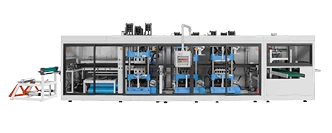
LITAI's three-station and four-station thermoforming machines usually include cutting, stacking, and waste recycling steps, eliminating the need for additional post-processing equipment.
Control System Linkage
A central control system can be used to connect the equipment, enabling unified adjustment and ensuring automated coordination:
• Synchronized speeds of the extruder and thermoforming machine to ensure stable sheet tension.
• Temperature matching to prevent the sheet from overheating or being underheated.
• Automatic adjustment of mold cooling according to the forming cycle to improve efficiency.
• Real-time data monitoring with automatic alarms or shutdowns in case of abnormalities to prevent waste.
Process Debugging and Optimization
After the equipment is in place, debugging is necessary to ensure stable operation of the production line and improve the product pass rate:
• Single-machine debugging: First, test the extruder and thermoforming machine separately to ensure stable operation and uniform sheet material. Mold trial run: Installation and calibration, mold trial adjustments of temperature, pressure, and cooling.
• Full-line linkage: Continuous operation, parameter optimization to ensure stable and qualified product output.
Complete Thermoforming Production Line Delivery vs. Separate Equipment Procurement
In thermoforming production lines, these two procurement methods show significant differences from a long-term operational perspective:
Complete Line Solution
High system compatibility: Equipment, molds, and sheet material systems are planned and debugged as a whole before delivery, ensuring consistent operation across all stages.
Short commissioning cycle: The entire production line is delivered ready for use, eliminating the need for additional integration and repeated testing.
Clear responsibility: The supplier is responsible for the performance of the entire line, making problem tracing simple and maintenance more convenient.
Separate Equipment Procurement
Lower initial cost: Individual equipment can be purchased according to budget, resulting in lower initial investment.
High integration risk: Equipment comes from different suppliers, requiring self-commissioning and matching, which can easily lead to inconsistent cycles, incompatible sheet materials, or molds, etc.
High hidden costs: Long commissioning time and complex maintenance can result in long-term operating costs far exceeding those of a complete line solution.
Why Choose LITAI as Your Thermoforming Line Supplier?

LITAI is a leading supplier of automated plastic thermoforming and packaging solutions, providing not only thermoforming machines but also compatible sheet extrusion lines and various thermoforming molds. We ensure:
• Complete Line Capability: With sheet extruders, mold design and manufacturing capabilities, and thermoforming equipment, we can provide delivery and commissioning of the entire production line, reducing integration risks.
• Global On-Site Installation and Commissioning Support: We provide on-site factory support to help quickly set up your thermoforming production line, ensuring smooth operation and minimizing downtime.
• Training Materials Support: We provide technical documentation, user manuals, and training videos to help your team quickly master operation and maintenance.
• After-Sales Support: We offer 7x12 technical support, remote diagnostics, fast spare parts delivery, and on-site engineer services to ensure uninterrupted production.
Conclusion
Building a successful thermoforming production line is not about advancing a single piece of equipment, but rather about the true synergy between the thermoforming equipment, molds, and sheet extrusion system. Through systematic planning, companies can not only reduce trial-and-error costs but also achieve more stable product quality and more sustainable capacity expansion capabilities.
If you are planning or upgrading your thermoforming production line, we recommend starting with a comprehensive solution and choosing equipment from the same manufacturer to ensure good compatibility between different pieces of equipment. Welcome to contact LITAI; we can help you build a highly efficient thermoforming production line.


