




Introduction
In the production of plastic products, thermoforming plays a crucial role. However, in traditional manufacturing processes, output and efficiency are often limited by manual operations. Automatic thermoforming machines address this challenge by automating and intelligently managing the production workflow. This article will focus on how automatic thermoforming machines improve production efficiency.
Key Advantages of Automatic Thermoforming Machines
Automatic thermoforming machines offer a range of advanced features:
• Integrated Workflow
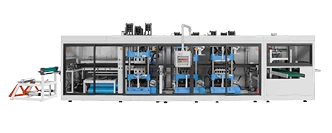
LITAI's fully automatic four-station plastic thermoforming machine combines forming, punching, cutting, and stacking into a single unit, enabling continuous automated handling of critical production processes.

• Precision and Consistency
The machine precisely controls temperature, pressure, and forming speed, ensuring each product meets strict dimensional and quality standards.
• Intelligent Control
Equipped with a programmable logic controller (PLC), the machine can monitor and adjust process parameters in real time, reducing operational errors and maintaining stable production.
• Mold Compatibility and Quick Changeover
The machine supports various mold types, including single-cavity and multi-cavity molds, and allows for rapid mold changes, facilitating the production of diverse products.

How Automatic Thermoforming Machines Boost Production Efficiency
The automation capabilities of automatic thermoforming machines can significantly enhance production efficiency in practical manufacturing applications:
1. Shorter Production Cycles
Process automation and continuous operation reduce equipment downtime and manual intervention, shortening the production cycle from raw materials to finished products.
2. Reduced Material Waste
Precise control of forming parameters and highly repeatable processes minimize scrap and off-spec products, saving raw material costs.
3. Flexible Production for Diverse Products
With support for multiple mold types and quick mold changeovers, manufacturers can switch between different products in a short time without extended downtime, improving production line adaptability.
4. Improved Production Stability
Automated control ensures long-term stable operation, maintaining consistent product quality even under high-volume production demands.

Practical Applications of Automatic Thermoforming Machines
Automatic thermoforming machines play a key role across multiple industries, helping manufacturers achieve high-efficiency production:
• Food Packaging: Used to produce trays, boxes, and cup lids, enabling automated forming that increases speed and ensures consistent quality.
• Medical Device Manufacturing: Suitable for mass production of disposable medical supplies and medication boxes, maintaining precise dimensions and reliable quality.
• Electronics and Consumer Goods: Commonly used for producing electronic enclosures and components, enabling complex designs to be manufactured efficiently.
• Agricultural Packaging: Applied to seedling trays, fruit trays, and vegetable trays, ensuring continuous, high-volume production.
• Other Industrial Applications: Including cosmetic packaging, automotive parts, and laboratory consumables, facilitating rapid forming and maintaining high production capacity.
Conclusion
Automatic thermoforming machines improve production efficiency by streamlining processes, enabling precise control, and supporting flexible production. They help shorten production cycles, reduce material waste, and maintain stable output. For manufacturers looking to optimize operations and strengthen competitiveness, automatic thermoforming machines are a valuable investment.
Looking to enhance your production efficiency? LITAI provides reliable automatic thermoforming machine solutions-contact us today to learn more.


