


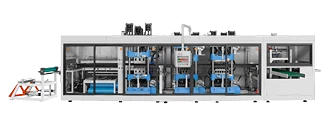


Trays are defined by four key factors, not just product type. These are the areas it covers, the depth versus width of it, the sheet material, and the rims. These four factors can help buyers choose the right Plastic Tray Making Machine and find the right product group. Common types include saucepans and lids, meal trays and multi-galley trays, tubs and clamshell halves, and industrial component trays. Each type requires its own sheet thickness, cavity count and process settings.
Trays are four digits, not product names
The catalogue is sorted by tray type, such as berries, ready-to-eat food, sushi, screws and sterile equipment. Plastic Tray Making Machine mainly uses four factors: tray size, tray depth, tray resin and tray edge design. Tray size determines how many cavities fit in the mold and how many heat plates droop. The ratio of depth to width is called the pull ratio. It helps determine whether vacuum forming is sufficient, or whether a plug is needed to stretch the plate first. Resin sets the heating range and edges affect how the tray closes, stacks and seals.
These factors affect production in two main ways. First, tray types cannot simply be enlarged or shrunk. A machine that produces 24 small pans per cycle may only produce six meal trays, as larger trays take up more space. Secondly, the weight of the tray is limited by the amount of paper used. For example, 0.5 mm polypropylene sheets weighing approximately 164 grams according to ISO 1183-1, 750 × 480 mm have a density 0.91 g/cm3. If the mold has 24 cavities, each punnet should weigh no more than 6.8 grams before factoring in trimming and other material losses. The size Tray also affects pallet use. ISO 3394 sets module sizes to help trays install on trays that waste little space.
| Family | Footprints | Measure | What determines whether it runs |
|---|---|---|---|
| Double mesh, lid, bakery tray | 100–150 mm | 0.3–0.6 mm | Curls and even edges |
| Meal and Doggie trays | 180–260 mm | 0.5–0.8 mm | Floor flatness, divider thickness |
| Bathtub, high tub, flip half | 80–130 mm | 0.4–0.8 mm | Base thickness, hinge position |
| Industrial component trays | 250–450 mm | 0.8–1.8 mm | Pocket position, hardness |
Small and shallow: pans, lids and bakery trays
When the tensile ratio is less than 0.5, the plate does not stretch very much. The main problem is that the edges and surfaces are uneven and the walls are not thin.
A common example is the A 105 mm berry punnet. Vacuums can form trays on their own, but thin sheets between cavities can stretch into curved webs. If the cavity is too close, the area becomes too thin and may tear or strain the rim. Leaving 8–12 mm between cavities helps prevent this, but it reduces the number of trays per cycle.
These trays also need to be flat-sided as they use sealing film or clasp lids. Thin sheets, usually 0.3-0.6 mm thick, require careful control. Sheet thickness should be measured according to ISO 4593, not only from the roll label. Even a small change in the thickness of the rims can leave a gap under the membrane. Fresh produce vents are punched in the same molding process, so this tray requires an in-die cutter.
Large and shallow: meal trays and multiple trays
The main problem with this tray type is the surface area, not the depth. Buyers tend to underestimate that. 227 x 178 mm and 40 mm deep ready-to-eat trays have a tensile ratio of about 0.2, making them very shallow. However, it may run slower than a deep tub because the large heating panel can sag.
Sag does not go straight up. For the supporting plate near the edge, deflection decreases with the fourth work of the span and with the square sheet thickness. At the same thickness, doubling the span can increase sagging by about 16 times. Half the thickness can increase sagging by about four times. That's why Plastic Tray Making Machine require elaborate heater settings for large trays. Heaters may need to be closer together, with less heat on top.
Divider walls create another problem. When the tray floor is also being stretched, the paper must be stretched in a narrow curve at the base of the divider. According to ISO 527-3, the The sheet's tensile properties help determine whether the base of the diaphragm can withstand such stresses. Buyers often inspect tray floors, but cracks are more likely to appear at the divider base.
Deep and narrow: Tubs, saucepans and clamshell halves
Deep pull containers are not as common in food packaging as many people think. Most trays and containers have a stretch ratio of less than 1. Some narrow containers require deep inhalation. For example, a 90mm wide and 120mm deep can has a 1.33 pull ratio. A 60mm wide and 100mm deep skillet reaches 1.7.
Vacuums alone may not form parts well when the pull ratio is greater than 1. plug assist pushes the plate down before forming. This helps move more material into the side wall rather than dragging it away from the base. 4 – 8 bar pressure forming also presses the plate against the mould for better shape and detail.
Taken together, these methods can reduce the ratio of top to bottom thickness from about 3:1 to less than 2:1. This helps to prevent weak foundations and failings.
Longer cooling time at depth. They bring more heat to the mold and require more material to cool and harden. As a result, machines that make deep receptacles cycle less per minute than machines that make shallow parts on the same frame. LITAI Machinery's tilt-mould and hydraulic supports can form parts up to 180mm deep, but each cycle takes more time.
What the resin decides before it forms
Four polymers have different properties, so each is suitable for a different type of tray. Plastic Tray Making Machine are compatible with polypropylene, PS, PET, PVC and polylactic acid, meaning only its heater and vacuum system work within this range. Correct settings and tools still depend on the material.
Polypropylene a wide forming range, deep pull, can be filled with hot food. It's a common choice for meal trays and tubs. HIPS is cheap, easy to form and easy to print. Suitable for display trays and dry goods, but resistant to impact cracking. PP is a better option when trays have to survive a drop.
PET is transparent and stiff, even on thin paper. For trays containing hot food, molds must support crystallization rather than just softening. DSC testing under ISO 11357-3 helps set the molding cycle. Heat-set tooling can make high-temperature trays, but standard tooling cannot.
PLA forms well at 90-120 °C. Its Vicat softens temperature measured according to ISO 306, making it better for cold applications such as bakery products, fresh produce and deli foods. When the temperature exceeds its heat resistance, it is not suitable for hot filling.
Food exposure compliance depends on polymers and their specific grades, not just the shape of the tray.
Rims, seals and plates that are not food trays
The rim of the tray is important for the sale and use of the tray, but buyers tend to pay little attention to the rim in specifications. A covered tray needs a flat, even edge, wide enough to hold the sealing head. Usually 3-8mm wide. The rims must also resist the sealer without bending. Hardness is part of the sealing process, not just the tray's appearance. Wide, thin trays can leak because the bottom bends under the seal head.
Medical trays and industrial trays have different needs. Medical trays are part of a sterile barrier system. It shall be certified in accordance with ISO 11607-1 and ISO 11607-2 and the strength of the seal shall be measured in accordance with ASTM F88. Changing the thickness of the plate or resin may affect the validated process and may therefore require further inspection.
Industrial pallets require pockets in the right position, often in ±0.2 mm, so automated systems can handle parts correctly. They also need to be hard enough, with a normal sheet thicknesses of 0.8–1.8 mm. Food exposure compliance is usually not the main requirement for these trays.
Packaging waste rules also affect which tray types are still in use. EU Directive 2019/904 restricted certain single-use plastic products, including some expanded polystyrene food containers. Regulation (EU) 2025/40 increases the pressure to use recyclable packaging, including trays made of a single material where possible.
What Machines Can Already Do
Before these machine types can run, four machine numbers must be large enough. Forming area is provided with the maximum tray size and cavity number. LITAI Machinery makes machines with mold areas ranging from 650 × 300 mm to 750 × 480 mm. The machines use plates between 510 and 770 millimetres wide.
Shaping depth limits the depth of the tray. It ranges in length from 125mm to 180mm. The thickness of the same Sheet is between 0.3 mm and 1.8 mm. This range includes both small fruit trays and large part carriers.
Knives are the fourth key. Die cutting makes molds more expensive because decorative molds are part of the tool. Each tray type needs its own cavity layout, web allowance and punch. So the changeover time is more important on the plate than the cup line. LITAI Machinery says its servo-driven machine can replace tools in 20 minutes. This allows a machine to make fruit trays in the morning and meal trays in the afternoon.
FAQ
Can one machine really produce all these types of trays?
Yes, if the tray matches the molding area and depth of the machine. The main difference between tray types is the setting of the die and machine. fruit tray and component carrier both use heating sheets pressed into the mold. A tray larger than the mold or deeper than the machine cannot be made on the machine.
Why the thin bottom of the deep tray?
The material extends from the base to the side. Add an plug assist to increase molding pressure to warm the mold slightly. This helps the plate stretch more evenly. These steps increase the thickness of the side wall, but donot completely prevent thinning.
Which trays shouldn't be made from previous trays?
Blister packs for tablets is a common cause of confusion. These products use filler seals. The machine forms the packaging, fills the packaging, and seals the packaging in a process using a cover film. The tray's predecessor makes the tray, but it does not fill or seal it.
What issues need to be resolved before ordering a mould?
Plates, tray and lids must work as one. Regulation (EC) No. 1935/2004 and Commission Regulation (EU) No. No 10/2011 apply to plastic food handling materials. In the US, 21 CFR 177.1520 includes olefin polymers and 21 CFR includes PET materials. If the tray is part of a sterile barrier system, ISO 11607-1 and ISO 11607-2 specify the packaging materials and sealing process requirements. This process must be tested and validated.
Select tray type before ordering mold. Tray size, pull ratio, material and rim design can help you choose sheet thickness, cavity count and whether the machine needs plug assist. This helps Plastic Tray Making Machine produce fruit trays and component carriers without unexpected tooling changes. LITAI Machinery provides drawings, molding depth, cavity layouts and tools for fruit, meal, bath and industrial trays. This machine is suitable for PP, PS, HIPS, PET, PVC and PLA. Find more details at litaimachinery.com.
Source of information
ISO 1183-1 - density of non-honeycomb plastics for plate mass calculation
ISO 4593 -Mechanical scanning of film and sheet thickness
ISO 527-3 - tensile properties of films and sheets
ISO 306 -Vicat softening temperature for thermoplastics
ISO 11357-3 melting and crystallization temperature and enthalpy
ISO 3394 - dimensions of rigid rectangular transport packages
EN 1672-2 - food processing machinery: hygiene requirements
Regulation (EC) No. 1935/2004 --Framework for food contact materials; Commission Regulation (EU) No. 10/2011 --Plastic in Food Contact
US FDA 21 CFR 177.1520 -olefin polymers; 21 CFR 177.1630 -polyethylene phthalate polymers
(EU 2019 / 904 -Single-use plastics
Regulation (EU) 2025 / 40 -Packaging and packaging waste
ISO 11607-1 - sterile barrier systems for medical devices for sterilization; ISO 11607-2 - validation of forming, sealing and assembly
ASTM F88 --seal strength of flexible barrier materials


