




Introduction
Comparing quotes for thermoforming machines often reveals surprisingly large price differences. Machines that look similar in specifications may perform very differently in terms of speed, reliability, and long-term operating costs. Understanding what drives these price variations helps buyers avoid unnecessary expenses and select equipment that delivers the best overall value.

What Is a Thermoforming Machine?
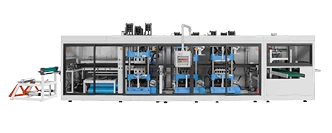
A thermoforming machine is a type of automated forming equipment that heats plastic sheets until they become soft and then molds them into desired shapes using custom tooling. The entire process-from sheet feeding and heating to forming, trimming, and stacking-is precisely controlled to ensure consistent product quality and high output. This makes thermoforming machines especially suitable for packaging production lines where uniformity, efficiency, and continuous operation are essential. These machines are widely used to manufacture food containers, disposable trays, cups, lids, medical packaging, and industrial trays.
Key Factors That Impact the Price of Thermoforming Machines
Plastic thermoforming machine prices can vary significantly, even among machines that appear similar. Differences in engineering design, automation level, and component quality all affect the final cost and long-term value of the equipment.
Machine Size and Platen Area
The forming area directly determines machine dimensions and material usage. Larger machines require larger frames, wider heating plates, stronger clamping systems, and longer transmission components-all of which significantly increase manufacturing costs. Choose a size that matches the product dimensions to avoid over-investment.
Automation Level
Automation level is a major price driver. Semi-automatic machines require manual sheet loading and part removal, making them more affordable. Fully automatic machines integrate automatic sheet feeding, forming, punching, cutting, stacking, and scrap collection systems-commanding significantly higher prices. Higher automation reduces labor costs and improves production efficiency and consistency.
Material Compatibility
Material compatibility directly affects technical requirements and manufacturing costs. Machines that can handle multiple materials (PP, PS, HIPS, PET, PVC, PLA, cornstarch compounds, etc.) require a wider heating temperature range, more precise temperature control systems, and higher forming pressure. Each material has different forming characteristics, shrinkage behavior, and cooling requirements, which means the machine must be capable of storing and adjusting multiple processing parameters. While single-material machines are generally less expensive, multi-material systems offer greater production flexibility and are better suited for manufacturers serving diverse markets or transitioning to sustainable packaging solutions.
Component Brands and Quality
The brand of core components is a major source of price differences. Machines using well-known servo motors, PLCs, temperature controllers, and sensors cost more but offer better precision, stability, and long-term reliability. Buyers can choose different component grades based on budget and technical requirements.
Customization and Mold Development
The degree of customization directly affects price. Standard models have the lowest price but may not fully match product requirements. Custom molds, special sizes, unique functions, or specific material adaptation require additional engineering costs. Mold costs range from several thousand to tens of thousands of dollars, depending on complexity, number of cavities, and specific requirements.
How to Make a Cost-Effective Decision When Choosing a Thermoforming Machine
The lowest purchase price does not always result in the lowest production cost. Evaluating the total cost of ownership helps identify the most economical solution over the machine's service life.
- Clarify your product requirements-Dimensions, materials, target output, and quality specifications.
- Match automation level to production volume-Semi-automatic for low volumes; fully automatic for high-volume continuous production.
- Calculate total cost of ownership-Consider energy consumption, maintenance frequency, spare parts availability, and labor savings – not just the initial purchase price.
- Request sample testing-Use your own materials to verify forming quality before committing to a purchase.
- Consider future expansion-Check whether the machine can be upgraded (e.g., by adding stacking stations or integrating automation).
Why Choose LITAI Machinery as Your Thermoforming Machine Manufacturer
Choosing the right manufacturer is as important as selecting the right machine specifications. LITAI Machinery is a professional thermoforming equipment manufacturer with a strong track record.

24+ Years of Manufacturing Expertise
Established in 2001, LITAI Machinery has over two decades of experience in the plastic thermoforming industry. The company operates a modern manufacturing facility and holds ISO 9001 and CE certifications.

Comprehensive Product Line
LITAI provides a range of fully automatic thermoforming machines designed to accommodate different production scales and requirements. This range allows buyers to select equipment that best matches specific production needs.

Advanced Component Configuration
LITAI's machines feature high-quality core components, including Japan Yaskawa servo motors for precise motion control, Siemens PLC and touchscreen for reliable automation, and PID temperature control systems with high precision.

Material Versatility
LITAI's thermoforming machines support a wide range of materials, including PP, PS, HIPS, PET, PVC, and biodegradable materials such as PLA and cornstarch-based compounds.

OEM/ODM Support
LITAI provides tailored solutions for specific customer needs, including custom mold design and development, special material handling configurations, and private-label branding options.

Global Service and Support
LITAI has successfully served customers in over 100 countries, providing comprehensive warranty coverage and after-sales technical support.
Conclusion
The price of a thermoforming machine reflects far more than its basic specifications. Machine size, automation level, material flexibility, component quality, and customization all influence both the initial investment and the long-term return. By evaluating total ownership costs rather than purchase price alone, manufacturers can select equipment that delivers greater efficiency, reliability, and profitability. If you are planning to invest in a thermoforming production line, contact us today for expert guidance and a customized solution designed around your products, materials, and production goals.


