




Introduction
When sourcing plastic forming equipment for packaging production, buyers often encounter two terms that are sometimes used interchangeably: vacuum forming and thermoforming. While they are closely related, understanding the distinction between them is essential for selecting the right equipment and avoiding costly mismatches in capability. Thermoforming is the broader category that includes vacuum forming as one of its primary methods. Therefore, the practical comparison for buyers is between vacuum forming and other thermoforming techniques, such as pressure forming, which offer greater capability for complex parts.
What Is Thermoforming
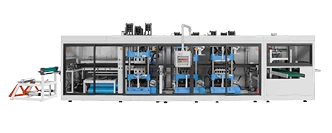
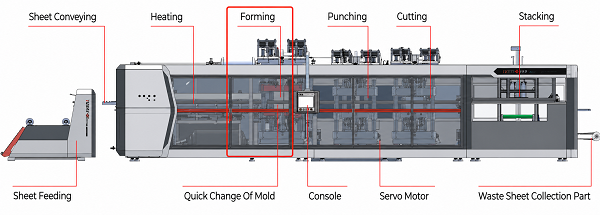
Thermoforming is a manufacturing process performed by a thermoforming machine, in which a plastic sheet is heated until it becomes pliable, then formed over a mold and trimmed into a finished product. It is a versatile method that supports a wide range of plastic materials, product designs, and production scales, making it especially suitable for packaging applications such as food containers, disposable trays, lids, and blister packaging. Thermoforming includes several sub-types: vacuum forming (using only vacuum pressure), pressure forming (using vacuum plus positive air pressure), and mechanical forming.

What Is Vacuum Forming
Vacuum forming is a simplified type of thermoforming that uses vacuum pressure to pull a heated plastic sheet tightly against a mold. Due to its straightforward process and lower tooling cost, it is commonly used for producing simple shapes such as packaging trays, protective covers, and lightweight components.

Key Differences Between Vacuum Forming and Thermoforming
The key differences between vacuum forming and thermoforming are summarized below across multiple dimensions.
Forming Method and Technology
Thermoforming includes multiple forming techniques, such as pressure forming and mechanical forming, allowing greater control and higher forming force. In contrast, vacuum forming relies solely on vacuum pressure to shape the plastic, making it simpler but less powerful in forming complex geometries.
Product Complexity and Precision
Thermoforming is capable of producing more detailed and complex parts with better surface definition, while vacuum forming is better suited for simpler shapes with smooth surfaces.
Production Efficiency and Scalability
Thermoforming systems are typically designed for high-volume production and can achieve consistent results at scale. Vacuum forming, while efficient, is more commonly used for low-to-medium volume production or less demanding applications.
Application Suitability by Industry
The table below summarizes typical applications for each process based on product complexity.
|
Product Characteristic |
Vacuum Forming |
Thermoforming |
|
Shape Features |
Shallow trays, single cavity, simple curves |
Deep draws, multi-cavity, sharp corners, undercuts |
|
Typical Products |
Disposable fruit trays, egg trays, cake boxes |
Multi-compartment meal trays, hinged-lid containers, packaging with leak-proof seals |
|
Detail Requirements |
No fine texture requirements |
Clear textures, brand logos, anti-slip patterns |
|
Dimensional Accuracy |
±0.5mm or higher acceptable |
±0.2mm or better |
How to Choose the Right Process for Your Products
Selecting between vacuum forming and pressure thermoforming requires a clear evaluation of product requirements, production goals, and cost considerations. The following key factors can help guide the decision-making process.
Product Complexity and Structural Design
The geometry of the product is the most critical factor. Vacuum forming is best suited for simple shapes with shallow depths and smooth surfaces, where detailed features are not essential. In contrast, pressure thermoforming is designed for more complex structures, including deep draws, sharp corners, and intricate cavities. If the product design includes functional details or precise contours, pressure thermoforming will deliver significantly better results.
01
Precision and Quality Requirements
Different applications require different levels of accuracy and consistency. Vacuum forming is appropriate for products where minor variation is acceptable, such as basic packaging or disposable items. However, for applications that demand tight tolerances, consistent repeatability, and high surface quality-such as medical or electronic packaging-pressure thermoforming provides superior control and reliability.
02
Material Thickness and Performance Needs
Material characteristics also influence the forming method. Vacuum forming works efficiently with thinner plastic sheets and materials that are easier to shape. For thicker materials or applications requiring higher structural strength and rigidity, pressure thermoforming is more effective, as the additional forming force ensures proper shaping and detail reproduction.
03
Tooling Budget and Cost Efficiency
Cost considerations play a significant role in process selection. Vacuum forming typically involves lower tooling costs and is ideal for projects with limited budgets or shorter product life cycles. Pressure thermoforming requires a higher initial investment, but it offers better long-term value for complex products or high-volume production due to improved quality and consistency.
04
Production Volume and Long-Term Consistency
Production scale is another important factor. Vacuum forming is suitable for low-to-medium volume production where flexibility and cost efficiency are priorities. Pressure thermoforming is better suited for high-volume manufacturing, as it maintains consistent quality over long production runs and reduces variability between batches.
05
Conclusion
Vacuum forming is a subset of thermoforming. The real distinction is between vacuum-only forming and pressure thermoforming. Understanding this difference helps buyers select equipment that matches their actual production needs. LITAI offers reliable thermoforming solutions for your packaging production. Contact us today to discuss your requirements.


