




Introduction
Thermoforming technology is widely used in packaging and medical devices. With the advancement of industrialization and automation, thermoforming equipment has evolved from manual operation to fully automated intelligent production, significantly improving production efficiency and product quality. This article reviews the evolution of thermoforming machines-from manual to fully automatic-and explores how this technology has transformed modern manufacturing step by step.

Origin and Early Stage: Manual Heating and Experience-Based Forming
In the mid-19th century, with the invention of the early synthetic plastic Parkesine, the prototype of thermoforming began to appear. At that time, the process relied entirely on manual experience-workers heated the plastic material and pressed it into a mold using simple tools.
Challenges
• Low efficiency: The daily output of a single worker was low, making it difficult to support large-scale industrial production.
• Unstable quality: Heating temperature and vacuum pressure were adjusted by experience, resulting in uneven thickness and edge cracking.
• Safety risk: The heating process released volatile gases harmful to workers' health.
Mechanization and Scale: From Manual to Roll-Fed Thermoforming Machine
In the 1930s, American engineer C.B. Strauch invented the world's first roll-fed thermoforming machine, marking the start of the mechanized thermoforming era. Simultaneously, driven by the aerospace and military industries, the development of pressure forming technology made it possible to manufacture more complex structural parts.
Technical Advancements
• Increased productivity: Output improved by 3–5 times compared with manual forming, laying the foundation for large-scale food packaging.
• Enhanced forming capability: Combined pressure and vacuum systems can manufacture complex structural components.
• Reduced labor dependency: Automatic roll feeding and mechanical pressing significantly lowered manual workload.
Remaining Limitations
• Rough temperature control: No precise heating control caused uneven heat distribution and product deformation.
• Unstable tension control: Roll misalignment and feeding errors often led to positioning inaccuracies.
• Manual post-processing: Trimming and stacking still required manual labor, preventing continuous production.
Emergence of Automation: The Rise of Semi-Automation Systems
Between the 1960s and 1980s, European and American manufacturers introduced semi-automatic thermoforming machines that integrated feeding, heating, forming, and preliminary trimming. These compact systems realized a more continuous production process.
Advantages and Breakthroughs
• More integrated workflow: Heating, forming, and part removal were completed on one machine, reducing intermediate steps.
• Improved stability: The introduction of temperature and timing controls reduced human error.
• Increased productivity: Enabled medium-scale production for blister trays and food containers.
Existing Problems
• Incomplete automation: Post-processing steps such as deburring still require manual intervention.
• Outdated control systems: Primarily based on relay logic or mechanical timers, making adjustments complex.
• High energy consumption: The heating zone uses a unified heating mode without zoned temperature control, resulting in significant energy waste.
• Long mold-change time: Mold alignment depended on manual calibration without standardized positioning.
Modernization Upgrade: Introduction of Servo and CNC Technology
In the 1990s, advances in electronics and automation marked a major turning point. Thermoforming machines began adopting PLC control systems, CNC mold processing, and servo-driven mechanisms, transitioning from semi-automation to full automation.
Key Advantages
• Improved precision: Servo-driven and PLC closed-loop control enabled precise management of temperature, vacuum, and pressure.
• Energy efficiency: PID zoned temperature control reduces energy consumption and significantly improves thermal efficiency.
• Upgraded Mold Quality: CNC-processed molds offer high repeatability and excellent appearance precision.
Challenges
• Rising Equipment Costs: High investment in servo systems and control hardware leads to significant procurement pressure.
• High Operational Barrier: The equipment requires professional personnel with skills in CNC programming and parameter debugging; a shortage of multi-skilled technical personnel has become a bottleneck for some enterprises;
• Limited flexibility: Switching between products still required manual mold and parameter adjustments.
Fully Automatic and Intelligent Stage: Closed-Loop and Digital Manufacturing
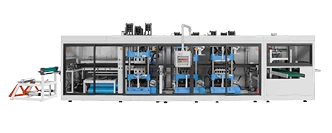
Entering the 21st century, thermoforming machines fully embraced automation and digitalization. Today's equipment can achieve full automation from material feeding to finished product stacking, and possesses real-time monitoring and self-adjustment capabilities.
Advantages
• Full-process automation: From raw material feeding, heating, and forming to edge trimming, stacking, and finished product conveying, everything is completed automatically.
• Intelligent closed-loop control: Sensors monitor parameters such as temperature, vacuum level, and product thickness, automatically correcting deviations.
• Digital interconnection: Equipped with HMI interfaces and cloud platforms for remote diagnostics, parameter tuning, and production data analysis.
• High Efficiency and Quality: Production efficiency, material utilization, and product consistency are all significantly improved.
Challenges and Outlook
• High investment cost: High-end automation systems require significant investment and are suitable for large-scale manufacturing enterprises.
• Complex maintenance: Integration of mechanical, electrical, and software systems requires specialized technical teams.
• Ongoing flexibility improvements: Rapid mold switching for small-batch and diversified production remains a key optimization goal.
Conclusion
The evolution of thermoforming machines reflects the shift in manufacturing from experience-driven to data-driven production. Each technological leap was driven by the pursuit of higher efficiency, precision, and sustainability. Looking ahead, thermoforming machines will continue to move towards a smarter and greener era of manufacturing.
LITAI: Committed to Providing More Advanced Thermoforming Machines
LITAI has been continuously innovating since 2001. We have undergone 10 generations of upgrades, evolving from blister machines to fully automatic plastic thermoforming machines. In the future, we will continue to upgrade and improve, driving the development of thermoforming machines. If you are interested, please contact us to learn more about our thermoforming machines.


