


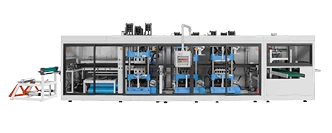


Plastic cup making machine heat a flat sheet of PP, PS, PET or PLA until it softens. It then uses vacuum and compressed air on an 8-bar pressure plate in a water-cooled mold. The flakes cool to take the shape of a cup. The cup is then cut from the paper in the same cycle using a mould.
Machines do not melt plastic or use injection molding. The walls of the cup come from the original sheet and become thinner where the material extends. heating system, air pressure and die cutting all affect wall thickness, rim shape and production speed.
Stations run in a fixed order
Plastic cup making machine work through a series of interdependent steps. First, the feed rollers moves the plate forward by one mold length. The heater is then moved into place and heated for 8–20 seconds depending on the thickness of the plate. After the heater is moved back, the die closes. Vacuum and compressed air-shaped plates, and cooling channels in the aluminum mold cool it. Punch the glass off the sheet and it's collected by a belt stacker or robot. The remaining flakes are sent to the granulator for recycling.
Each step must be completed before the next. The mould cannot be turned off until the heater moves and the punch cannot cut the cups until they are cool enough to be removed. As a result, slow heating or stacking can bring the entire production line to a halt.
Machine safety is also important. Risk assessment follows ISO 12100, electrical equipment follows IEC 60204-1 and safety controls are designed to meet ISO 13849-1 performance standards. These standards help manufacturers comply with EU machinery rules in Regulation (EU) 2023/1230.
LITAI Machinery uses an ISO 9001 quality management system to manufacture the machines using tilt-mold, servo-driven and hydraulic frames. This machine has a maximum forming depths of 125–180 mm and sheet widths 770 mm.
Heat must fall on the window, not the temperature
On plastic cup making machine, the plates must be at the right temperature to stretch without tearing. It must not get so hot that it sags into the heater or starts to crack. For PP, the range is about 150-165 degrees Celsius. For HIPS, about 120-140 degrees Celsius. For amorphous PET, about 110-130 °C. Temperatures for PLA are about 90-C. PLA softens at lower temperatures, which limits its processing temperature. Its softening point can be measured the Vicat test under ISO 306 or by transition temperature test under ASTM D3418.
There are two common problems that affect this temperature range. First, the sheet sag. No support is needed when the plate is soft, so a 0.3mm plate sags much faster than a 1.8mm plate. That's why heaters are divided into different areas, with the heat levels at the top and bottom adjusted. The bottom often stays cool to reduce sagging.
The second problem is the change in heating time. The temperature and cycle time of the heater must be set simultaneously. If the machine uses a thick sheet to set the sheet, the surface may blister or turn chalky.
What makes a cup shape
Usually all three forces are used together. Vacuums alone can produce a pressure difference of about a bar. That's enough for shallow plates and short, wide cups. Pressure forming uses different methods. Compressed air from 4 to 8 bar pushes the hot plate onto the die. This makes the rims sharper, the bottom corners tighter and there less webbing between nearby caves.
Plug assist solves another problem. The heated plug pushes the plate down before air pressure or vacuum completes the shaping process. This allows more material to be moved into the side wall, preventing too much material from being pulled out of the base.
The correct method depends on the stretch ratio, which is the depth of the cup divided by the diameter of the top. Below 1, air or vacuum is usually enough. Between 1 and 1.5, the stopper prevents uneven wall thickness.
| Forming method | Pressure Available | Best for: | Discount deals |
|---|---|---|---|
| Vacuum only | About 1 bar | shallow tray, wide short cup | Weak rim definition |
| Vacuum cleaner with plug assist | 1Baga Pre-Stretch | Deep cup with a pull ratio of more than 1.2 | Plug marks, extra temperature controlled |
| Pressure with plug assist | 4–8 bar | Thin cup, tightly rimmed | Mould cost, vent design |
| Pressure only | 4–8 bar | The walls are even and the tension is moderate. | Weaving between closed cavities |
A trimmed mould determines whether the cup is for sale
The pruning transforms the shape into a finished product. On most automated lines, it happens in the same cycle. While the cup is still in the mold, a steel ruler or machine punch moves down and cuts each cup from the paper. This prevents the cup from moving between molding and cutting.
This helps to keep rim dimensions within ± 0.2 mm. The rims are cut with the same tools that formed it, so there are no additional errors between cooling and contracting the different steps. Separate trim presses and off-line cuts require additional handling and a second set of fixtures. They can also lead to alignment errors avoided by mold interiors.
The punch also sets the cup's nesting shape. This is important for production and sales. If the rim of the cup is a little too large, the cups may not part cleanly in the dispenser. Buyers may blame cups.
Speed not output
The rated speed of plastic cup making machine is different from the actual output. Brochures often show speed without a production load. The tilt die can rotate 48 times a minute. Larger servo and hydraulic engines can run 30 -35 molding strokes per minute. The figures show how fast the machine moves, not how fast it heats and cools each cup.
Take a real example. A mold of 730 × 320 mm can produce cups 78 mm in diameter and 80 mm in pitch. It has nine wickets and four runs in 36 overs. Using 0.6mm PP, the actual speed is 20 rpm and can produce 720 cups per minute, or about 43,000 cups per hour. If you use the load rate of 48 times per minute, the same mould will appear 1,728 cups per minute produced. This is 2.4 times the actual output.
Heating helps explain the gap. About 140g of polypropylene passes through the machine per cycle. Heating from 25 °C to 155 °C with a specific heat of about 1.9 kJ/kg · K requires around 35 kJ. At 20 cycles per minute, this requires 11–12 kW of net energy to calculate radiant heat loss.
This also explains why faster mold changes are more useful than higher rated speed. LITAI Machinery lists mold change time of up to 20 minutes on its servo machines. This saves more time on the production line, making it a few cup sizes.
Thickness of walls is where most cups are missing
The wall thickness the A thermoformed cup is not the same everywhere. A common mistake is to think of sheet thickness as cup thickness. The material extends from the bottom up to the the sidewall, so a 0.6mm sheet can be produced into a 0.5mm cup with mm rim and a a 0.18 mm base.
Three factors affect wall thickness. The tensile ratio determines the thickness of the material. Plug assist and pressure forming help close the gap between top and bottom thickness, from about 3:1 to less than 2:1. Mold temperature is also important. Warm molds allow the sheet to stretch longer before cooling and stopping. But it also increases cycle time.
Tensile test data measure ISO 527-3 to help machine operators set up the the forming process. The resin's grade alone don't provide enough information. This is why LITAI Machinery gives a shaping tolerance of ±0.2 mm instead of using sheet thickness as the primary measure.
To safely reduce sheet thickness, first find the thinnest part of the cup. Cut the sample cup into small pieces and measure the thickness of the walls at different points.
Resins change machines, not just recipes
Changing materials is not just a matter of changing machine settings. PP is molded at high temperature and has a a wide forming range. It also handles deep painting well and can accommodate hot content. That's why it's often considered as an alternative to paper cups.
HIPS is a low-cost option. It's easy to form and print, but it can break the impact. PET need different conditions. The plate must be dry and the molding temperature range is narrow. For cups used with hot contents, molds and cycles must also consider crystallization, not just softening. ISO 11357-3 measures melting and crystallization behavior and helps determine correct processes.
PLA forms well at 90–120 °C but deforms when injected with a hot liquid. To reduce this risk, choose the right grade and thickness of the wall.
Machines compatible with PP, PS, PET, PVC and PLA can have heaters, vacuum system and discharge system covering these materials. But that doesn't mean one set of settings will work for all users. LITAI Machinery deploys production lines for PP, PS, HIPS, PET, PVC and cornstarch-blended materials. That's why it's important to choose both heating zones and stacking systems.
Food exposure compliance also depends on the ingredients. Regulation (EC) No. 1935/2004 and Commission Regulation (EU) No. 10/2011 apply to relevant food exposure materials in the EU. In the US, FDA 21 CFR 177.1520 includes certain olefin polymers. Compliance depends on the polymer and its additives. When different materials are used, cups made from PP meet the requirements, but do not automatically meet them.
Frequently Asked Questions
Is this machine made of resin pellets directly?
No. Cups are made of tablets. Complete production lines using a sheet extrusion line or buying sheet rolls. The particles are first processed into thin sheets. Then, the sheet thickness tolerance influences the forming process.
How deep can a machine go to form a cup?
Current multiple machines can form cups up to 180mm deep. Hydraulics are typically 125mm deep. The main limitation is not just the depth of the cup. Lottery percentages matter, too. A 180mm deep, 90mm diameter cup requires plug assist, pressure forming and careful mold temperature control to keep the bottom secure.
Why is the base of the cup thin and the edges thick?
This happens because the sheet stretches as it moves from the center to the sides. The material at the bottom stretches before thinning. The rims retain more of their original thickness as it extends less. Plug assist, higher forming pressure, and a warm mold help move more material to the side wall. But the thickness difference cannot be completely eliminated.
What to check during a test run
The quality of the plastic cup maker depends on the quality of the material you use. Run your own tables and measurements instead of relying on brochures. Cut a cup and measure the thickness of the rims, middle and bottom walls. Differences between these measurements are more important than average thickness. Measure the rim diameter of 20 cups continuously to check the actual size range. Time is a complete cycle that includes heating, cooling and pruning, not just the time the machine runs without a load. Weigh the leftover waste after molding and compare it to the weight of the finished cup. A well-equipped machine can produce only a small amount of waste. Test samples under ISO 291 conditions and then decide if they do not meet the requirements.
Source of information
ISO 12100: 2010 --Mechanical safety: general principles of design, risk assessment and risk reduction
ISO 13849-1 -Safety Related Parts of Control System, Performance Level
IEC 60204-1 --Electrical equipment for industrial machinery
Regulation (EU) No. 2023/1230 -Sale of Machines on the European Market
ISO 9001: 2015 --quality management, requirements
ASTM D3418 -Determination of polymer transition temperatures by differential scanning calorimetry
ISO 11357-3 melting and crystallization temperature and enthalpy
ISO 306 -Vicat softening temperature for thermoplastics
ISO 527-3 - tensile properties of films and sheets
ISO 291 -Standard Atmosphere for Plastic Regulation and Testing
Regulation (EC) No. 1935/2004 --Framework for food contact materials; Commission Regulation (EU) No. 10/2011 --Plastic Materials in Food Contact
US FDA 21 CFR 177.1520 -olefin polymers
Directive 2019 / 904 -Reducing the impact of certain single-use plastics


